On this page
Have you ever wondered why you can play at breathing smoke like a dragon on a frosty morning, but not during the summer? It feels like magic, but it is actually a beautiful demonstration of thermodynamics and phase changes happening right in front of you.
When you understand why a tiny cloud appears when you exhale, you see the same physics that explains why dew forms on grass, why glasses sweat, and how clouds form in the sky.
Why can you see your breath on cold mornings?
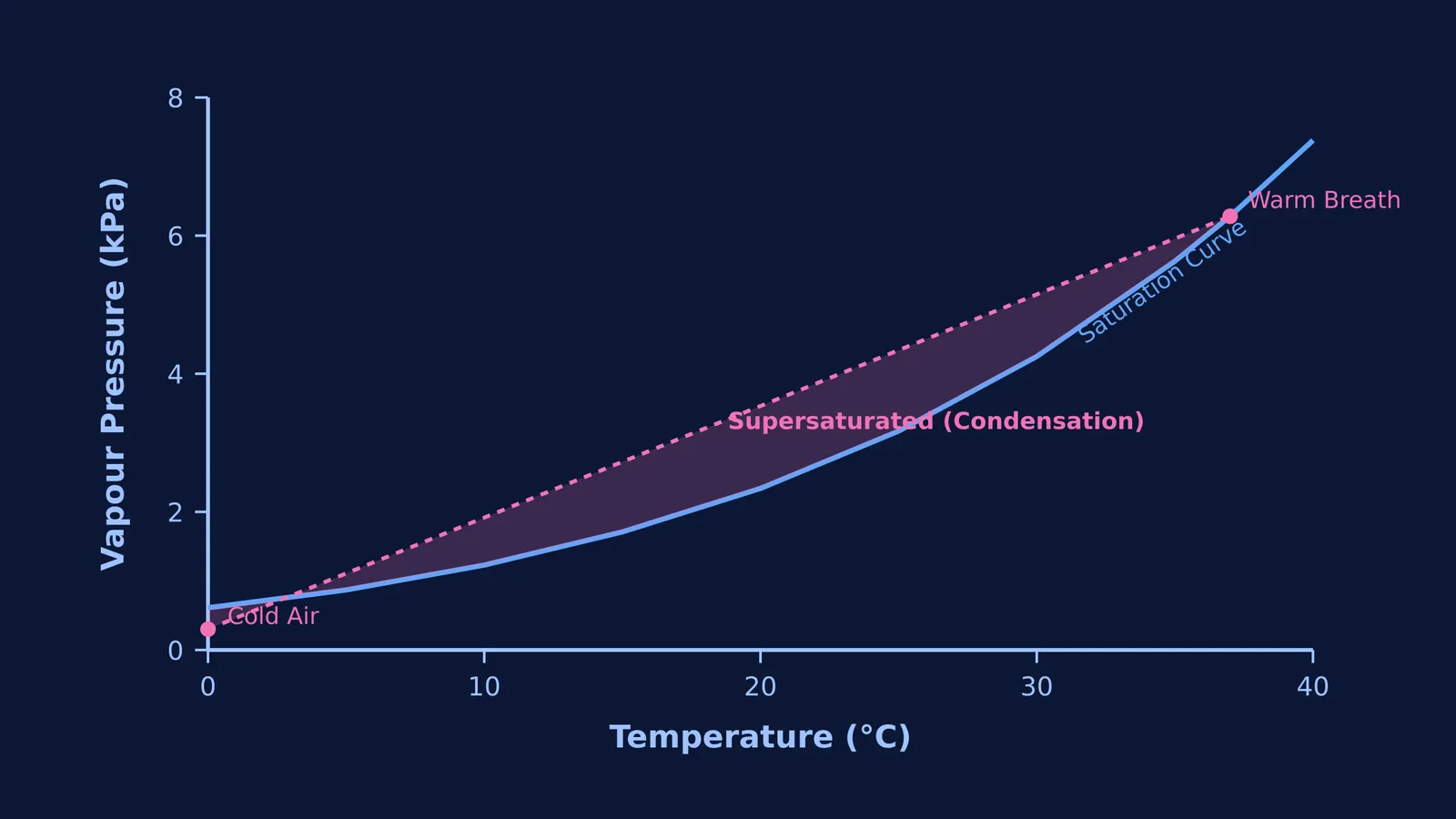
To understand this, we have to start inside your body. Your lungs are warm—typically at a core body temperature of about 37 °C (98.6 °F)—and wet. Inside your lungs, water molecules are constantly evaporating into the air you breathe in. Because your body temperature is carefully regulated, these molecules have high kinetic energy. They bounce around vigorously, remaining apart from one another as a gas. The air you exhale carries this invisible cargo of energetic water vapour out through your mouth or nose, meaning it is nearly 100% saturated [[1]](https://www.loc.gov/everyday-mysteries/meteorology-climatology/item/why-can-you-see-your-breath-on-a-cold-day/).
A fundamental rule of physics is that warm air has a much higher capacity to hold water vapour than cold air. When you breathe out on a cold winter morning, your warm breath mixes with the freezing ambient air, causing its temperature to plummet rapidly.
Because the cold air cannot hold all the moisture that was comfortably carried by your warm breath, the excess water vapour is forced to change state. It condenses into millions of microscopic liquid water droplets, which scatter light and create the mist you see. According to the Library of Congress, you will usually start to see your breath when the outside temperature drops below 7 °C (45 °F) [[1]](https://www.loc.gov/everyday-mysteries/meteorology-climatology/item/why-can-you-see-your-breath-on-a-cold-day/).
What is the dew point, and why does it matter?
The exact temperature at which this condensation happens is called the dew point. The dew point is the temperature to which air must be cooled to become completely saturated with water vapour. If the air cools even a fraction of a degree below its dew point, it has crossed the 100% relative humidity threshold, and liquid water must condense out of the gas.
At higher temperatures, water molecules have enough thermal energy to bounce off each other when they collide. But as the temperature drops, they slow down. Once the air drops below the dew point, the molecules no longer have the energy to bounce apart. Instead, when they collide, they stick together, forming microscopic liquid droplets.
When you mix exhaled breath (high temperature, high moisture) with winter air (low temperature, low moisture), the mixed air drops below its new dew point.
For students studying the kinetic theory of gases or thermodynamics, being able to picture this relationship between temperature, pressure, and volume is crucial. Watching formulas on a page can make the subject feel dry, but seeing the molecules move helps build intuition. The Fermi Simulation Lab provides interactive models where you can see how temperature changes affect the states of matter, making these abstract curves easier to see than to read.
Can you see your breath on a warm day?
While 7 °C is a good rule of thumb, you might occasionally see your breath on a warmer day, or fail to see it on a freezing one. This happens because the starting humidity of the outside air also matters.
If the winter air is extremely dry, the tiny droplets evaporate back into an invisible gas almost the instant they form, so the cloud vanishes immediately. Conversely, if it has just rained and the air is highly humid, the ambient air is already close to its dew point. In this case, even a mild temperature drop can cause your breath to condense, meaning you might see a faint mist even on a mildly cool day.
A simple condensation experiment to try
You can test these principles of condensation at home with a mirror and a freezer. This quick experiment proves that the cloud comes from the temperature difference, not just from breathing hard.
Place a small hand mirror in the freezer for ten minutes so it becomes thoroughly chilled.
Leave a second, identical mirror on the counter at room temperature.
Take the cold mirror out and breathe heavily onto both mirrors at the same time, exhaling equal amounts of breath.
You will see that the cold mirror fogs up instantly and heavily, forming a thick layer of condensation. Meanwhile, the room-temperature mirror stays relatively clear, or the slight fog clears up much faster. The cold glass rapidly chills your breath below its dew point on contact, exactly like the freezing winter air does outside. The room-temperature mirror does not lower the temperature of your breath enough to force significant condensation.
This is the exact same mechanism discussed in our guide on why does a glass of cold water get wet outside?. The next time you go for a run on a chilly morning, you can observe another phase change in action, as detailed in why we sweat when we exercise: The physics of cooling down.