On this page
Pour the same chai into a steel tumbler and a kulhad. Within seconds the tumbler is too hot to hold, and the kulhad is only warm. The difference is how fast each wall carries heat from the tea to your skin. That one idea is in your Class 7 science book, and you can measure it at home with a thermometer and a clock.
What does Class 7 science say about clay cups?
NCERT's Grade 7 textbook Curiosity covers this in Chapter 7, Heat Transfer in Nature. It defines conduction as the transfer of heat from the hotter part of an object to the colder part, with each heated particle passing heat to its neighbour while the particles stay where they are. The chapter calls metals good conductors of heat, which is why we cook in metal utensils. Then it says what this post is about: "Clay and porcelain are also poor conductors of heat—that is why tea or coffee kept in such cups stays hot longer."
That explains both things you notice about a kulhad. Heat crosses the clay wall slowly, so the outside stays cool enough to hold, and the tea loses heat slowly, so it stays hot.
How much better does steel conduct heat than clay?
Physicists put a number on this called thermal conductivity, k. It tells you how many watts of heat flow through a slab 1 metre thick and 1 square metre in area when the two faces differ by 1 kelvin. Our explainer on what k means and why its unit is W/(m·K) goes through the unit step by step.
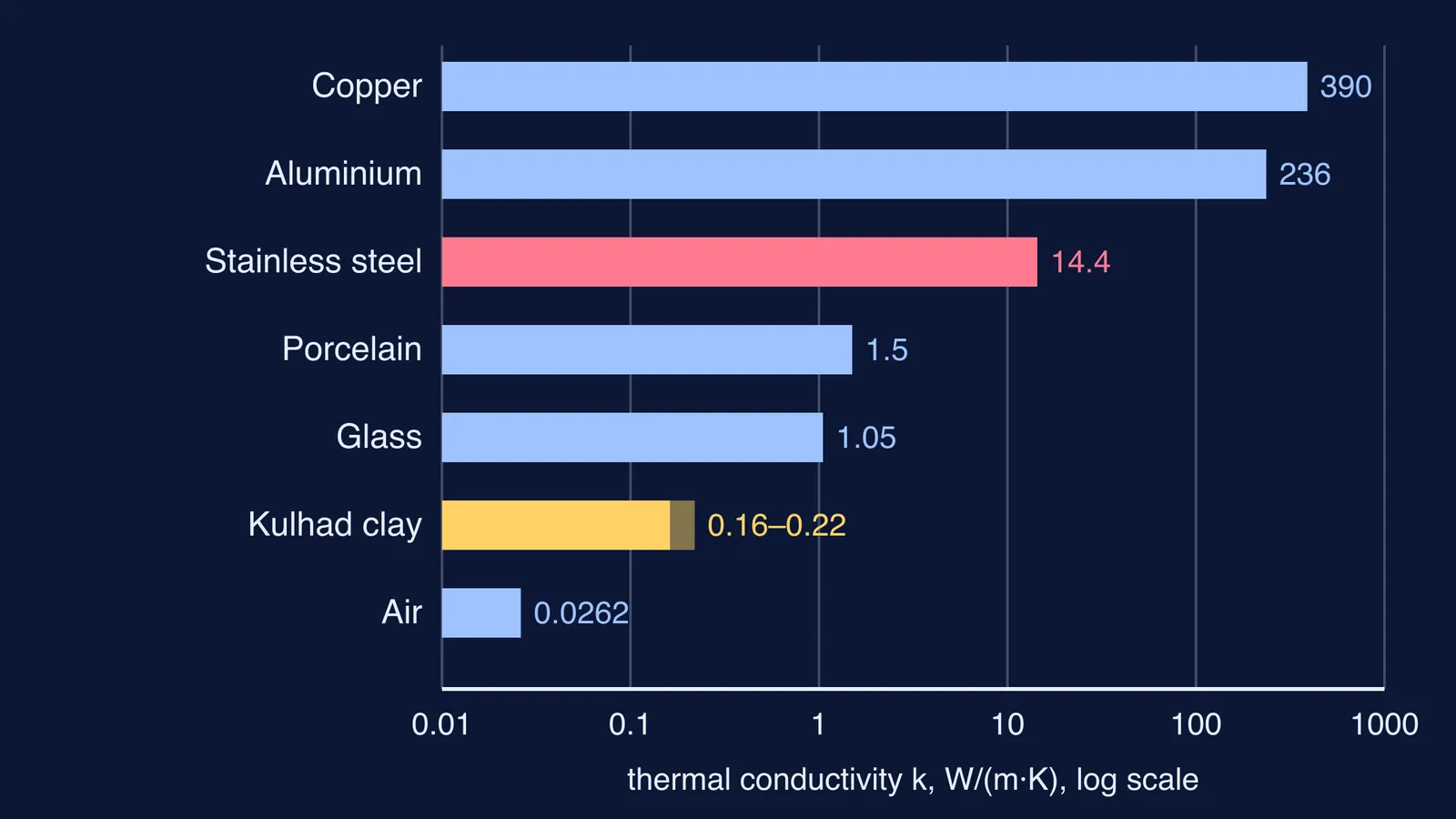
The Engineering ToolBox's table of metal conductivities lists type 304 stainless steel at 14.4 W/(m·K) at 20 °C, carbon steel at 36 to 54, aluminium at about 236 and copper at about 390.
For the kulhad side, ICAR researchers in Ludhiana baked mud cups, one plain and others blended with 5 to 15% corn cob powder. In their results, thermal conductivity ranged from 0.162 to 0.219 W/(m·K), highest for the plain cup and falling as corn cob was added (Tushir et al., Indian Journal of Agricultural Sciences, 2021). The paper's abstract gives a lower range, 0.132 to 0.192. The ToolBox's general conductivity table gives fire brick at 0.47, glass at 1.05 and porcelain at 1.5, so fired clay sits with the poor conductors, while still air is at 0.0262.
Divide 14.4 by 0.219 and then by 0.162, and you get roughly 66 to 89. For the same wall thickness, stainless steel carries heat about 65 to 90 times faster than those mud cups.
The thicknesses are assumptions, so measure your own cups and redo the sum. This steady-state formula is from Class 11; a real cup is still warming up, but the comparison holds.
How can you test kulhad vs steel at home?
This is a touch-and-time test. Ask an adult to pour, use hot tap water or water mixed to bath-warm (never boiling), and touch only with the back of a finger for one second at a time.
Collect a kulhad, a steel tumbler of similar size, a kitchen or lab thermometer, a measuring cup and a phone stopwatch.
Write your prediction: which cup will feel warm first, and which will have the warmer water after 5 minutes?
Pour the same volume of warm water into both cups at the same time. Note the starting water temperature.
Every 30 seconds, tap the outside of each cup halfway up with the back of a finger. Rate it 1 (cool) to 5 (too warm to hold).
Note the time at which each cup first reaches a rating of 3.
At 5 minutes, measure the water temperature in each cup.
Repeat twice and average your times.
NCERT's explanation predicts that the steel reaches 3 sooner, the kulhad takes longer or never gets there, and the kulhad water is warmer at 5 minutes. If your results differ, look at what else changed: a wet kulhad, thinner walls or a lid.
Where else does the same physics show up?
Once you see it, conduction is everywhere: steel pots with wooden handles, quilts that trap air, thick mud walls. For a classroom version, the wax-on-rods conduction race ranks copper, aluminium, iron and glass by how fast wax melts. Why mud houses stay cool in summer applies the same idea to an entire building.
If heat moving particle to particle is hard to picture, the Fermi Simulation Lab has interactive simulations for ideas that are easier to see than to read. If you want the concept on its own first, conduction and thermal conductivity each have a lesson in the Fermi Concept Library.
Tonight, try the test with two cups and a stopwatch, and write down your prediction before you pour.