

On this page
Step into a village mud house at 3 pm in May and the air feels gentler than outside, with nothing switched on. Two ideas from Class 11 physics explain it: conduction, how fast heat moves through the wall, and heat capacity, how much heat the wall soaks up before it warms. A thick mud wall is slow on the first and generous on the second, so the afternoon heat arrives indoors late, and much weaker.
Why do mud houses stay cool in summer?
A 2018 study of traditional rammed-earth houses in Vojvodina, Serbia, by Vesna Lovec and colleagues gives the numbers for earth walls (Lovec et al., Thermal Science, 2018).
Thermal conductivity is about 0.7 to 1.25 W/(m·K).
Density is about 1400 to 2000 kg/m³, so a wall holds a lot of mass.
Specific heat capacity is about 870 to 1260 J/(kg·K), so every kilogram needs plenty of energy to warm up.
The surprise: on paper, mud is not a great insulator. The authors say these conductivity values indicate "relatively poor" thermal performance in standard steady-state calculations. What saves it is that the Sun heats a wall for a few hours, then stops. Before much heat can push through 50 to 60 cm of earth, evening arrives.
Fuzzy on the terms? See our explainers on specific heat vs heat capacity and what thermal conductivity k means.
How slowly does heat travel through a mud wall?
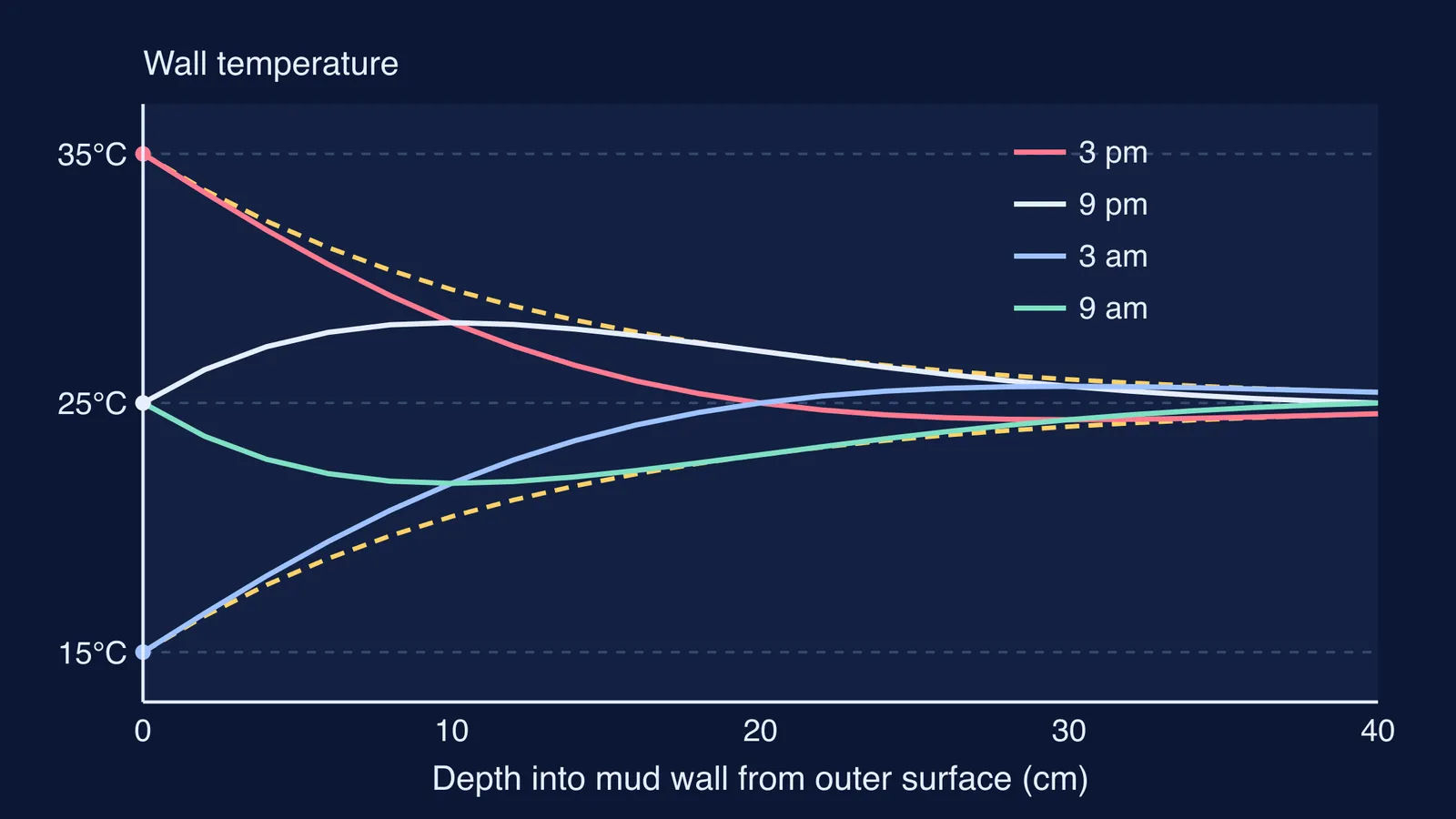
A daily heat cycle enters a thick solid as a temperature wave. An open textbook chapter on soil heat flow gives the two results we need (Physical Processes in Ecosystems, soil heat flow): thermal diffusivity is α = k/(ρc), and the damping depth is D = √(2α/ω), where ω is 2π divided by one day. At depth D the swing shrinks to 37% of its surface size, and the peak arrives later the deeper you go.
Here is a worked example.
Take mid-range earth values from the Lovec paper: k = 1.0 W/(m·K), ρ = 1700 kg/m³, c = 1000 J/(kg·K).
Diffusivity: α = 1.0 ÷ (1700 × 1000) ≈ 5.9 × 10⁻⁷ m²/s.
One day is 86,400 s, so ω = 2π ÷ 86,400 ≈ 7.27 × 10⁻⁵ per second.
Damping depth: D = √(2 × 5.9 × 10⁻⁷ ÷ 7.27 × 10⁻⁵) ≈ 0.127 m, about 12.7 cm.
Each D of depth delays the peak by one radian of the day: 24 h ÷ 2π ≈ 3.8 hours.
The shaded wall's outer surface in the Serbian study ran from about 15°C to 35°C, a swing of ±10°C. At 15 cm deep the model gives ±3.1°C, about 4.5 hours late; at 30 cm, under ±1°C, about 9 hours late.
So by the time the 3 pm heat has crawled 30 cm into the wall, it is around midnight, and most of the swing is gone.
What did measurements in real earth houses find?
The model ignores roofs, windows and doors, so real measurements matter more. In Lovec's 65 cm wall, measured over 74 hours in August 2014, outdoor air peaked at 35.2°C at 15:21 on 2 August and indoor air peaked at just 23.9°C at 22:41, a delay of 7 hours 20 minutes (Lovec et al., 2018). Across both measured walls the delay ranged from 4.5 to 7.3 hours.
A 2023 study of a rammed-earth house with 0.37 m walls in Mianyang, Sichuan, measured in August 2022, found an average thermal lag of 5.07 hours and a longest lag of 8 hours (Jiang et al., Materials, 2023). Outdoors reached 42.6°C; indoors stayed between 33.76°C and 35.08°C.
The catch: 34°C is still hot. Thick walls flatten and delay heat; they cannot remove it. Hassan Fathy built on this principle in Egypt, as our story on his mud-brick homes explains.
How can you use this physics at home?
The same rules apply to any heavy wall or roof.
Shade the sunny side. In the Serbian house, the sun-facing wall's outer surface reached 53.2°C, while the tree-shaded wall's outer surface peaked at about 35°C (Lovec et al., 2018).
Open up at night. The residents in that study kept windows shut overnight, and the authors note that night ventilation would have made daytime indoor air even cooler.
Close up by late morning. Once outside air is warmer than your walls, keep it out.
A heat wave moving through a wall is easier to see than to read about, and the Fermi Simulation Lab has interactive simulations for ideas like this. If heat capacity itself is shaky, the Fermi Concept Library gives each physics concept its own lesson.
Next time someone says mud houses are cool "because mud is cold", you can tell them the real reason: the heat is still on its way.


