

On this page
In the late 1940s, the Egyptian architect Hassan Fathy built a village near Luxor out of mud brick, without steel or concrete. A test he later reported helps explain why such buildings stay cool, and the physics is the heat-transfer chapter you study in Class 11.
Who was Hassan Fathy?
Hassan Fathy (1900-1989) was an Egyptian architect who won the Right Livelihood Award in 1980 "for developing an 'Architecture for the Poor'".
His village, New Gourna, sits on the West Bank of the Nile at Luxor. UNESCO says it was built between 1946 and 1952 to rehouse families who had lived above the ancient tombs of Thebes, and praises its "extraordinary sensitivity to climatic problems".
Fathy built with mud brick, a technique he learned in Nubia, taught the villagers to work with the bricks, and used enclosed courtyards and vaulted roofs, according to the University of Chicago Press description of Architecture for the Poor.
How do mud-brick walls keep a house cool?
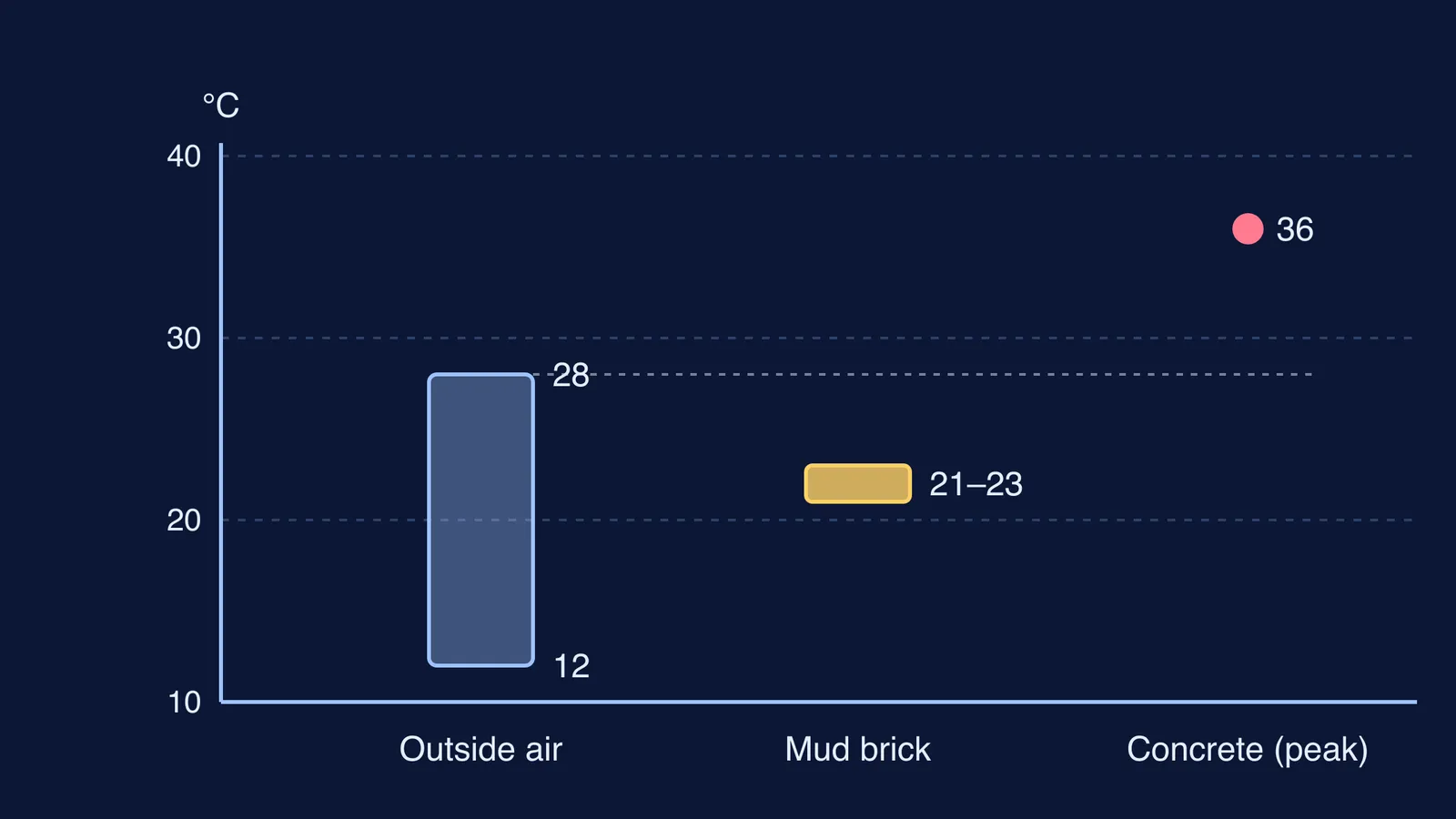
In his 1986 book for the United Nations University, *Natural Energy and Vernacular Architecture*, Fathy describes a test run in 1964 at the Cairo Building Research Centre (chapter 3, Building materials). Of six small test buildings, the two extremes were a mud-brick room with 50 cm walls and a combined dome-and-vault roof, and a room of 10 cm prefabricated concrete panels.
On a March day, the outside air went from 12 °C at 6 a.m. to 28 °C at 2 p.m. and back to 12 °C by 4 a.m.
Inside the mud-brick room, the air stayed between 21 and 23 °C for the full 24 hours, a swing of no more than 2 °C.
Inside the concrete room, the air peaked at 36 °C, which Fathy reports as 13 °C hotter than the mud-brick room and 9 °C hotter than the air outside.
Fathy notes the limit: the rooms were not measured on the equinoxes and solstices, which would have given fuller information on time lag and heat storage.
Worked example: where does "13 times" come from?
The rate of heat flow through a wall is H = kAΔT/L, so a wall's resistance per square metre is L/k. Fathy's book gives k = 0.9 for concrete and k = 0.34 for mud brick, in the book's units.
Concrete panel: L/k = 0.10 / 0.9 = 0.11
Mud-brick wall: L/k = 0.50 / 0.34 = 1.47
Ratio: 1.47 / 0.11 = about 13
Five times the thickness times 2.6 times lower conductivity gives Fathy's figure: more than 13 times the thermal resistance.
Why did Fathy use domes and vaults?
In chapter 4 of the same book, Fathy lists what a pitched or arched roof does better than a flat one:
It lifts part of the ceiling high, so warm air collects well above people's heads.
It has more surface area, so the same sunlight is spread thinner and the roof heats less on average.
For most of the day part of the roof is in shade and sheds heat to the cooler outside air; on a dome or half-cylinder vault, some part is always shaded except at noon.
Wind also speeds up over a curved roof (the Bernoulli effect), so cooling breezes carry more heat away.
How does a wind catcher work without electricity?
The wind catcher, called a malqaf, is a shaft rising high above the building with its opening facing the prevailing wind, Fathy writes in chapter 5. It traps the cooler, stronger wind above the building and channels it down into the rooms, as long as the air has an outlet, a wind-escape. The book traces the idea back to ancient Egypt, including the house of Neb-Amun painted on his tomb at Thebes, from about 1300 BC.
Where the air is hotter than is comfortable, Fathy describes hanging wet mats or panels of wet charcoal inside the shaft so evaporation cools the incoming air. That is the same physics that keeps water cool in a clay matka.
The courtyard does the night shift. In hot, dry regions, Fathy writes in chapter 6, houses opening onto inner courtyards get night-time air temperature drops of 10-20 °C. Cool night air settles into the courtyard and seeps into the rooms; shaded by its walls next morning, the courtyard becomes, in his words, "a reservoir of coolness".
What can you use from Fathy's ideas today?
The same physics works in a city flat. A summer checklist:
Find the hottest surface. On a top-floor flat it is usually the roof; see why white roofs keep homes cooler.
Close sunny-side windows and curtains in the afternoon; open them after sunset, once outside air is cooler than the room.
Give warm air a high exit. Open a high window or ventilator together with a low window facing the breeze.
In dry heat, a wet cloth where the breeze enters cools the air; in humid weather it does little, because water evaporates slowly into moist air.
To practise conduction numericals like this, the Fermi Problem Library has worked problems with a step-by-step solver that explains the reasoning. If rising warm air is hard to picture, the Fermi Simulation Lab has interactive simulations for ideas that are easier to see than to read.
Want to design buildings like these? Read what a B.Arch in India involves.


