

On this page
A Bachelor of Architecture (B.Arch) is often romanticised as a degree filled entirely with sketching and model-making. While design is at its heart, it is a rigorous professional programme demanding a blend of engineering, project management, and creative problem-solving. With India's architectural services market projected to grow by 8.66% annually through 2031, the demand for qualified architects is rising.
What does the 5-year B.Arch course involve?
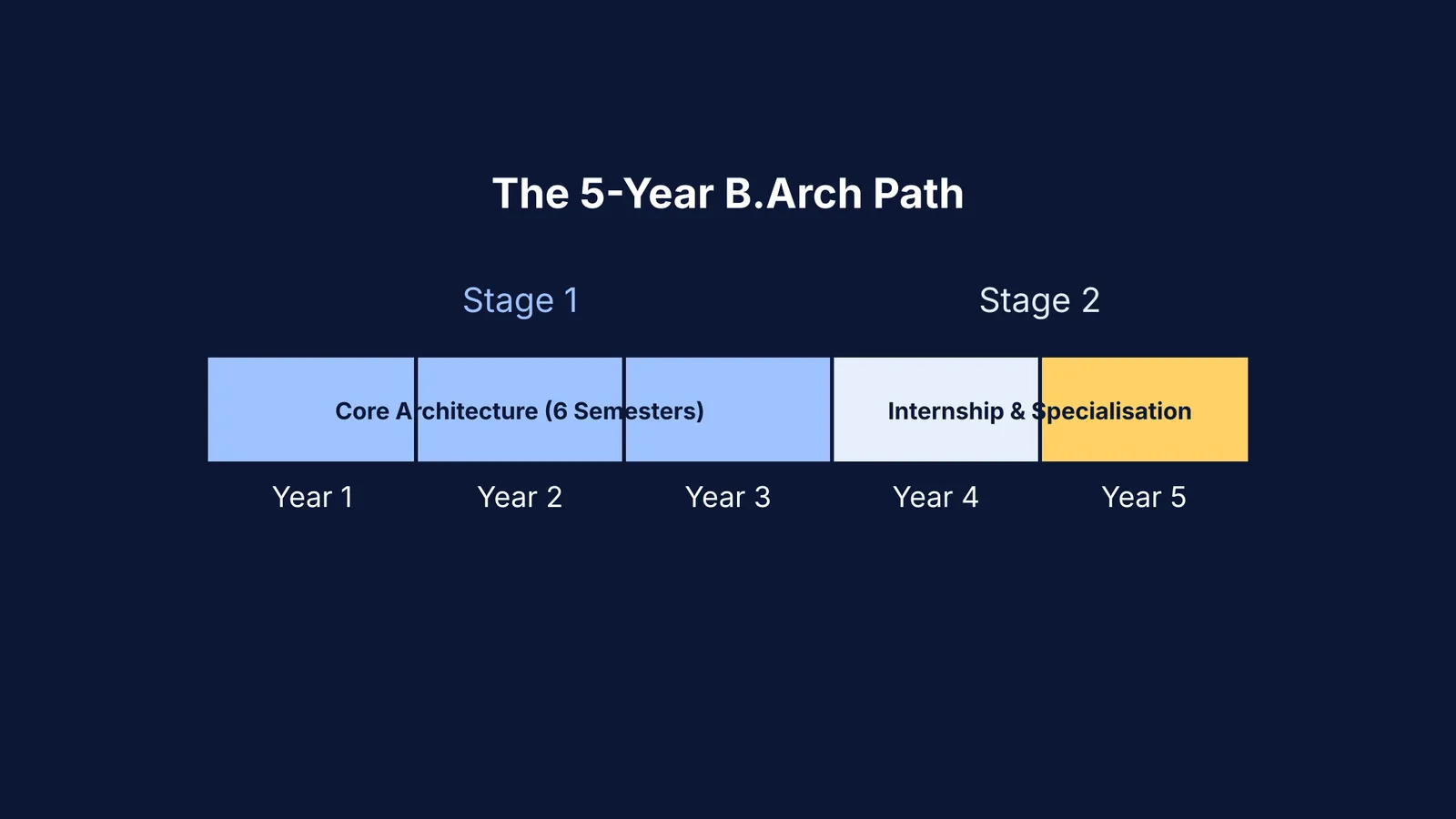
Unlike a standard three-year or four-year undergraduate degree, the B.Arch is a five-year full-time programme divided into 10 semesters. According to the Council of Architecture (CoA), which regulates the profession in India, the course is split into two distinct stages.
Stage 1 spans the first three years and focuses on the core of architectural education. You study design principles, building materials, and the physics of structures. The structural mechanics you learn in the first year can be abstract. Understanding basic forces—such as the contact force between blocks pushed together or how loads distribute across beams—is essential. If you get stuck on these foundational physics concepts, Fermi's AI tutor can work out what you already know and build a plan for the session, explaining the reasoning rather than just printing an answer.
For abstract structural concepts that are easier to see than read, the Fermi Simulation Lab provides interactive models to help you visualize how forces act on a building framework.
Stage 2 covers the final two years and shifts focus to professional practice and specialisation. This stage includes a mandatory internship, typically lasting one semester (six months) in a professional architect's office. This on-the-ground experience bridges the gap between classroom theory and construction reality.
How do you become a licensed architect in India?
Graduating with a B.Arch degree does not automatically make you an architect. Under the Architects Act of 1972, only individuals registered with the Council of Architecture can legally use the title "Architect" in India. To register, you must hold a recognized B.Arch degree and have successfully completed the full five-year programme.
Admission to a recognized B.Arch programme is highly competitive. In 2024, 99,086 unique candidates registered for the JEE Main Paper 2, underscoring the strong interest in the field. Aspiring students must also pass a recognized aptitude test, such as the NATA (National Aptitude Test in Architecture) or the JEE Main Paper 2 (B.Arch paper).
Is B.Arch a good career choice for the future?
Yes, the long-term career outlook is strong. The demand for architects is expected to surge as India targets massive urban development and sustainable building practices.
The gap between the current number of registered architects and the projected demand for new infrastructure presents a significant opportunity for new graduates. This is particularly true for those who specialize in high-growth areas like Building Information Modeling (BIM), green building certification, and urban planning.
What is the salary and career growth for an architect?
Architecture is a "long game" profession, and the financial trajectory is exponential rather than linear. According to salary data from AmbitionBox, general architects in India see the following progression:
Early Career: Fresh B.Arch graduates typically start with modest pay, ranging from ₹2 to ₹4 Lakhs Per Annum (LPA).
Mid-Level: As you gain 5 to 10 years of experience, manage complex projects, and specialize, salaries scale to ₹6 to ₹12 LPA.
Senior Level: Principal architects and firm owners can earn upwards of ₹20 LPA, with successful independent practices generating substantial revenue.
The early years can involve a heavy workload, but those who persist and build a strong portfolio often see rewarding financial and professional returns. The deep structural knowledge you acquire can even lead to innovations in large-scale building, much like the engineering behind Fazlur Rahman Khan and the tube design of skyscrapers.


