

On this page
When the long days of the summer sun beat down on a house, the roof inevitably takes the brunt of the immense heat. A traditional dark roof absorbs most of this incoming solar energy, essentially turning the rooms directly beneath it into an inescapable oven. But simply painting a roof white can drastically change how a building handles heat, transforming its thermal profile completely and providing a much more comfortable environment.
Why do white painted roofs keep houses cool?
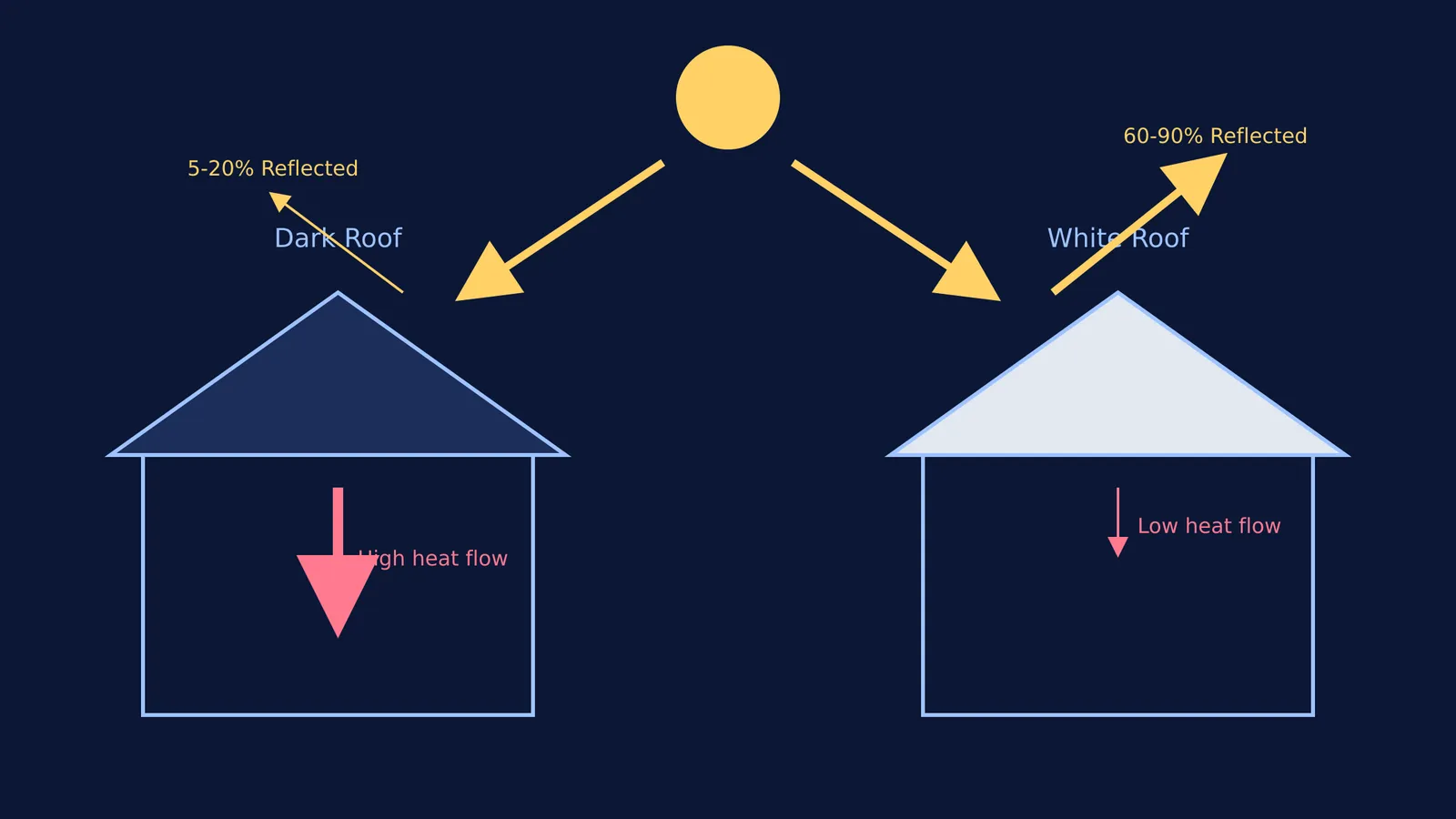
The answer comes down to a fundamental physical property of surfaces called albedo, or solar reflectance. Albedo is a precise measure of how much of the sun's total energy is bounced back into the atmosphere. It is measured on a scale from 0 (total absorption, like a perfect black body) to 1 (total reflection, like a perfect mirror).
A standard dark asphalt or concrete roof has a remarkably low albedo. This means it absorbs almost all of the incoming solar radiation, trapping the energy within its material. A white painted roof, however, has a high albedo. It effectively reflects the vast majority of visible, infrared, and ultraviolet light away from the building, preventing that energy from entering the structure in the first place.
How does heat transfer through a roof work?
When sunlight hits a surface, the energy that isn't reflected is immediately absorbed and converted into thermal energy. A dark roof heats up extremely quickly under direct sunlight, and this accumulated heat then travels downward through the ceiling into your living space via conduction—the exact same mechanism that governs how long it takes for ice to form on a pond—as well as thermal radiation. This relentless transfer of heat is why top-floor rooms feel unbearably hot by mid-afternoon on a clear summer day.
Because a white roof absorbs so little energy in the first place, there is far less heat available to transfer downward. It also undergoes much less thermal expansion, successfully avoiding the continuous physical stress you see when a pendulum clock loses time in summer. Furthermore, high-quality white roof paints typically have high thermal emittance. This means they can easily radiate any small amount of heat they do happen to absorb back into the much cooler night sky, resetting their temperature efficiently.
If the relationship between absorption, reflection and temperature is hard to picture, the Fermi Simulation Lab provides interactive simulations for the ideas that are easier to see than to read.
How much does a cool roof lower temperatures?
The real-world difference between a dark and light surface is both easily measurable and highly significant. According to the US Environmental Protection Agency (EPA), cool roofs can lower maximum indoor temperatures by 1.2 to 3.3 °C in buildings without air conditioning. Furthermore, they can cut peak cooling demand by 11% to 27% in homes with air conditioning systems (Using Cool Roofs to Reduce Heat Islands | US EPA).
A practical plan to cool your study space
If you are preparing for important exams in a stubbornly hot room, you can apply these same thermodynamic principles immediately, even if you cannot paint the roof yourself today:
Reflect sunlight early: Close pale-coloured curtains or reflective blinds before the sun hits the window directly. This bounces light back outside before it has a chance to heat the room's interior.
Ventilate at night: Open opposite windows after sunset when the outside air finally becomes cooler than the inside walls. This cross-breeze allows the absorbed daytime heat to escape efficiently.
Turn off heat sources: Incandescent bulbs and powerful desktop computers emit significant amounts of localized thermal energy; switch them off completely when not in active use.
When many buildings in a densely populated city use reflective roofs, they work collectively to mitigate the urban heat island effect, where concrete and dark surfaces unnaturally trap heat and raise ambient neighbourhood temperatures. If you are studying in a top-floor room, understanding this essential physics can easily keep you cooler, making the crucial difference between losing focus and staying consistently alert.
If you are ever stuck on the physics of radiation, thermodynamics, or heat capacity in your syllabus—such as calculating heat in isobaric and isochoric processes—you can work through the theory interactively with Fermi's AI tutor. It teaches rather than just answering questions, holding a line of reasoning across a whole session and drawing the figure to check your understanding as it goes.


