

On this page
Put a line of wax beads along four identical rods and heat one end of each. Which rod drops its first bead soonest, and on which does the wax melt furthest? This extends a Class 7 NCERT activity, and the same set-up appears in JEE Main practice questions as the Ingen-Housz experiment.
Which metal rod melts wax first?
Copper wins, aluminium comes a close second, iron is a clear third, and glass hardly melts any. The order follows thermal conductivity, which measures how readily a material carries heat through itself.
The list of thermal conductivities on Wikipedia gives pure copper about 385 to 401 W/m·K, pure aluminium about 204 to 237 W/m·K and pure iron about 72 to 80 W/m·K near room temperature. The Engineering ToolBox table for metals gives 401, 236 and 83.5 W/m·K at 0 °C, so the order is the same. The Wikipedia list puts glass at only about 0.8 to 0.93 W/m·K, more than 400 times less than copper.
How do you set up the wax race safely?
NCERT's Class 7 Curiosity textbook (Chapter 7, Activity 7.1) uses one aluminium or iron strip about 15 cm long, with four pins stuck on with wax about 2 cm apart, heated at one end with a candle or spirit lamp (NCERT, Heat Transfer in Nature). The pin nearest the flame falls first. It notes that a wood or glass strip would not drop its pins, and asks for adult supervision. To turn it into a race between four materials:
Use copper, aluminium, iron and glass rods of the same length and thickness, since a thicker rod carries more heat.
Stick small wax beads, or pins held by wax, at equal spacing along each rod.
Heat all four ends equally: together over one flame, or standing in one pan of just-boiled water, which is gentler.
Start a timer and note when each bead drops.
When beads stop falling, measure how far the melting reached on each rod.
Let everything cool before touching it. Metal ends can burn you, and unevenly heated glass can crack.
For simpler home tests, see how to test conductors and insulators of heat.
Why is the copper and aluminium race so close?
Benjamin Franklin passed his idea and materials to the Dutch scientist Ingen-Housz in 1780; Ingen-Housz coated wires of equal length and diameter with wax and found the order silver, copper, gold, tin, iron, steel and lead, as T. N. Narasimhan describes in Physics Today (2010). Narasimhan notes the catch: Ingen-Housz did not recognise the role of specific heat, and Fourier later showed that the speed at which heat spreads depends on conductivity divided by heat capacity, a quantity now called thermal diffusivity.
Thermal diffusivity is α = k/(ρc), conductivity divided by density times specific heat (Wikipedia, Thermal diffusivity). The same page lists copper at 111 mm²/s, aluminium at 97 mm²/s, iron at 23 mm²/s and window glass at 0.34 mm²/s.
Taking the top values in the conductivity list, copper conducts about 1.7 times better than aluminium, but copper also soaks up more heat per cubic centimetre as it warms. The time for heat to reach a bead grows roughly as distance squared divided by diffusivity, so aluminium should take only about 1.1 times as long as copper to drop the same bead, iron nearly 5 times as long, and glass over 300 times.
To see the temperature profile along a rod, read predicting the temperature gradient in a heated rod. The Fermi Simulation Lab has interactive simulations for ideas that are easier to see than to read, so you can explore before you light a flame.
What does the melted length tell you in a JEE question?
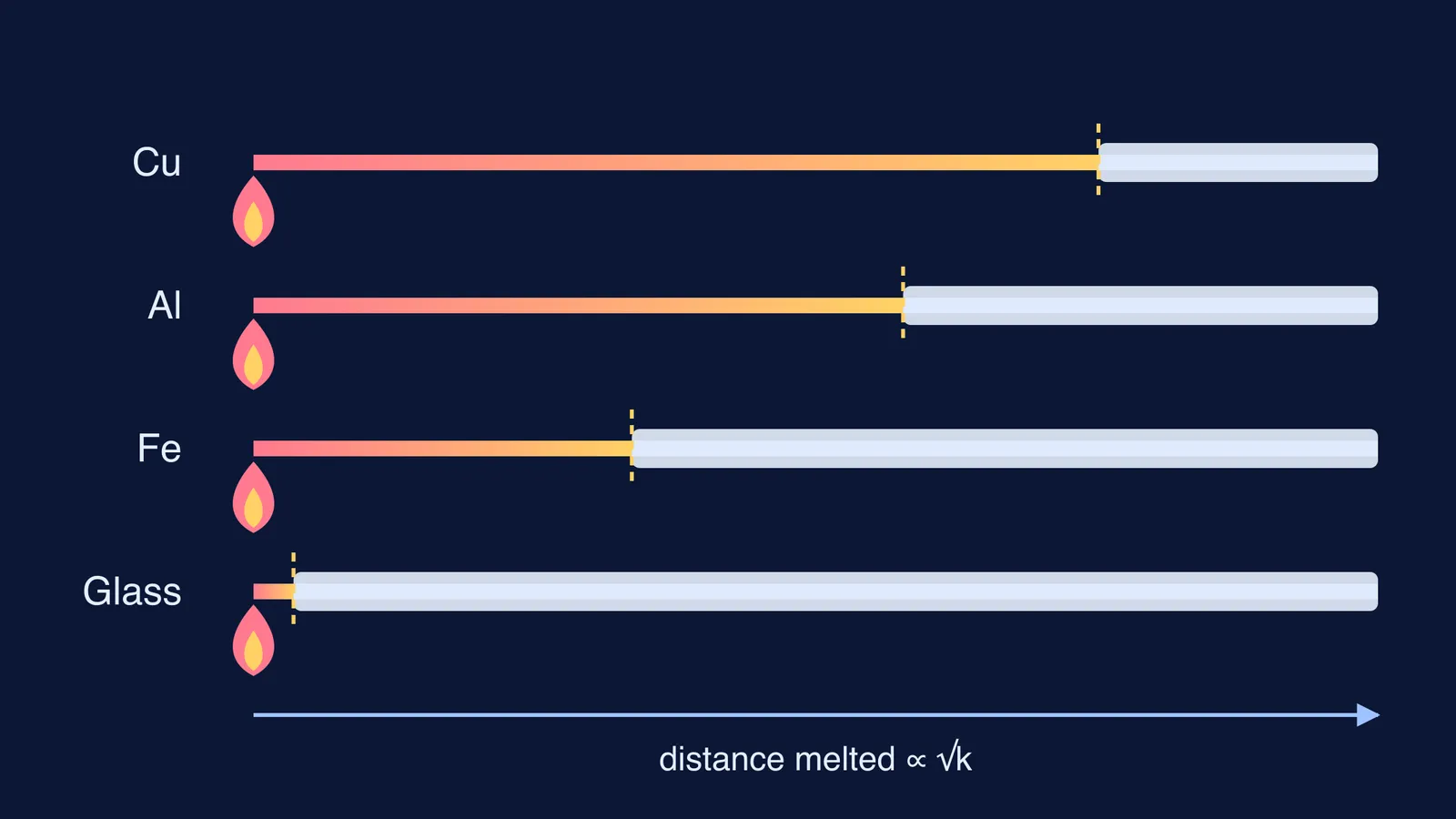
Wait long enough and each rod reaches a steady state, where heat flowing in balances heat lost from its surface. Now the melted length depends on conductivity, not diffusivity. For identical rods, K ∝ l², where l is the length of wax melted, the Ingen-Housz result used in JEE Main practice questions (Vedantu worked question). So melted length grows as the square root of conductivity.
Worked example, using the top values from the Wikipedia list and 0.9 W/m·K for glass, with copper melting back 10 cm:
Aluminium: 10 × √(237/401) ≈ 7.7 cm
Iron: 10 × √(80.4/401) ≈ 4.5 cm
Glass: 10 × √(0.9/401) ≈ 0.5 cm
Real rods will differ: shop rods are often alloys, and wax layers and draughts vary. For the formula behind the heat flow itself, see the rate of heat flow through a rod and what doubling does.
Your prediction sheet
Order of first bead dropping: predicted, then observed
Order of final melted length: predicted, then observed
Do the two orders match? If not, which quantity explains each one?
Copper-to-iron melted length ratio: predicted about 2.2, then measured
One surprise, and how you would explain it
If your measured ratio is far from 2.2 and you cannot see why, Fermi's AI tutor notices where you are stuck and decides whether to explain, ask or show, so you can work out what went differently.


