

On this page
Touch the metal frame of your desk on a winter morning and it feels sharply cold, while a wooden pencil feels comfortable. Both sit at identical room temperature, yet your hand registers a stark difference. That contrast illustrates the distinction between thermal conductors and insulators. Conduction is the transfer of heat through matter without bulk motion of the substance. Simple hands-on tests reveal how swiftly heat travels through different materials.
How does the wax-on-rod conduction test work?
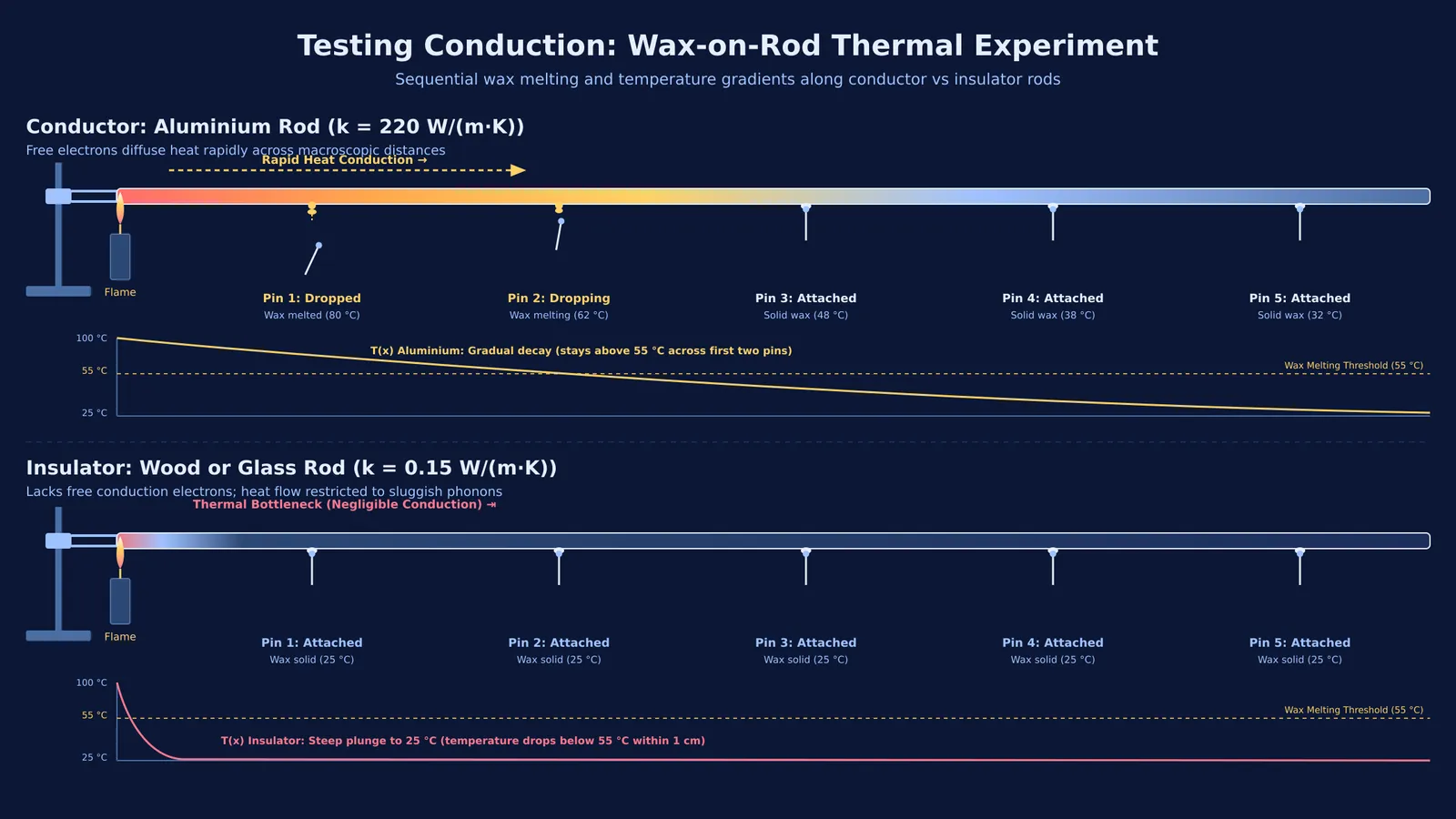
The classic demonstration of conduction in the Class 7 Science syllabus (NCERT) uses an aluminium or iron rod supported horizontally on a stand. Small wax droplets fix iron pins at regular intervals along the underside of the rod, typically 2 to 3 centimetres apart. When a candle flame heats one free end, thermal energy propagates along the rod.
As heat conducts through the metal, the section nearest the flame reaches the melting point of paraffin wax (roughly 50 °C to 60 °C), and the first pin drops. As the thermal front advances, subsequent pins drop sequentially. Repeating the test with a glass rod or wooden dowel reveals that pins fail to detach, because heat travels too slowly through an insulator.
As physicist Ernesto Marín demonstrated in *The Physics Teacher*, touching or heating a substance involves thermal effusivity during initial contact before reaching steady-state conduction.
What does the spoon-in-hot-water experiment reveal?
If you lack a clamp stand and candle, you can run the comparative test outlined in the Class 7 curriculum (NCERT) in any kitchen. Place a stainless steel spoon, a wooden stick, and a plastic scale into a mug of hot water.
After two to three minutes, touch the exposed ends. The steel spoon handle feels hot, whereas the wooden stick and plastic scale feel unchanged. This test proves that metals conduct heat rapidly from the water to the handle, while wood and plastics resist heat flow. In the study of conduction, convection, and radiation in Class 7 science, this hands-on test defines conductors as materials that allow heat to pass easily, and insulators as poor conductors.
What microscopic mechanism separates conductors from insulators?
The dramatic difference in thermal transport stems from atomic structure. In conductors like copper and aluminium, metallic bonds release valence electrons into a mobile electron sea. When heated, these free electrons gain kinetic energy and diffuse rapidly through the lattice, transferring energy across macroscopic distances. In our guide to energy bands and conductivity differences, this electron mobility explains why good thermal conductors are almost always good electrical conductors.
By contrast, non-metals like wood, glass, and polymers lack free conduction electrons. Their electrons are locked in tight covalent bonds, restricting heat flow to sluggish lattice vibrations (phonons). Wood also contains microscopic air pockets, and motionless air has an exceptionally low thermal conductivity of roughly 0.023 W/(m·K) according to OpenStax College Physics.
Thermal measurements compiled in Table 14.3 of the same OpenStax text underscore this gap: copper conducts heat at 390 W/(m·K) and aluminium at 220 W/(m·K), while wood measures 0.08 to 0.16 W/(m·K). Metals conduct heat hundreds to thousands of times faster than solid insulators. For connecting macroscopic heat flow with microscopic thermodynamics, the Fermi Concept Library contains every concept in physics, chemistry, biology, mathematics and computing, each with its own lesson and its place in the map.
Why do cookware handles use plastic or wood?
Cookware design exploits this thousand-fold difference in conductivity. Cooking pans require rapid heat distribution across their base, which is why they are made of aluminium or stainless steel. However, the cook must safely hold the handle while the pan is on the stove.
Attaching a handle made of wood or Bakelite—a thermosetting polymer that does not soften under heat—creates a severe thermal bottleneck. Using Fourier's law of conduction as formulated in OpenStax, the heat transfer rate is P = k A (T_hot - T_cold) / L, where P is power in watts, k is conductivity, A is cross-sectional area, and L is length:
For an aluminium handle with length L = 0.15 m and area A = 2 × 10⁻⁴ m² spanning a 120 °C difference, k = 220 W/(m·K) yields P = 220 × 2 × 10⁻⁴ × 120 / 0.15 = 35.2 W.
For a wooden or Bakelite handle of identical dimensions, k = 0.15 W/(m·K) yields P = 0.15 × 2 × 10⁻⁴ × 120 / 0.15 = 0.024 W (just 24 milliwatts).
The metal handle transfers heat roughly 1,467 times faster, risking severe burns, while the insulator transfers a harmless fraction of a watt. To master composite walls and thermal resistance, see our guide on thermal resistance and composite conduction. For students tackling heat transfer numericals, the Fermi Problem Library provides worked problems with a step-by-step solver that explains the reasoning rather than printing an answer. For visualizing lattice vibrations and free electrons, the Fermi Simulation Lab offers interactive simulations for ideas that are easier to see than to read.


