On this page
Some discoveries come from a careful plan; others come from noticing something that should not be there. Wilhelm Röntgen's discovery of X-rays was the second kind, but what made it science was the systematic testing that followed. This post gives the verified story from the Nobel Prize archive, explains what X-rays are in the terms your syllabus uses, and works out the shortest wavelength an X-ray tube can produce.
Who was Wilhelm Röntgen?
According to the Nobel Prize facts page, Wilhelm Conrad Röntgen was born on 27 March 1845 in Lennep, Prussia (now Remscheid, Germany), and died on 10 February 1923 in Munich. He grew up in the Netherlands, studied at ETH Zurich and earned his doctorate from the University of Zurich.
His Nobel biography traces a career through Würzburg, Strasbourg, Hohenheim and Giessen, before he accepted the chair of physics at the University of Würzburg in 1888. In 1900 he moved to the University of Munich, where he stayed for the rest of his life. The biography describes him as someone who preferred to work alone and built much of his apparatus himself.
What happened on 8 November 1895?
In 1895 Röntgen was studying what happens when an electric current passes through a gas at very low pressure, a field in which many physicists, including Crookes and Hertz, had already worked. The Nobel biography records that on the evening of 8 November he enclosed his discharge tube in a sealed, thick black carton to block all light and worked in a dark room. A paper plate coated on one side with barium platinocyanide, placed in the path of the rays, still became fluorescent, even when it was as far as two metres from the tube.
Light could not escape the carton, so something else was reaching the screen.
How did Röntgen test the new rays?
Then he tested it. The biography describes what his subsequent experiments showed:
Penetration. Objects of different thickness placed in the path of the rays showed different transparency when recorded on a photographic plate.
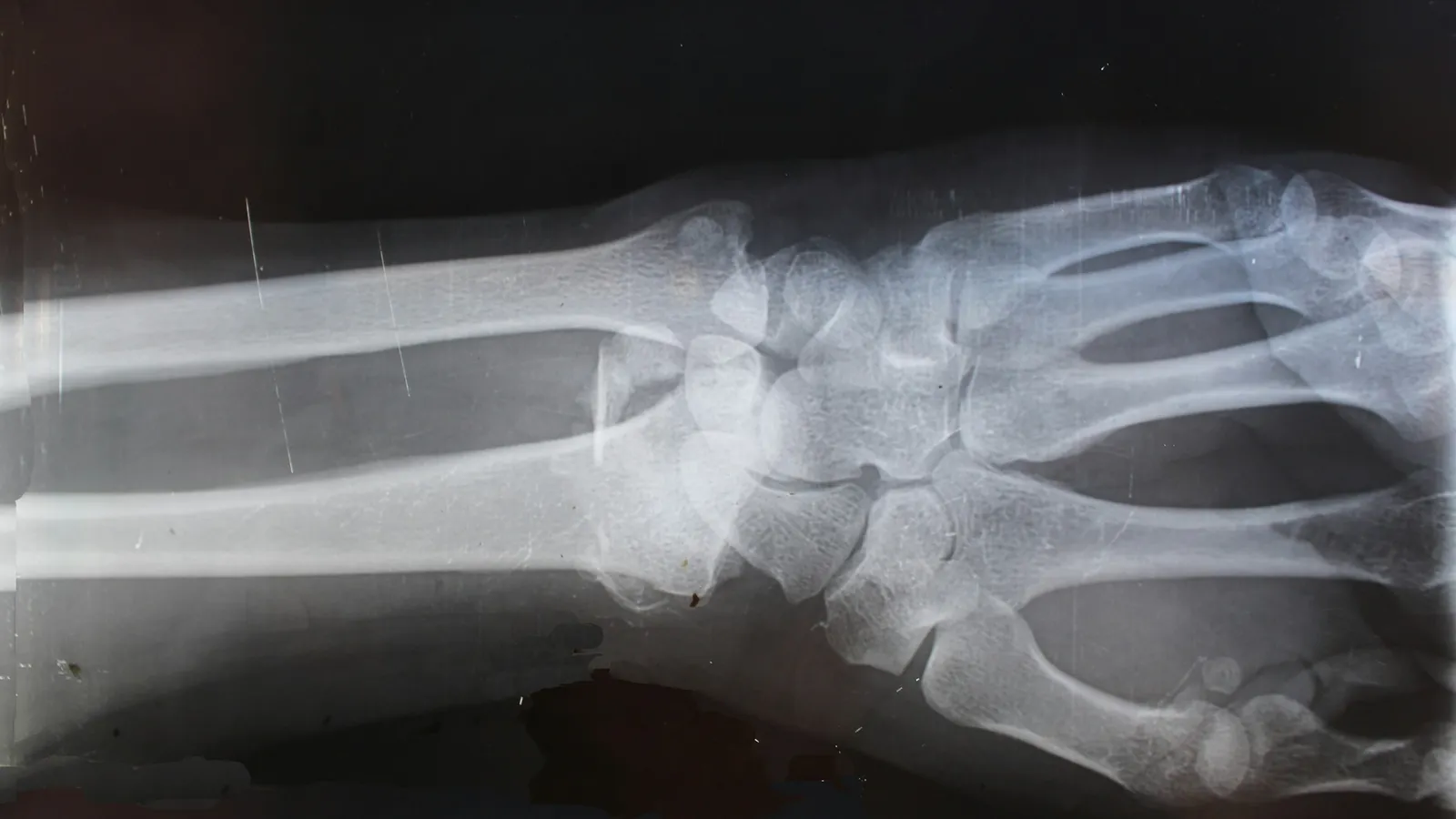
The first radiograph. He held his wife's hand in the path of the rays over a photographic plate. The developed plate showed the shadows of her bones and of a ring she was wearing, with the flesh throwing a fainter shadow. The biography calls this the first "röntgenogram".
The source. He showed that the new rays are produced when cathode rays strike a material object.
Because their nature was unknown, he called them X-rays. An English translation of his first report, On a New Kind of Rays, appeared in Nature on 23 January 1896.
What did the world make of it?
Röntgen received the first Nobel Prize in Physics in 1901, unshared, "in recognition of the extraordinary services he has rendered by the discovery of the remarkable rays subsequently named after him", as the Nobel facts page states. The Nobel summary notes that X-rays became a powerful tool both for physics experiments and for examining the inside of the body. Later, the biography adds, Max von Laue and his students showed that X-rays are electromagnetic waves like light, differing only in their much higher frequency.
What are X-rays, in syllabus terms?
NCERT's chapter on electromagnetic waves places X-rays beyond the ultraviolet, with wavelengths from about 10^-8 m (10 nm) down to 10^-13 m. It notes that a common way to produce them is to bombard a metal target with high-energy electrons, essentially Röntgen's cathode rays striking matter. NCERT also warns that X-rays damage living tissue, so unnecessary exposure must be avoided. The JEE (Advanced) 2026 syllabus goes further and lists characteristic and continuous X-rays and Moseley's law.
Worked example: the shortest wavelength from an X-ray tube
Electrons are accelerated through a potential difference V and hit a target. Each electron arrives with kinetic energy eV. The most energetic X-ray photon possible is made when one electron gives all its energy to one photon, so the continuous spectrum stops at a minimum wavelength.
Set the energies equal: eV = hc / λmin, so λmin = hc / (eV).
Use the constants: h = 6.63 × 10^-34 J s, c = 3.00 × 10^8 m/s, e = 1.60 × 10^-19 C. So hc/e = (6.63 × 10^-34 × 3.00 × 10^8) / (1.60 × 10^-19) = 1.24 × 10^-6 V m.
For a tube at 30 kV: λmin = 1.24 × 10^-6 / 30,000 = 4.1 × 10^-11 m, or about 0.041 nm.
Check the range: 4.1 × 10^-11 m lies inside NCERT's X-ray range.
Doubling the voltage halves the cut-off wavelength. The cut-off depends only on the voltage, not on the target metal; the target decides the characteristic lines, which is where Moseley's law comes in. Common mistakes are using the electron's de Broglie wavelength instead of the photon's, and forgetting to convert kV to V. Our post on X-rays and Moseley's law continues from here.
What can a student take from Röntgen's way of working?
Take anomalies seriously. A faint glow where none should be was the start of a new field.
Test before you claim. He checked penetration, recorded images and found the source before reporting.
Build your own tools. His biography notes that he made much of his apparatus himself, which meant he understood exactly what each part did.
If photon energy and wavelength still feel disconnected, revise them together. The Fermi Concept Library covers every concept in physics, each with its own lesson, so you can go from photon energy to the X-ray spectrum without switching books. Our guide to the electromagnetic spectrum puts X-rays alongside the other bands.
Work out the cut-off wavelength for a tube at 50 kV, and check that it is shorter than the 30 kV answer.