On this page
Magnets look like an easy chapter: things stick, things don't. But the exam questions in Class 6 are about reasoning. How do you prove a bar is a magnet? Why does a compass point north? This post covers what Chapter 4 teaches, works through three puzzles step by step, and lists the mistakes that cost marks.
Where is this chapter?
"Exploring Magnets" is Chapter 4 of Curiosity, NCERT's Class 6 science book marked Reprint 2026-27. The chapter PDF starts with a story about sailors lost in a storm without stars and asks how they could find direction.
Which materials does a magnet attract?
Materials attracted by a magnet are magnetic: iron, nickel and cobalt, and some combinations of them with other metals. Everything else is non-magnetic, including wood, plastic, rubber and glass. Early magnets were natural lodestones; the ones in pencil boxes and labs are artificial and come as bar, U-shaped, ring and other shapes.
Where are the poles, and can you have just one?
Spread iron filings and lay a bar magnet on them. Most filings cling near the two ends. These ends are the poles. If you break a magnet, each piece still has a North and a South pole. The book is clear: a single pole cannot exist.
Why does a compass point north-south?
Hang a bar magnet from a thread at its middle and let it settle. It always comes to rest along the north-south line. The end pointing north is the North-seeking (North) pole. An ordinary iron bar does not do this; it can rest in any direction.
The book explains that this happens because Earth itself behaves like a giant magnet. NOAA's geomagnetism FAQ adds a detail for later: Earth's field is very similar to that of a straight magnet at its centre, but tilted from Earth's spin axis, so the magnetic poles and the geographic poles are not in the same place. The angle between magnetic north and true north at a place is called declination. For Class 6, "the needle rests north-south" is the answer the book expects.
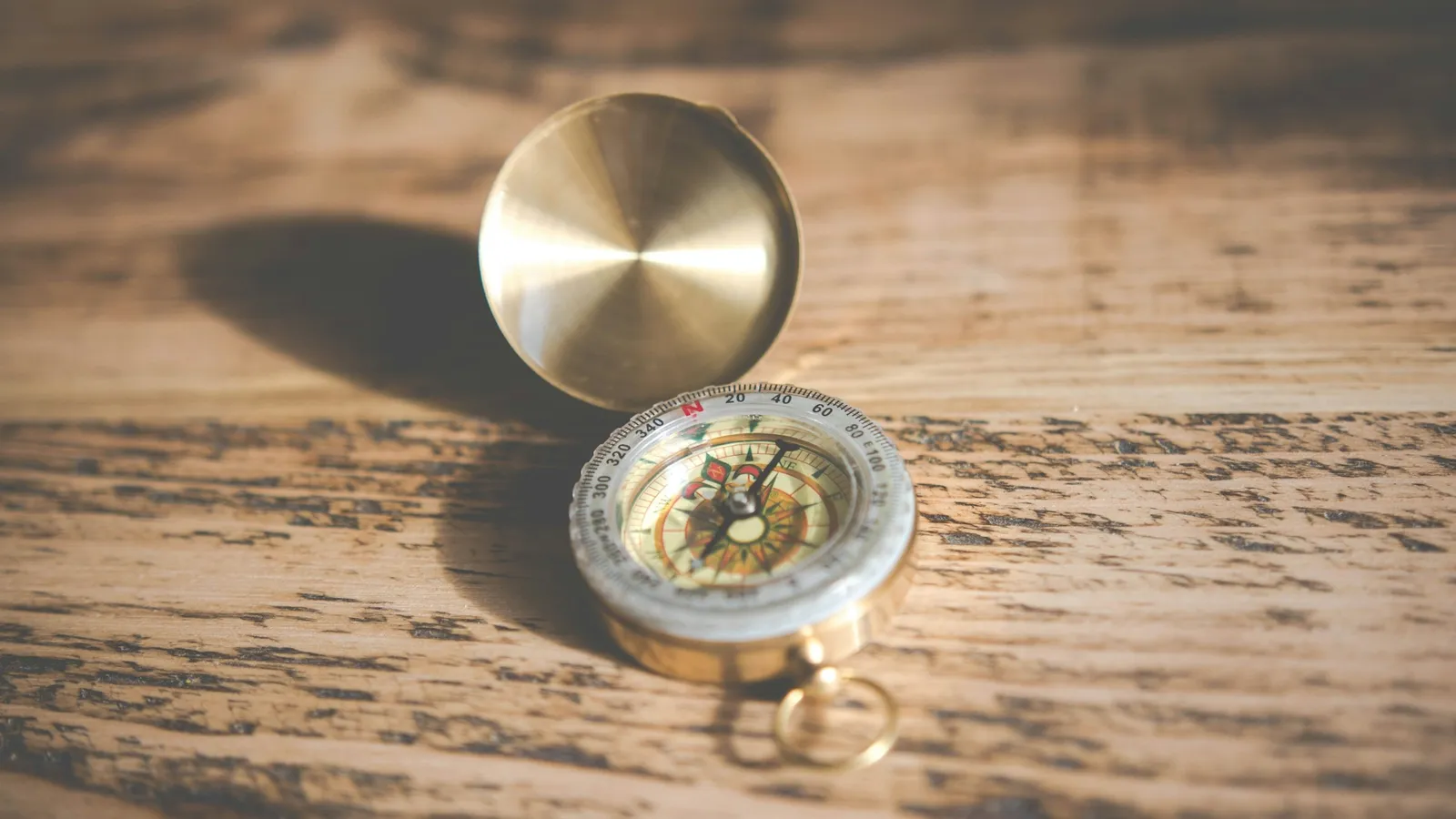
A compass is a magnetised needle on a pin that can turn freely, over a dial. You wait for the needle to settle, then turn the box until N on the dial lines up with the needle. The book also mentions the matsya-yantra, a magnetised fish-shaped iron piece floating in oil, used by Indian sailors.
Like poles and unlike poles
Unlike poles (N and S) attract. Like poles (N and N, or S and S) repel. Here is the key idea for exam questions: an iron bar is attracted by both ends of a magnet, but it is never repelled. So repulsion is the only sure test that something is a magnet. The book also shows a magnet's effect passes through wood, cardboard, plastic and glass.
Worked puzzles
Puzzle 1 (Exercise 5). Reshma has three identical bars: two magnets and one iron bar. How can she find the magnets using nothing else?
Bring the ends of bar 1 and bar 2 together, then flip one and try again.
If at some point they push apart, both are magnets, and bar 3 is iron.
If they only ever attract, one of them is iron. Now test bar 3 against bar 1. Repulsion means bars 1 and 3 are the magnets; no repulsion means bar 1 is the iron bar, so bars 2 and 3 are the magnets.
Puzzle 2 (Exercise 4). Atharv rolls a bar magnet in steel U-clips and counts clips at the left end (A), middle (B) and right end (C). Which result fits: (i) 10, 2, 10; (ii) 10, 10, 2; (iii) 2, 10, 10; (iv) 10, 10, 10? Most clips gather at the poles, which are the ends, and very few in the middle. So (i): 10 at each end, 2 in the middle.
Puzzle 3 (directions). Your compass needle has settled with its red end pointing north. Directions on a compass go clockwise: north 0°, east 90°, south 180°, west 270°. A friend's house is at 90° from you, so it lies due east. A temple at 225° is halfway between south (180°) and west (270°), since (180 + 270) ÷ 2 = 225, so it is south-west.
Which mistakes cost marks?
"All metals are magnetic." Copper and aluminium are not attracted.
"It attracted the magnet, so it is a magnet." Iron is attracted too; look for repulsion.
"Iron filings stick mostly in the middle." They gather at the poles.
"Break a magnet to get a single North pole." Every piece has two poles.
Forgetting to wait for the needle to settle before reading a compass.
How should you look after magnets?
The book's tips: store bar magnets in pairs with unlike poles on the same side, with wood between them and soft iron pieces across the ends. Do not heat, drop or hammer them, and keep them away from phones and remote controls.
A one-week practice routine
Day 1: Before testing ten household objects with a magnet, write your predictions. Predicting first is not a formality; in a physics classroom study, students who predicted a demonstration's result understood it better than students who only watched.
Day 2: Make the floating needle compass from Activity 4.4 (stroke the needle 30 to 40 times in one direction with the same pole).
Day 4: Solve Puzzle 1 again from memory and explain it to someone at home.
Day 7: Draw three bar magnets in a row and label each pole so that every pair of neighbouring ends attracts.
How a compass needle swings near a magnet is easier to watch than to read, and the Fermi Simulation Lab has interactive simulations for ideas like this. For history, read how William Gilbert studied magnetism, and see magnets at work in methods of separation.
Today, find one object at home that a magnet attracts and prove it is not itself a magnet.