On this page
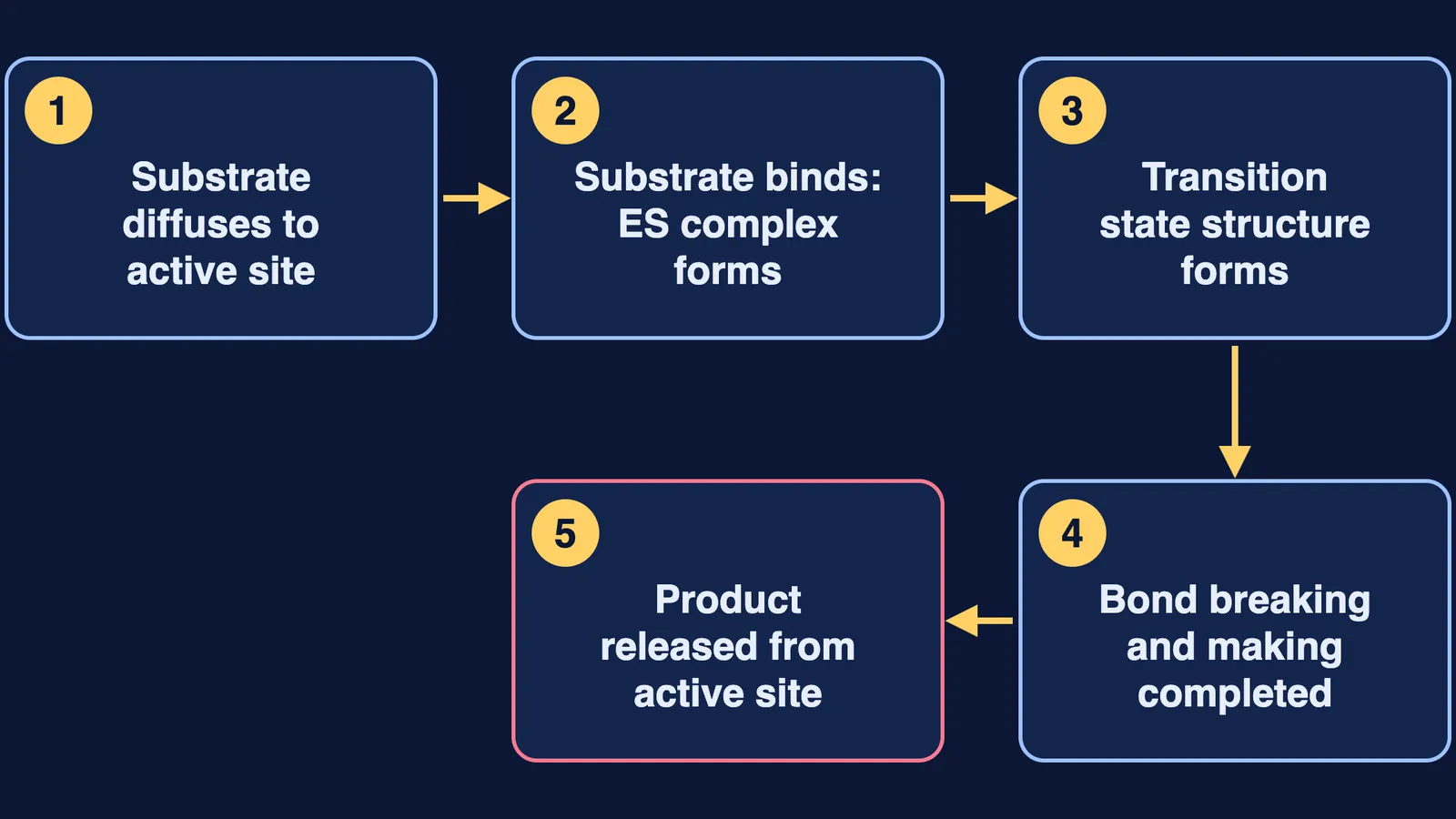
In 1890 Cornelius O'Sullivan and Frederick W. Tompson published a 98-page study of invertase, the yeast enzyme that splits cane sugar. Alone, invertase was mostly destroyed by 45 °C. In sugar solution it survived 60 °C untouched. So, they argued, the enzyme must hold on to the sugar while it works. That idea, an enzyme–substrate complex, came 23 years before the Michaelis–Menten paper.
The paper is C. O'Sullivan and F. W. Tompson, "Invertase: a Contribution to the History of an Enzyme or Unorganised Ferment", J. Chem. Soc. Trans. 57 (1890) 834–931 (DOI 10.1039/CT8905700834; scan on the Internet Archive). The paper gives no affiliation beyond "F.R.S." after O'Sullivan's name. Numbers and quotes come from that scan, with tables checked against the page images.
What were O'Sullivan and Tompson trying to find out?
The authors quote Roberts's The Digestive Ferments: the organism stores "vital force" in the ferment, which spends it until "the ferment is still left—but it is dead." They tested the other view, that an enzyme is an ordinary chemical reagent, using this reaction:
C₁₂H₂₂O₁₁ + H₂O → C₆H₁₂O₆ (glucose) + C₆H₁₂O₆ (fructose)
It balances: 12 C, 24 H and 12 O each side. They also preferred "invertase" to "invertin", because "the ending (ase) should be the distinguishing affix" of enzyme names.
How did they measure inversion with a polarimeter?
Sucrose is dextrorotatory and invert sugar laevorotatory, as explained in why sucrose hydrolysis is called inversion of sugar. With 20 g sucrose per 100 mL in a 100 mm tube, they read a Soleil–Ventzke–Scheibler polarimeter in scale divisions and used:
p = (38.4 − d) ÷ 0.518
Here d is the reading and p the percentage inverted. 38.4 is the reading for pure sucrose; 51.8 is the total fall on full inversion.
Worked example: where does 51.8 come from?
Their rotations are [α]ⱼ, read with an older reference light, not sodium-light [α]D: sucrose +73.8°, dextrose (glucose) +57°, laevulose (fructose) −106°.
Water adds mass: 20 g sucrose becomes 20 × 360.31 ÷ 342.30 = 21.05 g of invert sugar.
Average rotation of the equal mix: (57 − 106) ÷ 2 = −24.5°.
A reading scales with mass × rotation, so the final reading is 38.4 × (21.05 × −24.5) ÷ (20 × 73.8) = −13.4 divisions.
Total fall: 38.4 − (−13.4) = 51.8 divisions, their constant.
Their activity test timed the reading to zero: d = 0 gives p = 74.1% inverted.
The time curve matched Harcourt's law for a change "of which no condition varies excepting the diminution of the changing substance": first order, as in finding k from optical rotation.
Why did adding alkali make the rotation drop?
Alkali kills invertase "instantly and irretrievably", so they stopped samples with KOH. The rotation then fell further. In one run (200 mm tube) it dropped 24.1 divisions out of a full fall of 103.6, as if 24.1 ÷ 103.6 = 23.3% more sucrose had inverted. Was more sugar really split? Freezing points count particles and ignore rotation, so they checked.
Worked example: molar mass from freezing point
One sucrose (342) gives two particles averaging 180, so the mean molar mass falls from 342 to 180. They took −1.27 °C for the sucrose solution and −2.71 °C after full inversion, and interpolated:
Observed −1.82 °C: M = 342 − 162 × (1.82 − 1.27) ÷ (2.71 − 1.27) = 280.
Observed −2.52 °C: M = 201. Observed −2.69 °C: M = 182.
Their Table XX, from rotation: 281, 190 and 183 after alkali; 312, 223 and 195 before.
Freezing points matched the readings after alkali: no extra sugar had been split. Ideal check: the solution holds roughly 88 g water, so m ≈ 0.664 mol/kg and ΔTf ≈ 1.86 × 0.664 ≈ 1.23 °C, rising to about 2.50 °C after inversion. Their 1.27 and 2.71 include allowances for hydration and contraction.
A. L. Stern suggested the answer: newly released glucose is "bi-rotatory", turning light more strongly than at equilibrium, and alkali ends this at once. One dextrose solution fell from [α]ⱼ +130° to +57°. Today this is mutarotation, explained in T. M. Lowry's 1899 work on mutarotation. Their rule: stop with alkali, wait a quarter of an hour, then read.
Is invertase a true catalyst?
A catalyst comes out unchanged. A tiny weighed amount of invertase sat in a large flask of sugar solution at 50–54 °C for a fortnight, beside a blank with no enzyme. After allowing for the 10% inverted in the blank, it had acted on "over 100,000 times its own weight of the sucrose", and inversion was still going.
Worked example: how much work per gram?
100,000 g of sucrose ÷ 342.30 g/mol = 292 mol of sucrose split by 1 g of enzyme.
Their strongest sample inverted 74 times its weight in 25.1 minutes at 15.5 °C. At 54 °C it was 7.5 times faster: 74 × 7.5 = 555 times its weight, or 555 ÷ 25.1 ≈ 22 times its own weight per minute. They wrote "about 22".
Harcourt's rule (rate doubles every 10 °C) predicts 2⁴ = 16 times from 15.5 to 55.5 °C. They found 7.5: heat begins to destroy the enzyme.
Their conclusion: inversion by invertase is "a simple chemical change, differing in no important way from those which inorganic substances undergo." They also said the products do not affect the rate; Michaelis and Menten later found that they do (Michaelis and Menten's invertase experiment).
How did sugar protect invertase from heat?
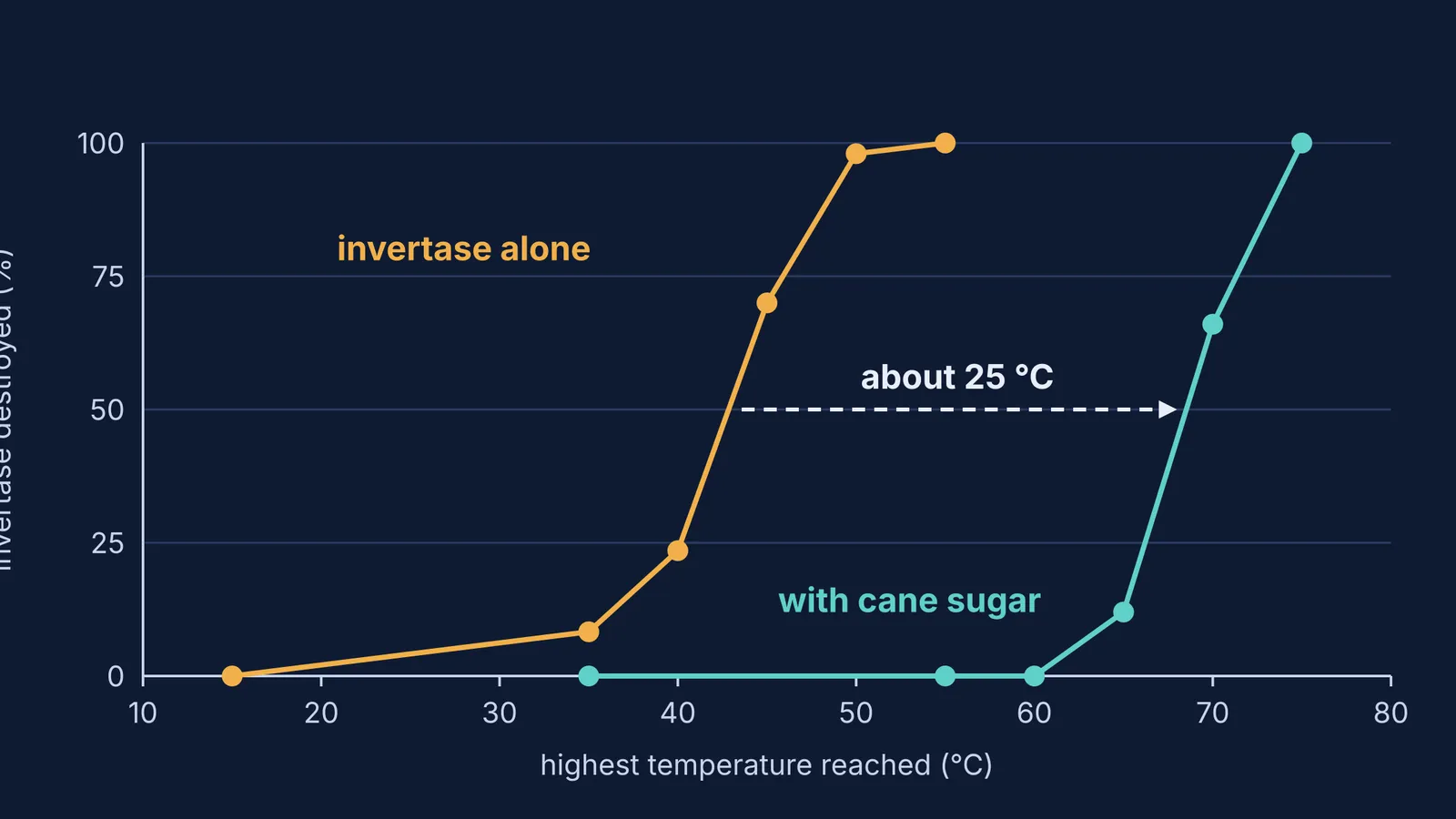
They heated invertase alone (Experiment A) and in sugar solution (Experiment B), sampling as the temperature rose, and measured the inverting power left. Table XXXIV, percentage destroyed:
Without sugar: 35 °C 8.3%, 40 °C 23.5%, 45 °C 70.0%, 50 °C 98.0%, 55 °C 100%.
With sugar: none at 35, 55 or 60 °C; 12% at 65 °C, 66% at 70 °C, 100% at 75 °C.
Worked example: how big is the shift?
Activity left is measured in their "time units". Without sugar, 40 °C left 15.6 against 20.4 unheated: 1 − 15.6 ÷ 20.4 = 23.5% destroyed. With sugar, 70 °C left 8.9 against 26.0: 66%.
Interpolate for 50% destroyed. Without sugar: 40 + 5 × (50 − 23.5) ÷ (70.0 − 23.5) ≈ 42.8 °C. With sugar: 65 + 5 × (50 − 12) ÷ (66 − 12) ≈ 68.5 °C.
The shift is about 25.7 °C, matching their "fully 25° higher".
Their reasoning: "there is only one explanation of it, namely, the invertase enters into combination with the sugar." The combination, they argued, must last until the next sucrose arrives, or heat would destroy the enzyme between reactions. It was an inference: they said they could give no further proof, and the two heating runs were not identical in timing.
If catalysts, rate laws or colligative properties still feel loose, the Concept Library covers each as its own concept.
Quick checklist
p = (38.4 − d) ÷ 0.518; the 51.8 comes from [α]ⱼ +73.8°, +57° and −106°.
Alkali stops invertase and destroys glucose's high-rotation form, so wait before reading.
Freezing points showed no extra splitting: M = 280, 201, 182.
Over 100,000 times its weight inverted, about 22 times per minute at 54 °C: a true catalyst.
Sugar lets the enzyme survive about 25 °C more heat: their evidence for an enzyme–sugar combination.
Syllabus: Class 12 Biomolecules (invert sugar, mutarotation, enzymes), Chemical Kinetics (first order) and Solutions (ΔTf).