On this page
Hydrogen fluoride boils near 19 °C, while HCl, HBr and HI are gases at room temperature. In the 1880s some chemists took that, and KHF₂, as proof that the molecule is really H₂F₂ and that fluorine has a valency of two. In 1889 T. E. Thorpe and F. J. Hambly weighed HF vapour in a vessel made entirely of platinum. Just above the boiling point it came out at a molar mass of 51, heavier than H₂F₂. And when they lowered the pressure at a fixed temperature, the apparent "H₂F₂" fell apart.
The paper is T. E. Thorpe and F. J. Hambly, "The Vapour-density of Hydrogen Fluoride", J. Chem. Soc. Trans. 55 (1889) 163–184 (DOI 10.1039/CT8895500163; scan on the Internet Archive). The paper gives "F.R.S." after Thorpe's name and no other details about either author. Numbers are from that scan, with Tables I and III read from the page images.
HF is extremely dangerous. The authors themselves record that Louyet and Nicklès "were killed by accidentally inhaling the vapour of the strong acid", and that a single drop on the skin "produces a very serious and painful wound". This post is history and calculation only.
Why did chemists think HF was H₂F₂?
Mallet, in 1881, weighed HF vapour in large paraffin-coated glass flasks. Kletzinsky reported 1.75 to 1.79 g per litre, which the paper says gives a molecular weight of about 39.5. On the old scale (H = 1, F = 19), H₂F₂ is 40.
Worked example: Mallet's flasks with PV = nRT
Use M = mRT ÷ PV with R = 62,364 mL mmHg mol⁻¹ K⁻¹.
First flask: 7.250 g in 4347.4 mL at 29 °C (302.15 K) and 743.7 mm. M = 7.250 × 62,364 × 302.15 ÷ (743.7 × 4347.4) = 42.3 g/mol.
Second flask: 6.819 g in 4394.7 mL at 30.5 °C and 745.2 mm. M = 39.4 g/mol.
Vapour density on the hydrogen scale is M ÷ 2: 21.1 and 19.7. Mallet's own values were 21.06 and 19.66.
Divide M by 28.96 (the molar mass of air) to get density relative to air: 1.459 and 1.361. Thorpe and Hambly quote 1.459 and 1.363.
Both sit close to H₂F₂, but Mallet measured only near 30 °C and at one pressure.
What did Thorpe and Hambly measure?
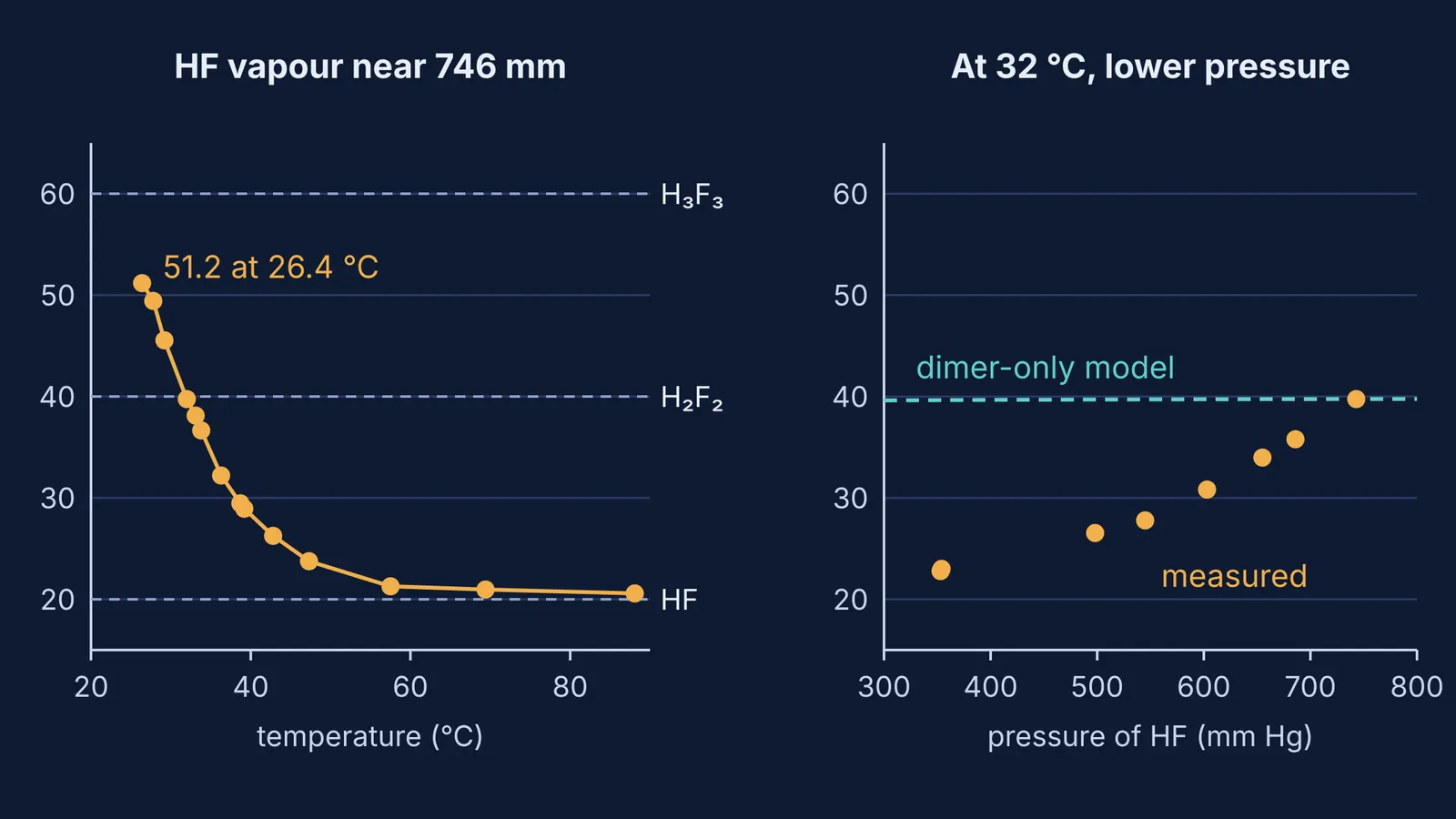
They weighed the vapour in a platinum vessel of about 288.6 mL, from 26.4 °C up to 88.1 °C, near 746 mm. Their theoretical densities (air = 1) were HF 0.6927, H₂F₂ 1.3854 and H₃F₃ 2.0781. Some rows of their Table I:
26.4 °C: density 1.773, molecular weight 51.18
32.0 °C: 1.377, 39.74
42.8 °C: 0.910, 26.26
57.5 °C: 0.737, 21.28
88.1 °C: 0.713, 20.58
The paper's verdict: "the process of dissociation of the vapour of hydrogen fluoride is a perfectly continuous one, and … there is no direct evidence of the existence of a molecule corresponding to the formula H₂F₂." The density passes the H₂F₂ value near 32 °C without pausing. By about 60 °C it is "approximately normal", meaning nearly all HF.
Worked example: from density to degree of association
Their molecular weight is 28.87 × density, from their air value of 14.435 on the hydrogen scale. At 26.4 °C: 28.87 × 1.773 = 51.2. With today's 28.96 you get 51.3.
In NCERT form, vapour density (H₂ = 1) is M ÷ 2 = 25.6, against 10.0 for HF.
Count particles. Each "particle" in the vapour carries on average 51.2 ÷ 20.0 = 2.56 HF units.
A vapour made only of H₂F₂ carries exactly 2. So at 26.4 °C there must be groups larger than two.
The authors wrote only that it "behaves like a mixture of a complex molecule HₓFₓ, or of HₓFₓ and HᵧFᵧ molecules", and that extrapolating to the boiling point gives a value between H₃F₃ and H₄F₄. This is the same reasoning as the van't Hoff factor in acetic acid association in benzene, and they compared HF with acetic acid vapour directly.
What happened when they lowered the pressure?
At about 32 °C they pumped the vessel down and weighed again (Table III):
743 mm: density 1.377, molecular weight 39.74
655 mm: 1.177, 33.98
545 mm: 0.963, 27.78
353 mm: 0.789, 22.78
Halving the pressure took the vapour from "H₂F₂" almost to plain HF. Diluting it with dry air gave the same curve, so the partial pressure of HF is what matters. Lower pressure favours the side with more particles: Le Chatelier's principle. It is the same idea worked in the degree of dissociation of PCl₅ from vapour density.
Can a simple dimer equilibrium explain the data?
Suppose the only change is H₂F₂ ⇌ 2HF. Start with 1 mol H₂F₂ and let a fraction α split. Then α = (D − d) ÷ d, with D = 1.3854, and Kp = 4α²P ÷ (1 − α²).
Worked example: two pressures, two "constants"
At 743 mm, d = 1.377: α = (1.3854 − 1.377) ÷ 1.377 = 0.0061. Kp = 4 × 0.0061² × 743 ÷ (1 − 0.0061²) ≈ 0.11 mm.
At 353 mm, d = 0.789: α = 0.756. Kp = 4 × 0.756² × 353 ÷ (1 − 0.756²) ≈ 1880 mm.
Same temperature, so Kp should be the same. Instead it changes about 17,000-fold.
Run it forwards: with Kp = 0.11 mm, at 353 mm α would be only 0.009 and d about 1.373. They measured 0.789.
So the dimer-only model fails. As Thorpe and Hambly put it, "the change cannot be solely attributed to a resolution of H₂F₂ molecules into HF molecules." As an extra check on their Table III (our calculation, not theirs), a trimer-only model still drifts about tenfold, and models with clusters of four to six HF drift by a factor of about 3. Larger groups fit better, though none of these simple models is exact.
Did this settle whether fluorine has a valency of two?
They argued the salts were no proof. Moissan had made KF·2HF and KF·3HF, which would "justify" H₃F₃ and H₄F₄ just as KHF₂ was said to justify H₂F₂. Hydrochlorides of the chlorides of gold, platinum, mercury, cadmium and zinc are known too, and nobody took them to show that chlorine is polyvalent. So "the argument as to the bivalent or, indeed, polyvalent character of fluorine seems to us to be inconclusive."
Today HF's association is explained by hydrogen bonding, covered in why HF is a liquid but HCl is a gas. Fluorine's valency is one.
For more vapour density numericals, the Fermi Problem Library has a step-by-step solver that explains the reasoning. For JEE Main and Advanced practice on mole concept and equilibrium, see Fermi Test Prep.
Quick checklist
Mallet, 1881: M ≈ 42 and 39 near 30 °C, which looked like H₂F₂.
Thorpe and Hambly, 1889: M = 51.2 at 26.4 °C, nearly 20 by about 60 °C, with no step at 40.
More than 2 HF units per particle means groups larger than H₂F₂.
At 32 °C, 743 mm gives 39.7 but 353 mm gives 22.8. Dimer Kp changes 17,000-fold, so a dimer alone cannot explain it.
Syllabus: Class 11 mole concept, Equilibrium (degree of dissociation, Le Chatelier), Chemical Bonding (hydrogen bonding); Class 12 Solutions (association).