

On this page
At room temperature (around 20 to 25 °C), a sealed flask of hydrogen chloride contains a gas, but a flask of hydrogen fluoride holds a fuming liquid. Because chlorine is a larger atom than fluorine, you might expect HCl to have a higher boiling point than HF due to stronger dispersion forces. Instead, the opposite is true.
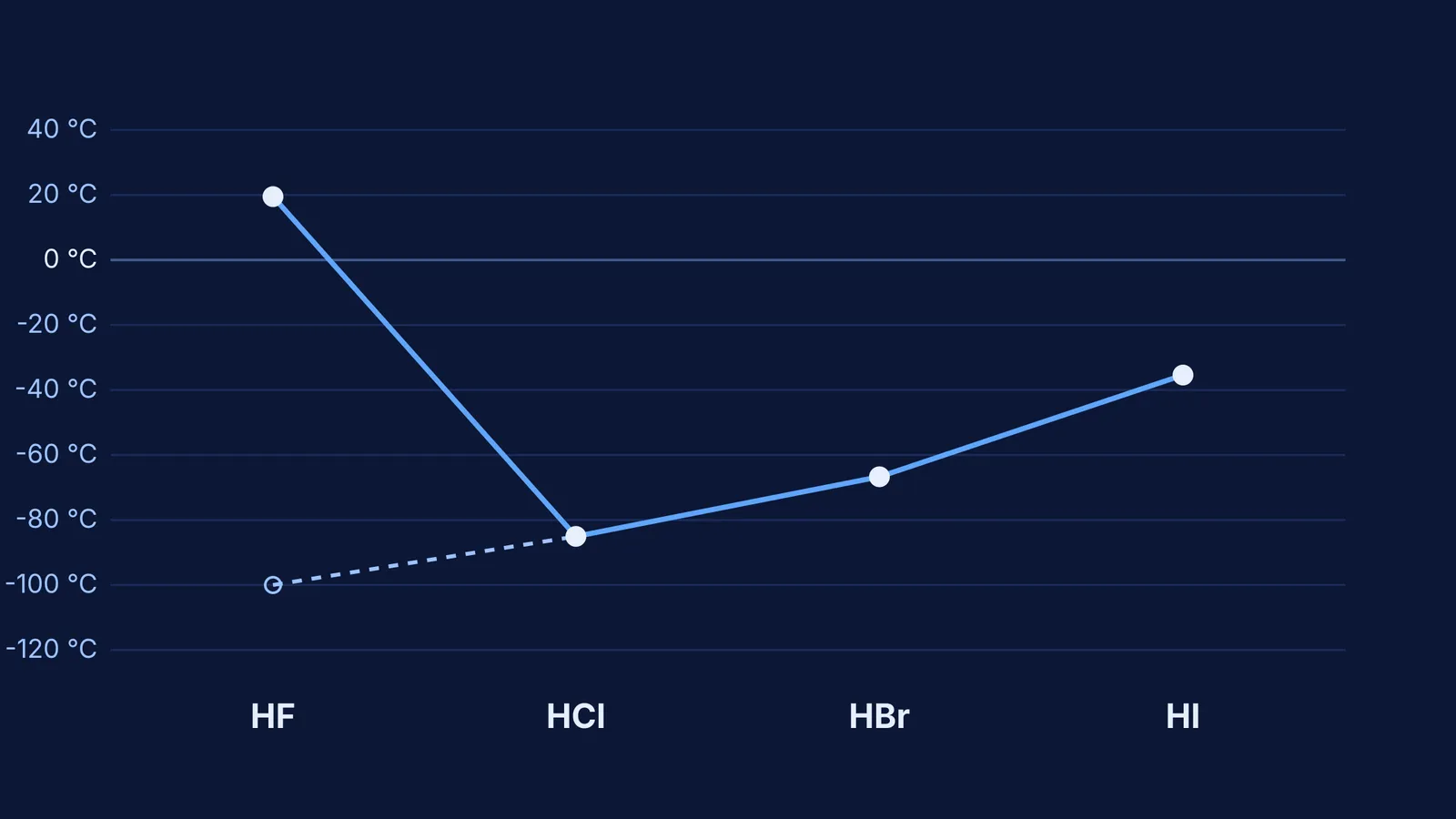
Hydrogen fluoride boils at 19.5 °C, making it a liquid on a cool day (PubChem). Hydrogen chloride, however, boils at a frigid -85.05 °C (PubChem). The dramatic 104 °C difference comes down to one exceptionally strong intermolecular force: hydrogen bonding.
Why is HF liquid but HCl is gas?
Molecules of both HF and HCl are polar. In each, the halogen atom pulls the shared pair of electrons away from the hydrogen atom. This gives the hydrogen end a partial positive charge and the halogen end a partial negative charge.
When these molecules bump into each other, opposite charges attract. In HCl, this attraction is a standard dipole-dipole force. It is strong enough to make HCl deviate from ideal gas behaviour, but not strong enough to keep it liquid at room temperature.
In HF, the fluorine atom is small and highly electronegative. It pulls the electron pair so far away from the hydrogen atom that the hydrogen is left almost bare. When this exposed, positively charged hydrogen gets near a lone pair of electrons on a neighbouring fluorine atom, it forms a strong, directional attraction called a hydrogen bond. This network of hydrogen bonds ties HF molecules together so tightly that it takes significant thermal energy to break them apart and turn the liquid into a gas.
You can see similar anomalies when comparing H₂O and H₂S, or NH₃ and PH₃. In every case, the hydride of the smaller, more electronegative element forms hydrogen bonds, breaking the expected trend.
Why doesn't HCl form hydrogen bonds?
Chlorine is electronegative, but it is much larger than fluorine. Its electron cloud is more diffuse, meaning its partial negative charge is spread over a larger volume.
As a result, chlorine does not concentrate enough charge to form a strong, specific hydrogen bond. It relies on standard dipole-dipole interactions and London dispersion forces. While dispersion forces increase with molecular mass—which is why HBr (-66.7 °C) and HI (-35.4 °C) boil at progressively higher temperatures than HCl—they are no match for the hydrogen bonds in HF (PubChem and PubChem).
Understanding these competing forces can be tricky when you are revising for exams. If you are struggling to picture how these electron clouds interact, the Fermi Concept Library can help you visualise the intermolecular forces step by step. Fermi's AI tutor works out what you already know and builds a plan for the session, checking your understanding as it goes.
How can you spot hydrogen bonding in an exam?
When you are asked to predict boiling points or solubility, use this two-step checklist to see if a pure substance can form hydrogen bonds:
Check for the right atoms: Does the molecule contain Nitrogen (N), Oxygen (O), or Fluorine (F)? These are the only three elements small enough and electronegative enough to form typical hydrogen bonds.
Check the connection: Is a hydrogen atom directly covalently bonded to one of those N, O, or F atoms?
If both answers are yes, the substance has hydrogen bonding.
HF: Contains F, and H is directly bonded to it. (Yes)
H₂O: Contains O, and H is directly bonded to it. (Yes)
CH₃F (Fluoromethane): Contains F, but all H atoms are bonded to Carbon, not Fluorine. (No)
HCl: Contains Cl, which is not N, O, or F. (No)
This simple framework helps you quickly identify why molecules like HF behave differently from their heavier neighbours. To master more exceptions in periodic trends, explore the Fermi Concept Library today.


