On this page
Microbes in Human Welfare is Chapter 8 in the 2026-27 reprint of NCERT Class 12 Biology, and the NEET (UG) 2026 syllabus lists it in Unit 8 (Biology and Human Welfare). Every order below is NCERT's; the 11 questions are original, not past or predicted items. Antibiotics appear only as NCERT describes them: a study summary, not medical advice.
Which sequences does NCERT give in Microbes in Human Welfare?
Curd from milk (8.1): curd added as starter → lactic acid bacteria multiply and make acids → milk proteins coagulate → curd, richer in vitamin B12.
Distilled drinks (8.2.1): malted cereals or fruit juice → fermented by *Saccharomyces cerevisiae* → ethanol in the broth → broth distilled for whisky, brandy or rum.
Penicillin (8.2.2): Fleming sees *Staphylococci* fail to grow around a mould → traces this to a chemical → names it Penicillin → Chain and Florey establish its potential → Nobel Prize, 1945.
Primary treatment (8.3): floating debris filtered out → grit sedimented → settled solids form primary sludge; supernatant (effluent) goes on.
Secondary treatment (8.3): effluent agitated and aerated → aerobic flocs grow, consuming organic matter → BOD falls → settling tank → flocs settle as activated sludge → most goes to anaerobic sludge digesters.
Gobar gas (8.4): rumen methanogens break down cellulose → dung rich in methanogens → slurry fed into a concrete tank → floating cover rises as gas forms → biogas piped to houses.
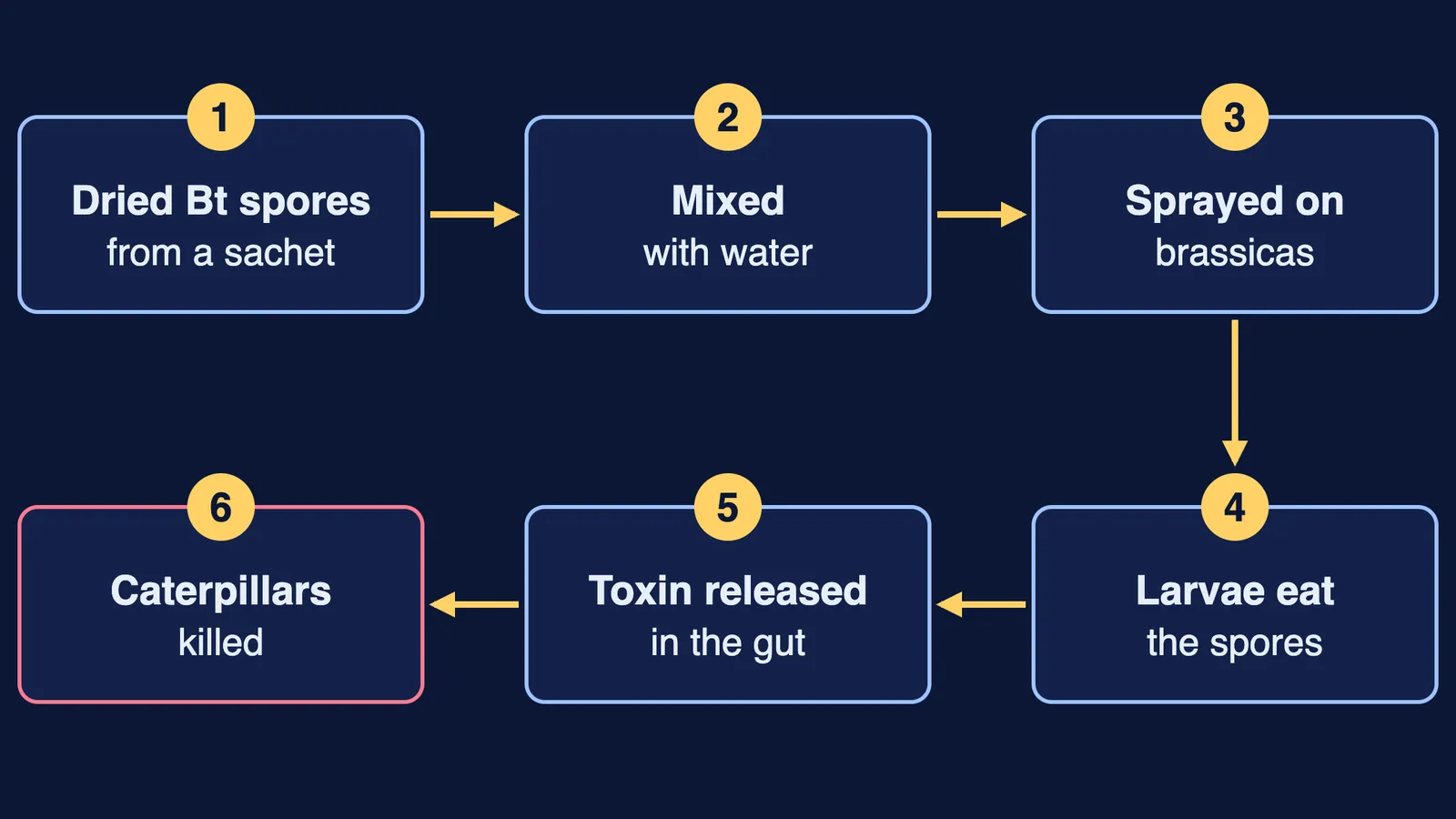
Bt spray (8.5): dried spores mixed with water → sprayed on brassicas → larvae eat them → toxin released in the gut → caterpillars killed.
How do you attack arrange-in-order questions?
Fix the first and last steps, strike options that disagree, then check the first position where survivors differ.
Arrange-in-order questions
Q1. Order the making of whisky, brandy or rum: A. The fermented broth is distilled B. Malted cereals or fruit juices are taken C. Brewer's yeast ferments them D. Ethanol is produced in the broth. (1) C, B, D, A (2) B, C, A, D (3) B, C, D, A (4) B, D, C, A
Answer: (3). Only fermented broth is distilled (8.2.1).
Q2. Order the penicillin story: A. Chain and Florey establish its potential B. Fleming notices a mould on an unwashed plate C. The three receive the Nobel Prize D. Fleming names it Penicillin E. Fleming traces the effect to a chemical. (1) B, D, E, A, C (2) B, E, D, A, C (3) E, B, D, A, C (4) B, E, A, D, C
Answer: (2). Chemical found, then named; potential came "much later" (8.2.2).
Q3. Order across a sewage plant: A. Grit settles out B. Effluent is aerated in large tanks C. Floating debris is filtered out D. Flocs settle as activated sludge E. Sludge is digested without oxygen. (1) A, C, B, D, E (2) C, A, D, B, E (3) C, B, A, D, E (4) C, A, B, D, E
Answer: (4). Physical primary steps come first (8.3).
Q4. Order this part of secondary treatment: A. Effluent passes into a settling tank B. Primary effluent is agitated and aerated C. Flocs sediment as activated sludge D. A small part of that sludge returns to the aeration tank as inoculum. (1) B, A, C, D (2) A, B, C, D (3) B, C, A, D (4) B, A, D, C
Answer: (1). Only settled sludge is pumped back (8.3).
Q5. Order the biogas plant: A. The floating cover rises as gas forms B. Dung slurry is fed into the concrete tank C. Biogas is used for cooking and lighting D. Biogas is piped to nearby houses. (1) A, B, D, C (2) B, D, A, C (3) B, A, D, C (4) D, B, A, C
Answer: (3). Gas forms from the slurry before it lifts the cover or reaches a pipe (8.4).
Q6. Order the Bt spray: A. Larvae eat the sprayed spores B. Dried spores are mixed with water C. Toxin is released in the gut D. The mixture is sprayed on brassicas E. Caterpillars die. (1) D, B, A, C, E (2) B, D, C, A, E (3) B, A, D, C, E (4) B, D, A, C, E
Answer: (4). The toxin is released inside the larval gut (8.5).
Before, after and out-of-place questions
Q7. What comes immediately after floating debris is removed by sequential filtration? (1) Effluent is aerated (2) Grit is removed by sedimentation (3) Activated sludge goes to digesters (4) Flocs form
Answer: (2). NCERT says "initially" debris, "then" grit (8.3).
Q8. According to NCERT, which came after the discovery of penicillin? (1) Fleming's work on *Staphylococci* (2) A mould growing on an unwashed plate (3) Other antibiotics purified from other microbes (4) *Staphylococci* failing to grow around the mould
Answer: (3). Penicillin was the first antibiotic; others followed (8.2.2).
Q9. A student writes: A. Floating debris filtered out B. Grit sedimented C. Flocs sediment as activated sludge D. Effluent aerated in large tanks E. Aerobic microbes grow into flocs. Which single step is out of place? (1) A (2) B (3) C (4) D
Answer: (3). Moving C to the end is the only one-step fix (8.3).
Two-statement questions on order
Key: (a) I and II true (b) I and II false (c) I true, II false (d) I false, II true.
Q10. I: Sewage is treated in a plant before discharge into rivers. II: *Rhizobium* fixes atmospheric nitrogen into organic forms, which the plant then uses.
Answer: (a). Both follow NCERT's order (8.3, 8.6).
Q11. I: Primary sludge forms after the effluent has been aerated. II: Dung slurry is fed into the biogas tank before the floating cover rises.
Answer: (d). Primary sludge settles before any aeration (8.3, 8.4).
What should you do after the set?
Redraw sequences 4, 5 and 7 from memory and tag each miss as a wrong end or a swapped pair. Then try the microbes statement and match-the-list questions, the diagram-based questions on this chapter and the assertion-reason set on microbes.
Which chain keeps slipping? Fermi's AI tutor works out what you already know and builds a plan for the session.