On this page
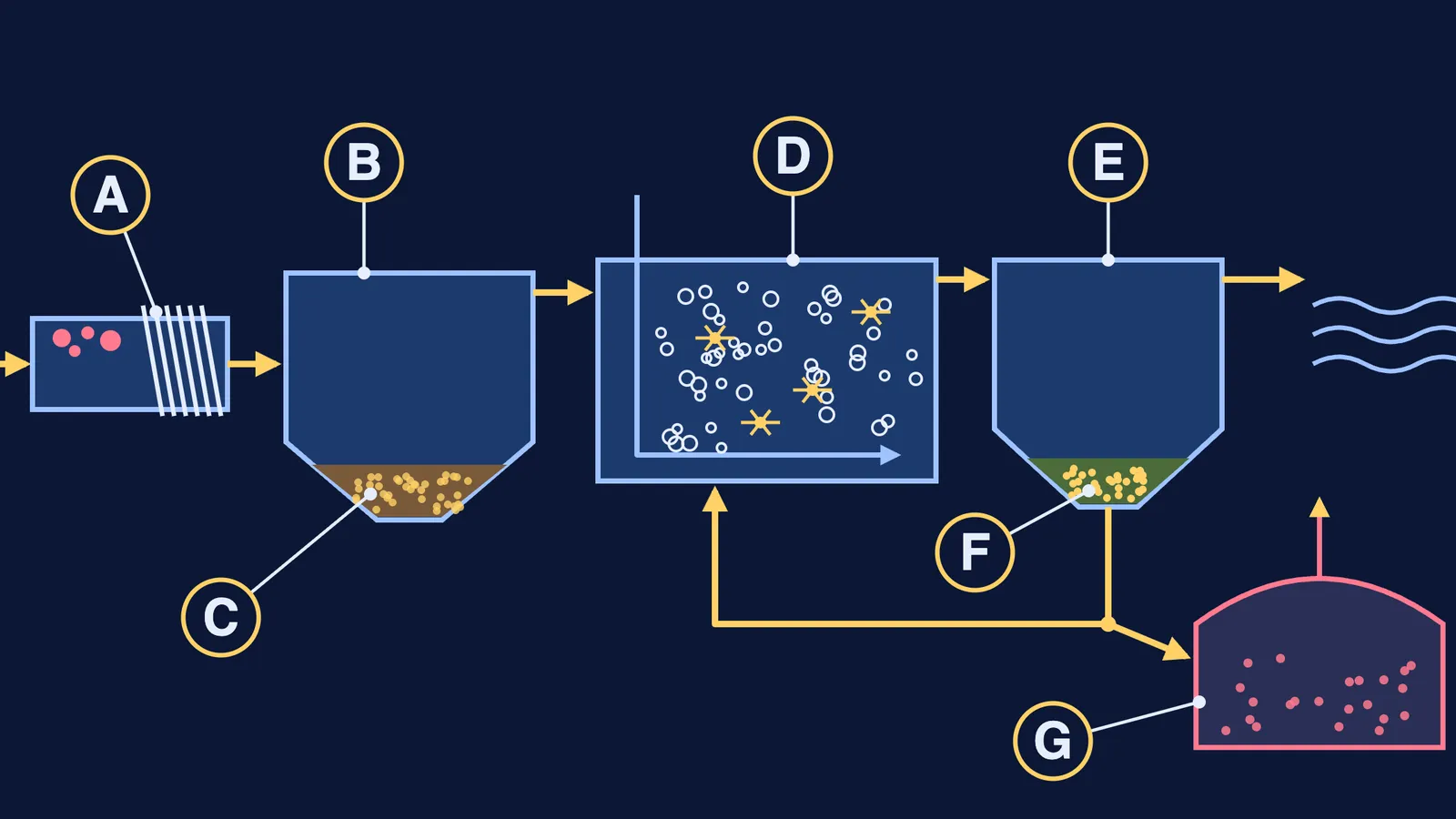
Microbes in Human Welfare, Chapter 8 of NCERT Class 12 Biology, has eight figures. The NMC's NEET (UG)-2026 syllabus lists the chapter's topics under Unit 8, Biology and Human Welfare. Q1 to Q6 below use the lettered sewage plant; Q7 to Q14 describe the biogas plant and other figures in words. All 14 are original.
Sewage and viruses are covered only as NCERT covers them; treat this as a study summary, not medical advice.
Where do you start on a lettered process diagram?
A plant drawn as boxes and arrows tests order more than names. Before the options:
Follow the main arrow from inlet to outlet and number the boxes.
A line that loops back usually carries something reused.
For each box, ask: physical work, or microbes, with or without air?
Find the stem's key verb (settle, aerate, digest) and the box that does it.
Two-statement items use this code: (1) only I holds (2) only II holds (3) both hold (4) neither holds.
Which sewage plant parts are A to G?
Reasons come from section 8.3 of NCERT Chapter 8.
Q1. Which lettered parts belong to primary, purely physical, treatment? (1) D and E (2) A, B and C (3) B, D and F (4) A and G
Answer: (2). Primary treatment is filtration and sedimentation.
Q2. In which part is the liquid stirred mechanically while air is pumped in? (1) B (2) E (3) G (4) D
Answer: (4). Aeration lets useful aerobic microbes grow into flocs.
Q3. Statement I: Grit and other solids settle at C, and the liquid above them moves on to D. Statement II: Material from C is pumped into D to act as the inoculum.
Answer: (1). The inoculum is part of the activated sludge, not primary sludge.
Q4. Match each letter with what happens there. List-I: (P) A (Q) D (R) F (S) G. List-II: (I) Anaerobic bacteria digest the sludge (II) Floating debris is taken out (III) Flocs consume most organic matter (IV) Settled flocs, partly sent back. (1) P-III, Q-II, R-IV, S-I (2) P-II, Q-III, R-I, S-IV (3) P-II, Q-III, R-IV, S-I (4) P-IV, Q-III, R-II, S-I
Answer: (3). Filtration, aeration, activated sludge, anaerobic digestion.
Q5. What happens to the effluent between entering D and leaving for E? (1) Its BOD rises because microbes multiply (2) Grit is removed (3) Methane builds up in it (4) Its BOD drops significantly
Answer: (4). Flocs consume organic matter, which BOD indirectly measures.
Q6. Statement I: Microbes in G release a mixture of methane, hydrogen sulphide and carbon dioxide. Statement II: That gas mixture is inflammable, so it can serve as a source of energy.
Answer: (3). NCERT calls the mixture biogas.
Answer key for the lettered diagram
A: sequential filtration of floating debris
B: primary settling tank (grit sedimentation)
C: primary sludge
D: aeration tank
E: settling tank
F: activated sludge
G: anaerobic sludge digester
Can you answer the other Chapter 8 figures from a description?
Reasons come from the text and captions of the NCERT chapter.
Q7. Figure 8.8 shows a tank of dung slurry with a cover resting on it, a pipe at the top and a second outlet. Why does the cover rise? (1) Gas made by microbial activity collects beneath it (2) Spent slurry swells as it dries (3) Air is pumped in under it (4) Rainwater raises the slurry level
Answer: (1). NCERT calls it a floating cover that keeps rising as gas forms.
Q8. Match each feature of the biogas plant with its job. List-I: (P) Concrete tank (Q) Outlet joined to a pipe (R) Floating cover (S) Second outlet. List-II: (I) Sends biogas to nearby houses (II) Removes spent slurry, usable as fertiliser (III) Holds the dung slurry (IV) Rises as gas forms. (1) P-III, Q-II, R-IV, S-I (2) P-IV, Q-I, R-III, S-II (3) P-I, Q-III, R-IV, S-II (4) P-III, Q-I, R-IV, S-II
Answer: (4). All from section 8.4.
Q9. Statement I: Biogas plants are built more often in cities, where dung is plentiful. Statement II: Cattle dung is rich in methanogens because these bacteria live in the rumen.
Answer: (2). NCERT says rural areas have the dung, so most plants are there.
Q10. Figure 8.5 is a photograph of a fermentation plant. Which product needs the fermented broth to be distilled? (1) Beer (2) Wine (3) Rum (4) Curd
Answer: (3). Whisky, brandy and rum are distilled; wine and beer are not.
Q11. Figure 8.1 shows rod-shaped and spherical bacteria at 1500X and one rod-shaped bacterium at 50,000X. What does the high-magnification panel add? (1) Flagella (2) A protein coat (3) A colony (4) Spores
Answer: (1). The caption names a rod-shaped bacterium showing flagella.
Q12. Figure 8.2 has three viruses. Which statement matches its caption? (1) The adenovirus is rod-shaped (2) Tobacco Mosaic Virus is rod-shaped (3) The bacteriophage causes respiratory infections (4) All three are magnified 1500X
Answer: (2). All are magnified about 1,00,000 to 1,50,000X.
Q13. Statement I: Figure 8.3 shows viruses growing as colonies on a nutritive medium. Statement II: The fermentors in Figure 8.4 are small flasks used for home fermentation.
Answer: (4). Figure 8.3 shows bacterial and fungal colonies; fermentors are very large vessels.
Q14. Figure 8.7 is an aerial view of a sewage plant. Which line about such plants matches NCERT? (1) Microbial sewage treatment has been practised for over a century (2) Plants rely on chemical oxidation, not microbes (3) A man-made technology now does better (4) Untreated sewage never reaches rivers
Answer: (1). NCERT adds that no man-made technology has rivalled it.
How should you follow up on this set?
Sketch the plant from memory, name each part and compare with the key.
Sort misses into flow errors and fact gaps; fix fact gaps from NCERT sections 8.3 and 8.4.
Then try the chapter's statement and match-the-list questions, the eight graded NEET MCQs with solutions and the key terms list for this chapter.
Still mixing up primary sludge and activated sludge? Fermi's AI tutor works out what you already know and builds a plan for the session.