On this page
A badminton player lands hundreds of times in a match, often on one foot after a jump smash. On bare concrete each landing would stop the body over a distance of almost nothing, and the force would be large. A sports floor is built to give a little. How much it gives is not left to feel: labs drop a weight on it with a machine called the artificial athlete and report a single number, the force reduction. The physics behind that number is a mass dropped onto two springs in series.
What is the artificial athlete test?
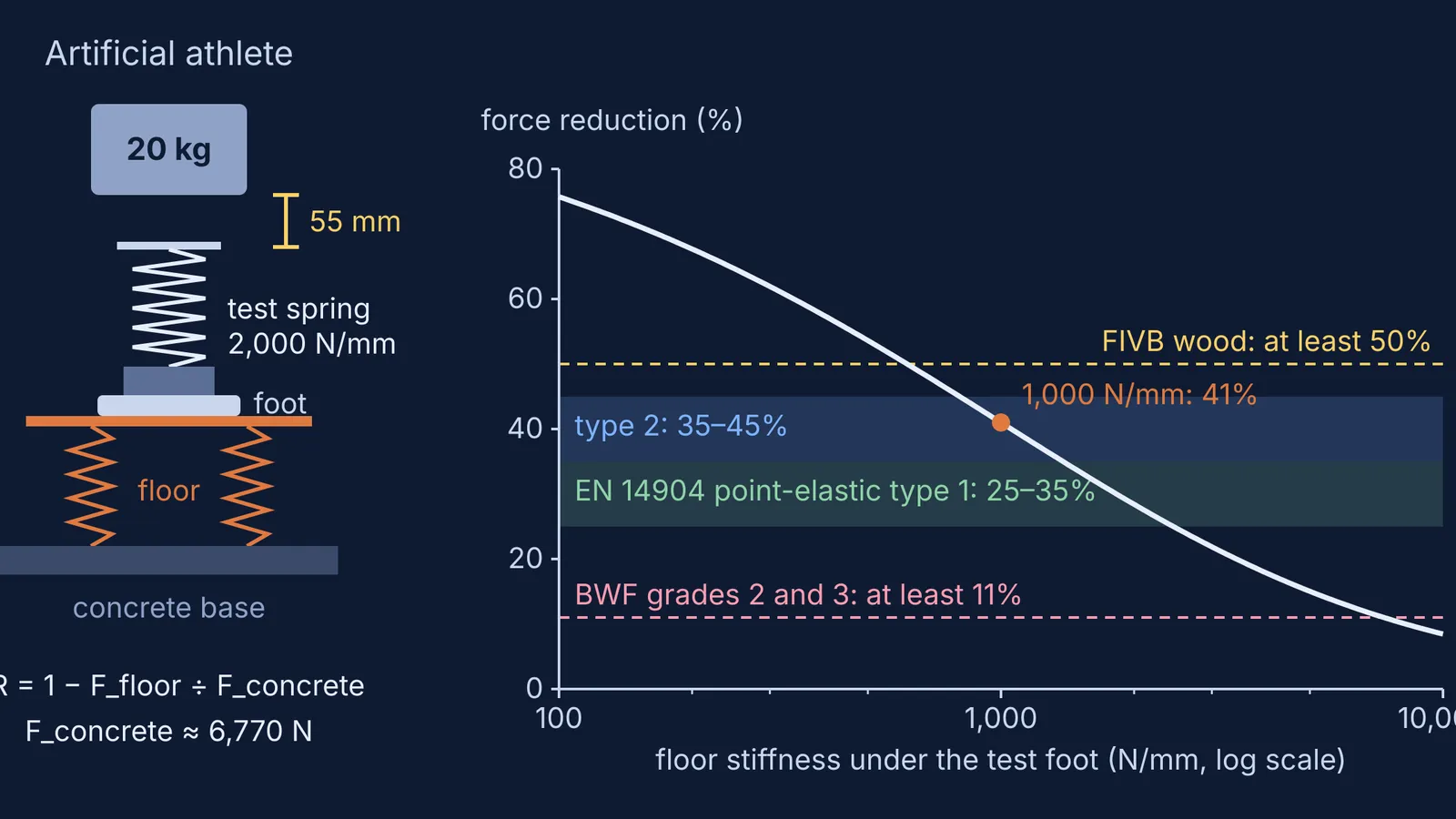
The test method is EN 14808, and EN 14904, the European standard for indoor multi-sports floors, uses it to judge shock absorption. A 20 kg mass is released from 55 mm above a stiff steel spring. The spring sits on a load cell and a 3 kg test foot that rests on the floor. The load cell records the peak force.
The figures come from two sources. A 2008 ISBS conference paper by Nunome and co-workers describes the test as "a 20 kg mass is released from 55 mm height onto a load cell with spring on the top". A presentation by Hans Kolitzus of the Institut für Sportbodentechnik, hosted by the International Association for Sports Surface Sciences, gives the spring rate as 2,000 ± 60 N/mm for EN 14808 and lists the reference peak force on a concrete base for the EN 14808 method as 6.60 ± 0.25 kN.
Force reduction compares the two peaks:
FR = 1 − F_floor ÷ F_concrete
A floor with FR = 40% lets through 60% of the peak force that concrete would.
How big is the force on concrete?
On concrete only the test spring gives, so this is the problem worked in a mass dropped onto a spring. The mass falls h, then compresses the spring by x before stopping:
mg(h + x) = ½kx²
At the lowest point the spring force is F = kx. Substituting x = F/k and solving the quadratic for F gives
F = mg + √((mg)² + 2mghk)
With m = 20 kg, g = 9.81 m/s², h = 0.055 m and k = 2.0 × 10⁶ N/m:
mg = 196.2 N.
2mghk = 2 × 196.2 × 0.055 × 2.0 × 10⁶ = 4.32 × 10⁷ N².
√(196.2² + 4.32 × 10⁷) = √(4.32 × 10⁷) ≈ 6,573 N.
F = 196 + 6,573 ≈ 6,770 N, with the spring squeezed by 3.4 mm.
That sits inside the 6.60 ± 0.25 kN reference band above. The ideal spring model lands close to the real calibration.
Why does a giving floor lower the peak force?
On a sports floor the test spring and the floor both compress. They carry the same force, one on top of the other, so they act as springs in series:
k = k_s k_f ÷ (k_s + k_f)
where k_s is the test spring and k_f is the floor's stiffness under the test foot. A softer combination stops roughly the same energy, about 10.8 J (mgh), over a longer distance, so the peak force falls. It is the same idea as a bike helmet spreading an impact over more distance.
How do you find the force reduction of a floor?
Treat this as a JEE-style springs-in-series problem. Take a floor that behaves as a light spring of 1,000 N/mm.
Combined stiffness. k = (2,000 × 1,000) ÷ (2,000 + 1,000) = 667 N/mm = 6.67 × 10⁵ N/m.
Peak force. 2mghk = 2 × 196.2 × 0.055 × 6.67 × 10⁵ = 1.44 × 10⁷ N². F = 196 + √(196.2² + 1.44 × 10⁷) ≈ 196 + 3,798 = 3,990 N.
Force reduction. FR = 1 − 3,990 ÷ 6,770 = 41.0%.
How far each spring gives. Same force in series: the floor moves 3,990 ÷ 1,000 = 4.0 mm and the test spring 2.0 mm.
Other floors, same method:
5,000 N/mm: 5,750 N, FR = 15.0%, floor gives 1.2 mm.
2,000 N/mm: 4,850 N, FR = 28.4%, floor gives 2.4 mm.
400 N/mm: 2,890 N, FR = 57.4%, floor gives 7.2 mm.
Working backwards, FR = 25% needs a floor no stiffer than about 2,450 N/mm (it gives 2.1 mm in the test), 40% needs 1,055 N/mm (3.9 mm) and 55% needs 461 N/mm (6.6 mm). These deflections are model values in this test. The standards' separate "vertical deformation" measurement uses a different rig.
What force reduction do badminton floors need?
Federations set their requirements in terms of EN 14904 results. A BWF equipment approval certificate for a wooden floor lists the BWF grades. Grade 1 (International Elite) needs EN 14904 friction, shock absorption and vertical deformation plus a BWF referee's inspection report. Grades 2 and 3 require shock absorption of at least 11%.
The FIVB's testing protocol for sport floors asks for at least 50% on wooden floors and 45% on synthetic ones. It notes that EN 14904 allows point-elastic synthetic floors a range of 25 to 35% for type 1 and 35 to 45% for type 2. So the standard has upper limits as well as lower ones. In the spring picture, a floor that is too soft also gives way under the player's push-off and stores energy that is not all returned, so softer is not always better.
In the spring model, 11% needs a floor of about 7,350 N/mm, 25% needs 2,450 N/mm and 50% needs 613 N/mm.
Keep two limits of the model in mind. Real floors have mass and damping, so lab results differ from this light-spring picture. And force reduction describes the floor and test rig. It is not by itself a measure of injury risk.
For more energy-and-spring problems like this, the Fermi Problem Library has a step-by-step solver that explains the reasoning. For a full plan, Fermi Test Prep offers personalised preparation for JEE Main & Advanced with an AI tutor, live classes, adaptive mocks, mentorship and a study plan that updates based on mastery.
Quick checklist
Artificial athlete: 20 kg dropped 55 mm onto a 2,000 N/mm spring on a test foot.
Peak force: F = mg + √((mg)² + 2mghk); about 6,770 N on concrete.
Floor and test spring act in series: k = k_s k_f ÷ (k_s + k_f).
FR = 1 − F_floor ÷ F_concrete; a 1,000 N/mm floor gives 41%.
BWF grades 2 and 3 need at least 11%; FIVB wants 50% for wood.
Standards cap force reduction too: softer is not always better.