On this page
The NMC's NEET (UG) 2026 syllabus places Human Reproduction in Unit 6, Reproduction. Every rule and exception comes from Chapter 2 of NCERT's Class 12 Biology textbook (Reprint 2026-27), with its section ("opening" is the text before 2.1). All 12 questions are original. Pregnancy, menstruation and lactation appear only as NCERT describes them; read this as a study summary, not medical advice.
What are the NCERT exceptions in Human Reproduction?
Sperm formation continues even in old men. Exception: in women, ovum formation ceases around the age of fifty (opening).
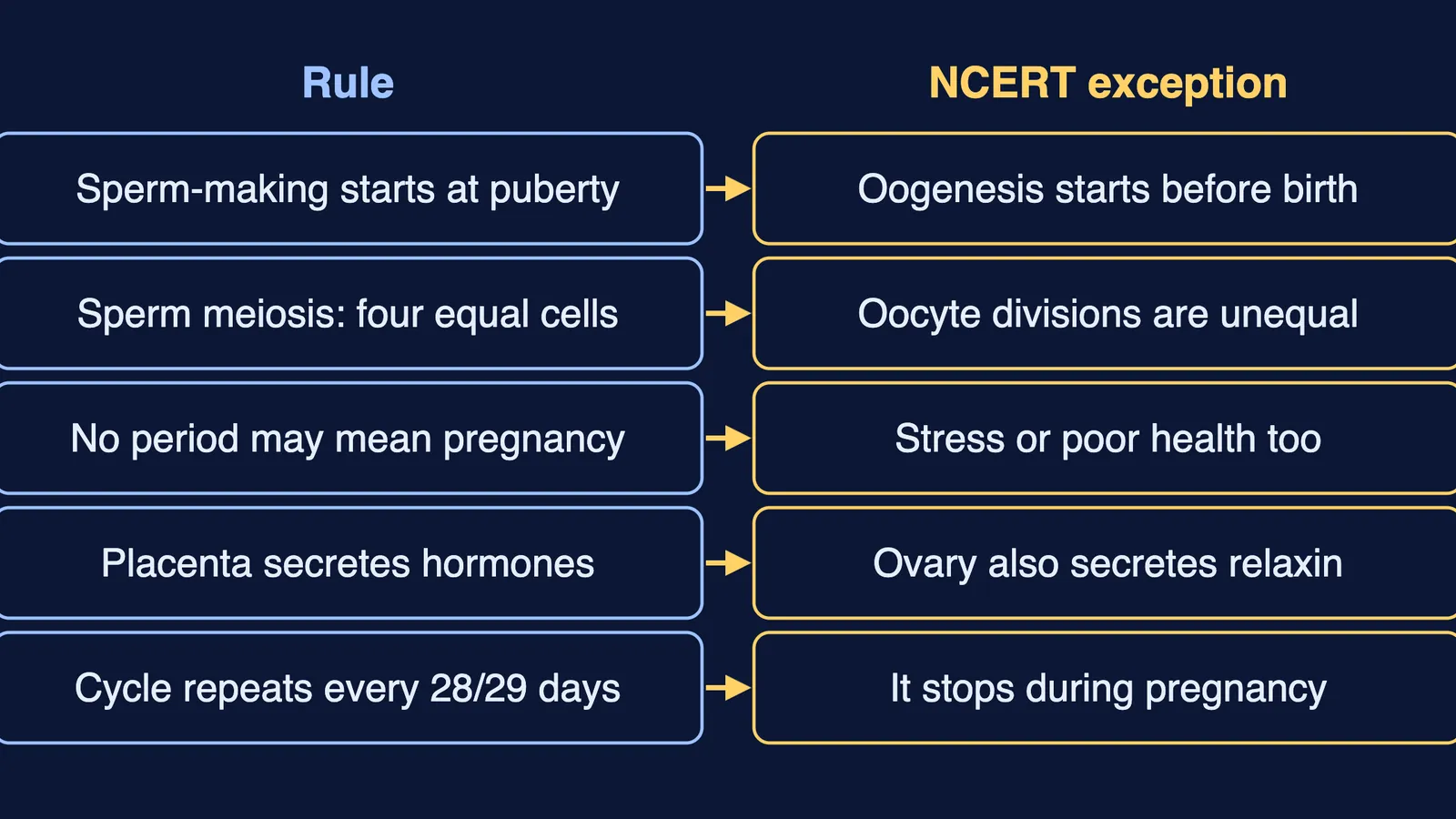
Spermatogenesis begins at puberty. Exception: oogenesis starts in the fetal ovary, and no oogonia are added after birth (2.3).
A primary spermatocyte's two meiotic divisions give four equal haploid spermatids. Exception: both meiotic divisions in oogenesis are unequal, each leaving a polar body (2.3, 2.5).
A primary spermatocyte completes its first meiotic division. Exception: a primary oocyte is temporarily arrested in prophase I and completes that division only in the tertiary follicle (2.3).
Each secondary spermatocyte goes through meiosis II to give spermatids. Exception: the secondary oocyte completes it only when a sperm's entry induces it (2.5).
NCERT notes the hymen often tears at first coitus. Exception: a fall, a tampon or sports such as cycling can also break it, and in some women it persists after coitus (2.2).
Menstruation repeats about every 28/29 days. Exception: during pregnancy all cycle events stop (2.4).
Lack of menstruation may indicate pregnancy. Exception: it may also be caused by stress, poor health and similar causes (2.4).
During pregnancy the placenta acts as an endocrine tissue, producing hCG, hPL, estrogens and progestogens. Exception: in the later phase of pregnancy, relaxin is also secreted by the ovary (2.6).
Estrogens, progestogens, cortisol, prolactin and thyroxine rise severalfold during pregnancy. Exception: women make hCG, hPL and relaxin only in pregnancy (2.6).
All ova carry the sex chromosome X. Exception: half of all sperms carry X and half carry Y (2.5).
How do you handle odd-one-out and exception questions?
Write the basis in the margin first: timing, source, size, chromosome or function. Judge each option on that basis alone; two crosses means you drifted, so reread the stem. In a "NOT an exception" item, pick the option that quietly obeys the rule.
Odd-one-out questions
Q1. Judged by whether NCERT lists it as a role of the placenta, which is the odd one out? (1) Supplying oxygen and nutrients to the embryo (2) Removing carbon dioxide and excretory wastes (3) Producing hCG and hPL (4) Producing milk
Answer: (4). NCERT credits milk production (lactation) to the mammary glands (2.6, 2.7).
Q2. Judged by when in life NCERT says it begins, which is the odd one out? (1) Menarche (2) Spermatogenesis (3) Formation of oogonia (4) The rise in GnRH that drives spermatogenesis
Answer: (3). The others begin at puberty; oogonia form in the fetal ovary (2.3, 2.4).
Q3. Judged by whether NCERT calls its secretion essential for the maturation and motility of sperms, which is the odd one out? (1) Bulbourethral glands (2) Epididymis (3) Vas deferens (4) Seminal vesicle
Answer: (1). NCERT's list is epididymis, vas deferens, seminal vesicle and prostate; bulbourethral secretion is linked to lubrication (2.1, 2.3).
Q4. Judged by whether NCERT names it as a possible reason for a lack of menstruation, which is the odd one out? (1) Pregnancy (2) Stress (3) Poor health (4) Menarche
Answer: (4). Menarche is the first menstruation, at puberty (2.4).
Which is NOT an exception?
Q5. Rule: gamete formation starts at puberty and then continues through adult life. Which case is NOT an exception NCERT states? (1) Sperm formation in old men (2) Oogonia forming before birth (3) Ovum formation ceasing around fifty (4) All events of the menstrual cycle stopping during pregnancy
Answer: (1). That follows the rule (opening, 2.3, 2.4).
Q6. Rule: menstruation recurs about every 28/29 days. Which is NOT a break in this pattern that NCERT states? (1) No menstruation before menarche at puberty (2) Cycles ceasing around 50 years of age (3) No menstruation during pregnancy (4) Ovulation after the mid-cycle LH surge
Answer: (4). Ovulation is a normal event of each cycle (2.4).
Two-statement and single-correct questions
Codes for Q7 to Q9: (1) Both correct (2) Only I correct (3) Only II correct (4) Neither correct.
Q7. I: Androgens maintain the functions of the male sex accessory ducts and glands. II: The mammary glands begin producing milk only after the baby is delivered.
Answer: (2). Milk production starts towards the end of pregnancy (2.3, 2.7).
Q8. I: After spermiogenesis, sperm heads lie embedded in Sertoli cells until spermiation releases them. II: Colostrum, the milk of the first few days of lactation, contains several antibodies.
Answer: (1). Both match 2.3 and 2.7.
Q9. I: Menstruation takes place even when the released ovum is fertilised. II: Cyclic menstruation is an indicator of the normal reproductive phase.
Answer: (3). Menstruation occurs only if the ovum is not fertilised (2.4).
Q10. Which rule-exception pair matches NCERT? (1) Ovum formation goes on into old age; sperm formation stops around fifty (2) Ova carry X or Y; sperms all carry X (3) Spermatocyte meiosis gives equal cells; both oogenesis divisions are unequal (4) Cycles repeat every 28/29 days; they continue through pregnancy
Answer: (3). Options 1 and 2 swap the sexes; cycles stop in pregnancy (opening, 2.3 to 2.5).
Q11. Which feature-group pairing does NCERT give? (1) Menstrual cycle: all female mammals (2) Functional mammary gland: all female mammals (3) Functional mammary gland: female primates only (4) Menstrual cycle: humans only
Answer: (2). The menstrual cycle is the female primate cycle: monkeys, apes, humans (2.2, 2.4).
Q12. Which cells does NCERT say can give rise to all tissues and organs? (1) Certain cells in the inner cell mass (2) Trophoblast cells (3) Chorionic villi (4) Sertoli cells
Answer: (1). These are stem cells (2.6).
What should you do with your misses?
Missed Q2 or Q5: redraw the oogenesis timeline. Missed Q4, Q6 or Q9: reread 2.4; Q1, Q7 or Q8: 2.6 and 2.7. For other formats, try our statement and match-the-list questions on human reproduction, the human reproduction diagram-based questions or the solved human reproduction NEET practice questions.
Which exception keeps slipping away from you? Fermi's AI tutor works out what you already know and builds a plan for the session.