On this page
Every NCERT student learns that cold, dilute potassium permanganate, Baeyer's reagent, loses its purple colour when it meets a C=C bond and turns an alkene into a vicinal glycol. The chemist who reported that reaction as a way of making glycols was G. Wagner, in a paper in the Berichte of 1888. The same paper holds a fact you still need for the exam: cyclopropane, which has the same formula as propene, is not touched by permanganate. This post rests on the English abstract of Wagner's paper printed in the Journal of the Chemical Society, not on the German original, and every quote below comes from that abstract.
Who was G. Wagner?
The abstract gives only "G. Wagner" and the reference: Berichte, volume 21, pages 1230–1240 (DOI 10.1002/cber.188802101235). He is usually identified with the Russian chemist Yegor (Georg) Yegorovich Wagner. The historian David Lewis, in his paper "Feuding rule makers", lists an "E. E. Vagner (1849-1903)" as a student of Alexander Zaitsev at Kazan. We have not checked in a primary source that these are the same man, so treat the biography as unverified. Zaitsev himself is covered in how Zaitsev predicted the major alkene in 1875.
What did Wagner's 1888 paper report?
The abstract, signed F. S. K., is on pages 665–666 of the Journal of the Chemical Society Abstracts for 1888. Its opening sentence is the whole method:
"Olefines yield the corresponding glycols, and alcohols of the allyl alcohol series yield glycerols when oxidised with potassium permanganate in neutral, aqueous solution."
The other points, in order:
The yield of glycol is "about 50 per cent.", and that of glycerol "in some cases about 80 per cent." of the theoretical quantity.
Isobutylene gives its glycol, but part of it is oxidised further to hydroxyisobutyric acid, which breaks down to acetone and formic acid.
"Ethylene yields the glycol and formic acid."
Trimethylethylene made from tertiary amyl iodide gives two different glycols.
"Trimethylene is not oxidised by potassium permanganate, but diallyl yields a tetrahydroxy-alcohol, and pinene yields a dihydroxy-alcohol."
Trimethylene is the old name for cyclopropane. Notice what the abstract does not say: it gives no temperature and no concentration, only "neutral, aqueous". The words "cold, dilute" are the textbook condition, and the abstract alone does not tell us whether Wagner worked that way.
Why does the test use cold, dilute permanganate?
Wagner's own side products give the reason. A glycol can be oxidised further, and his isobutylene and ethylene runs already lost some product to acids. A cold, dilute solution stops the reaction at the glycol. Hot or concentrated permanganate cuts the carbon chain, as explained in cold dilute versus hot KMnO₄ with alkenes.
The balanced equation for ethene is:
3CH₂=CH₂ + 2KMnO₄ + 4H₂O → 3HOCH₂CH₂OH + 2MnO₂ + 2KOH
Check it: 6 C, 20 H, 12 O, 2 K and 2 Mn on each side. The electrons agree too. Each manganese goes from +7 to +4 and gains 3 electrons. Each alkene carbon goes from −2 to −1, so one C=C loses 2 electrons. Three alkenes (6 electrons) match two permanganates (6 electrons). That is the n-factor of 3 for permanganate in neutral medium.
The equation also explains a small puzzle. Wagner started in neutral solution; textbooks say "alkaline". The reaction makes KOH, so a neutral solution turns alkaline as it goes, and the brown MnO₂ is what you see settle out.
How does permanganate tell propene from cyclopropane?
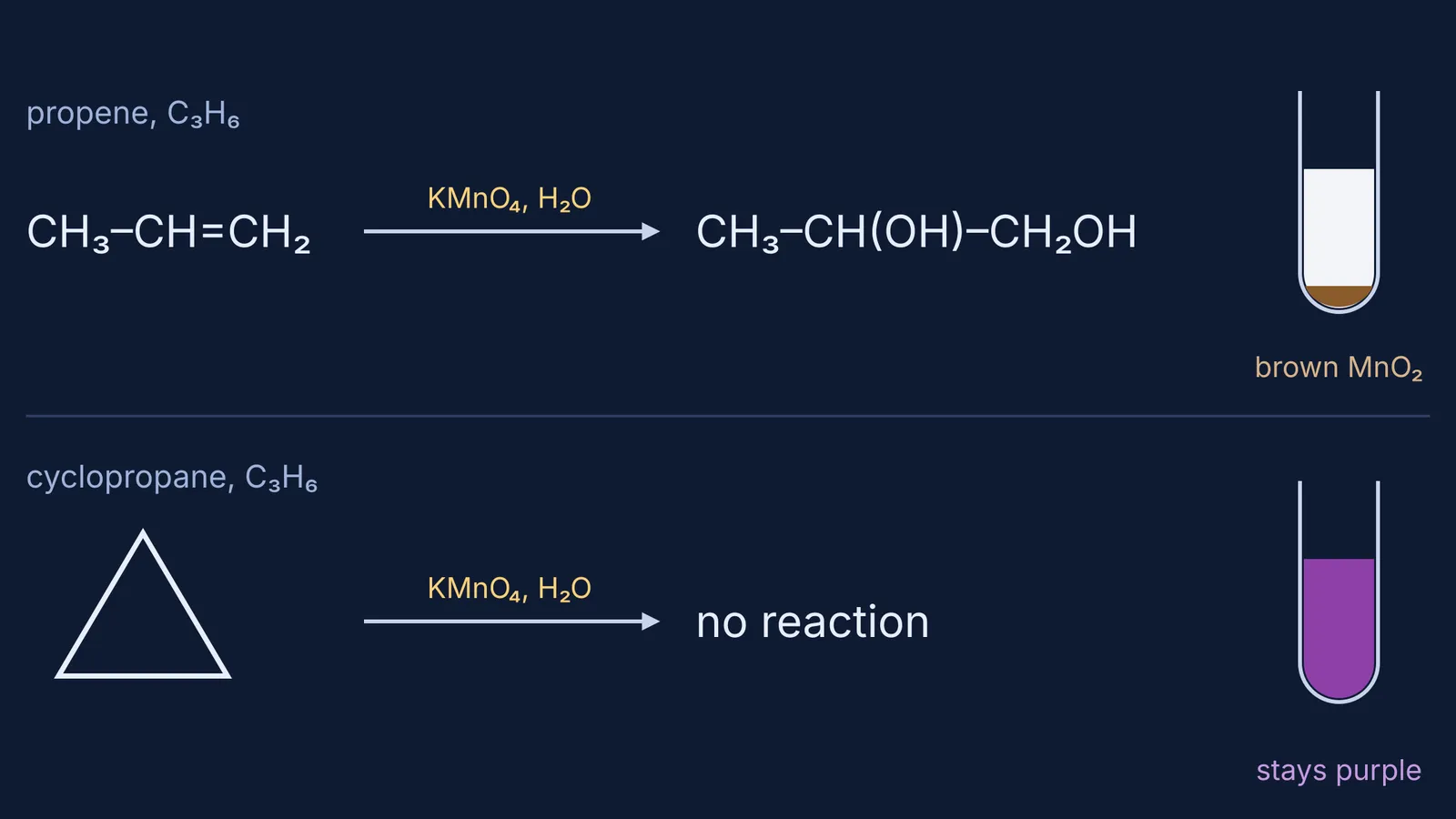
Propene and cyclopropane are both C₃H₆, and both have one degree of unsaturation. One has a C=C bond; the other has a ring. Wagner's line "Trimethylene is not oxidised by potassium permanganate" is the basis of a standard exam question:
Propene decolourises cold, dilute KMnO₄ and gives a brown precipitate. The product is propane-1,2-diol: 3C₃H₆ + 2KMnO₄ + 4H₂O → 3CH₃CH(OH)CH₂OH + 2MnO₂ + 2KOH. That balances with 9 C, 26 H and 12 O on each side.
Cyclopropane leaves the purple colour unchanged.
So the test detects the double bond, not the formula. A ring counts as a degree of unsaturation but does not react here. If a question also asks about the shape of the diol from a cis or trans alkene, that is covered in why OsO₄ gives cis diols; cold permanganate adds both OH groups to the same face in the same way.
Worked example: how much glycol and how much reagent?
Question. (a) 5.00 g of ethene is oxidised by permanganate as above. What mass of KMnO₄ is needed, what mass of glycol forms in theory, and how much would you expect at Wagner's "about 50 per cent" yield? (b) 0.300 mmol of an unknown C₃H₆ gas is bubbled through 10.0 mL of 0.0200 M KMnO₄. The purple colour just disappears. Which isomer was it?
Solution (a).
Molar masses: C₂H₄ = 28.05, KMnO₄ = 158.03, C₂H₆O₂ = 62.07 and MnO₂ = 86.94 g mol⁻¹.
Moles of ethene = 5.00 ÷ 28.05 = 0.178 mol.
KMnO₄ = 2/3 × 0.178 = 0.119 mol = 18.8 g.
Glycol in theory = 0.178 mol × 62.07 = 11.1 g.
At about 50% yield, you get about 5.5 g. The brown solid is 0.119 mol × 86.94 = 10.3 g of MnO₂.
Solution (b).
KMnO₄ present = 10.0 mL × 0.0200 M = 0.200 mmol.
One alkene needs 2/3 of a permanganate, so 0.300 mmol of alkene needs exactly 0.200 mmol.
The colour went, so the gas is propene. Cyclopropane would have left the solution purple. The precipitate is 0.200 mmol × 86.94 = 17.4 mg of MnO₂.
For JEE Main and Advanced preparation, Fermi Test Prep has practice on reagent tests and redox stoichiometry like this.
What did tertiary amyl iodide reveal?
Wagner made "trimethylethylene" (2-methylbut-2-ene) by treating the iodide of tertiary amyl alcohol, 2-iodo-2-methylbutane, with alcoholic potash. The abstract says the oxidation gave "a mixture of trimethylethylene glycol" and a second glycol, "which shows that two olefines are produced by acting on the tertiary iodide with alcoholic potash".
The logic is neat. Each alkene gives its own glycol, so two glycols mean two alkenes:
2-methylbut-2-ene, (CH₃)₂C=CHCH₃, gives 2-methylbutane-2,3-diol.
2-methylbut-1-ene, CH₂=C(CH₃)CH₂CH₃, gives 2-methylbutane-1,2-diol.
The abstract names the second glycol "unsymmetrical methylethylene glycol", which looks like a shortened name. 2-methylbut-1-ene is the only other alkene this elimination can give, so its glycol is the one meant. This is the same substrate used to teach the Saytzeff rule: the more substituted alkene is the major product, but not the only one. The abstract does not give the proportions.
Quick checklist
Wagner (1888): olefines + permanganate in neutral, aqueous solution give glycols, in about 50% yield.
Over-oxidation of the glycol is why the test reagent is cold and dilute.
3 C=C : 2 KMnO₄, because MnO₄⁻ gains 3 electrons and each C=C loses 2.
KOH forms as the reaction runs, so the mixture turns alkaline.
Cyclopropane is not oxidised; propene is. Same formula, different result.
Two glycols from tertiary amyl iodide showed two alkenes had formed.
If you want more distinguishing-test practice, the Fermi Problem Library has a step-by-step solver that explains the reasoning.