On this page
Take a small speaker out of its box and play some music through it. The voices are still there, but the bass has almost gone. Hold it in a hole cut in a large sheet of cardboard and the bass comes back. What changed is whether sound from the back of the cone can reach the front. Engineers call it the acoustic short circuit, and you can work it out with the same path-difference rule you use for two-source interference.
Why does a speaker cone make two sounds?
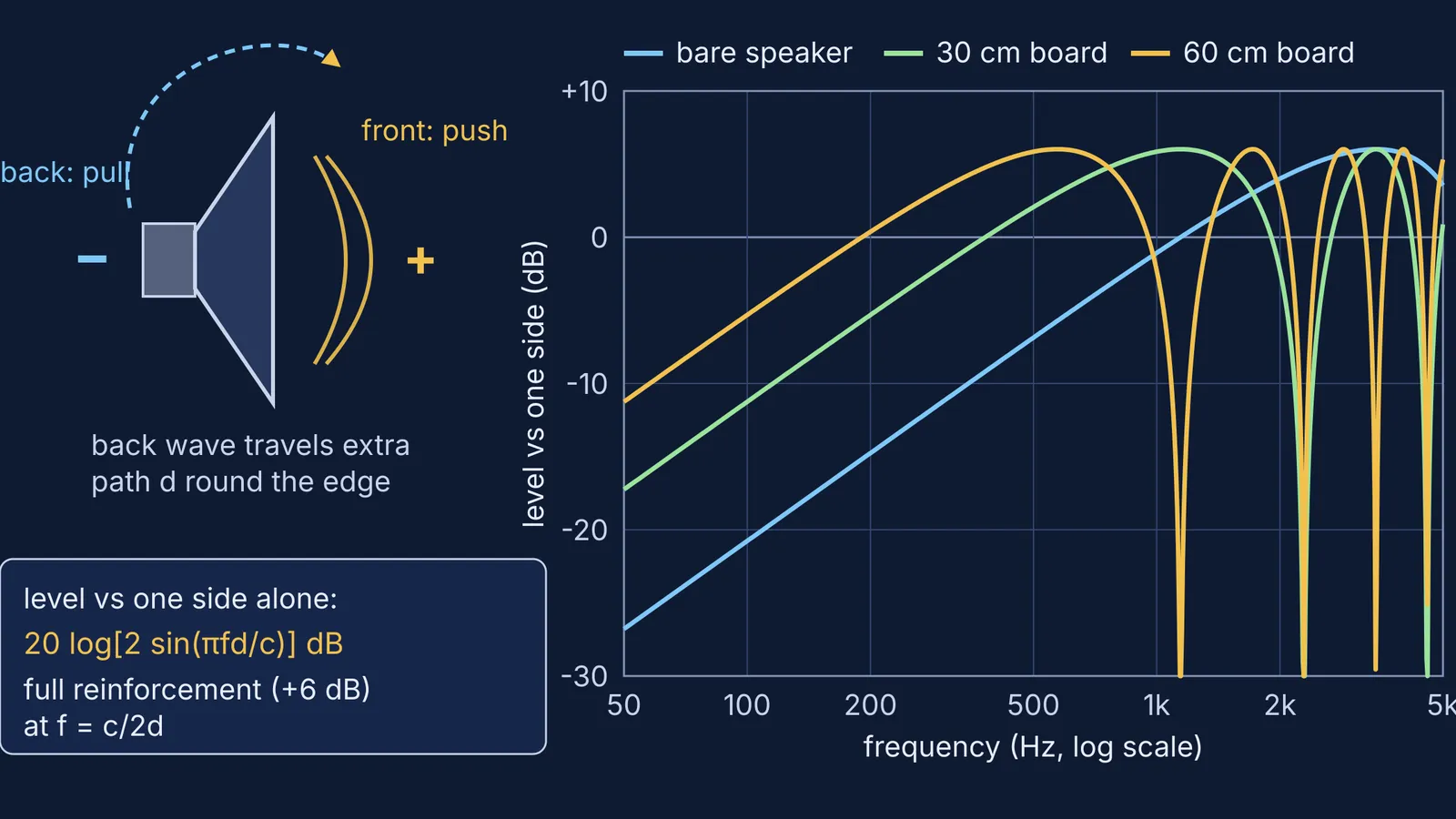
The cone of a speaker is a piston. The voice coil drives it forwards and backwards, as explained in how a speaker turns electricity into sound. When it moves forwards it squeezes the air in front (a compression) and, at the same instant, stretches the air behind (a rarefaction). When it moves back, the roles swap.
So a bare cone is two equal sources, front and back, always exactly opposite in phase: a phase difference of π is built in before any path difference is added.
You have met this situation before with two speakers, one wired the wrong way round, in two-speaker interference: where sound is loud or quiet. Here the "second speaker" is the back of the same cone, and it is always wired backwards.
How much does the back wave cancel the front?
Stand far away on the axis, straight in front. The back wave has to travel round the edge of the speaker to reach you, so it covers an extra distance d. Its phase lag from the path is 2πfd/c, on top of the built-in π.
Add two waves of equal amplitude A with total phase difference π + 2πfd/c. The resultant amplitude is 2A|sin(πfd/c)|. Compared with one side alone, the level in decibels is:
relative level = 20 log₁₀[2 sin(πfd/c)]
Loudspeaker designer Siegfried Linkwitz gives exactly this result for two opposite-phase sources a distance D apart, |H| = 2 sin(πfD/c) on the axis, in his notes on dipole models. Three things follow from it:
Low frequencies cancel. When d is much shorter than half a wavelength, sin x ≈ x, so the amplitude is about 2πfd/c, which is proportional to f. Halve the frequency and the pressure halves: the level falls by 6 dB for every octave down. Linkwitz describes this as the characteristic 6 dB per octave roll-off.
One frequency gets full reinforcement. When d is half a wavelength, f = c/2d, the path difference adds another π and the two waves arrive in phase: +6 dB, twice the pressure of one side.
Side-on there is nothing. Off the axis the path difference becomes d cos α. At 90° to the axis it is zero, so the opposite-phase waves cancel at every frequency. The pattern is a figure of eight, with nulls at ±90°, as the same Linkwitz page shows.
Worked example: a 10 cm speaker with and without a board
Take c = 343 m/s. For a bare 10 cm speaker, estimate the extra path round the rim as about half the width, d ≈ 5 cm. This is a rough estimate, since a real cone has depth and a frame.
Phase term at 100 Hz. πfd/c = π × 100 × 0.05/343 = 0.0458 rad.
Amplitude ratio. 2 sin(0.0458) = 0.0916. The two sides together give only about 9% of the pressure of one side alone.
Level. 20 log₁₀(0.0916) = −20.8 dB.
Other frequencies. The same steps give −14.8 dB at 200 Hz, −6.9 dB at 500 Hz and −1.1 dB at 1 kHz. Each octave down costs about 6 dB, as predicted.
Now mount the speaker in the middle of a 60 cm board, so the back wave must travel round the board: d ≈ 30 cm.
At 100 Hz. πfd/c = π × 100 × 0.30/343 = 0.275 rad, 2 sin(0.275) = 0.542, so the level is −5.3 dB. The board has recovered about 15 dB of bass.
Full reinforcement. f = c/2d = 343/(2 × 0.30) = 572 Hz, where the level is +6 dB.
Level with one side alone (0 dB). This needs 2 sin(πfd/c) = 1, so πfd/c = π/6, which gives f = c/6d = 191 Hz.
A 30 cm board (d ≈ 15 cm) gives −11.2 dB at 100 Hz. Above c/2d the curves swing up and down, with deep dips wherever d is a whole number of wavelengths.
How big would a board need to be for full bass?
Ask for 0 dB at 50 Hz. You need d = c/(6 × 50) = 1.14 m, so a board about 2.3 m wide. For full reinforcement at 50 Hz, d = c/(2 × 50) = 3.4 m, a board about 7 m wide. Neither fits in a living room.
That is why most speakers sit in a closed box. The box traps the back wave completely, so there is no second source to cancel the front. Phone speakers work the same way, with a small closed volume behind the diaphragm. The trapped air has a price: it acts as an extra spring behind the cone and raises the speaker's resonance, so a small box still limits the lowest note. Small speakers fall back on another trick, covered in why you hear a bass pitch that is not there.
What is the baffle step on a boxed speaker?
A box does not make the front of the cabinet infinite. At low frequencies, where the wavelength is much longer than the box, the sound spreads out in all directions. At high frequencies the front panel acts as a wall and the sound goes only forwards, into half the space. Driver maker Purifi explains in what is the baffle step that this raises the forward sound pressure by about 6 dB on average once the front panel is large compared with the wavelength. It is far gentler than the acoustic short circuit, which can cost 20 dB or more.
Where does the simple two-source model fail?
It assumes a small source, far away, on the axis. Close up or off the axis, the path differences change.
Edges diffract. Linkwitz notes that on a real open baffle, edge diffraction makes the low-frequency slope steeper than 6 dB per octave before the response levels out.
Half the board width is only an estimate of d. Edges at different distances smear out the dips.
For more path-and-phase problems like this one, the Fermi Problem Library has a step-by-step solver that explains the reasoning. For a complete plan, Fermi Test Prep offers personalised preparation for JEE Main & Advanced with an AI tutor, live classes, adaptive mocks, mentorship and a study plan that updates based on mastery.
Quick checklist
The front and back of a cone are two sources with a built-in phase difference of π.
On the axis, the level relative to one side is 20 log[2 sin(πfd/c)].
For d much less than λ/2, the bass falls by 6 dB per octave down.
Full reinforcement (+6 dB) comes at f = c/2d; level with one side alone at f = c/6d.
A bare 10 cm speaker is about 21 dB down at 100 Hz; a 60 cm board brings it to about −5 dB.
A closed box removes the back wave; the baffle step is a separate, smaller 6 dB effect.