On this page
Ring a friend on an ordinary landline and his voice still sounds like his voice. Yet the line throws away everything below about 300 Hz, and a man speaking at a typical pitch of around 120 Hz has his fundamental right in that discarded range. The sound that reaches your ear has no 120 Hz component at all. You still hear the low pitch. This is the missing fundamental, and the physics behind it is something you already know from Class 11 waves: harmonics, periodic sums and beats.
What frequencies does a telephone line actually carry?
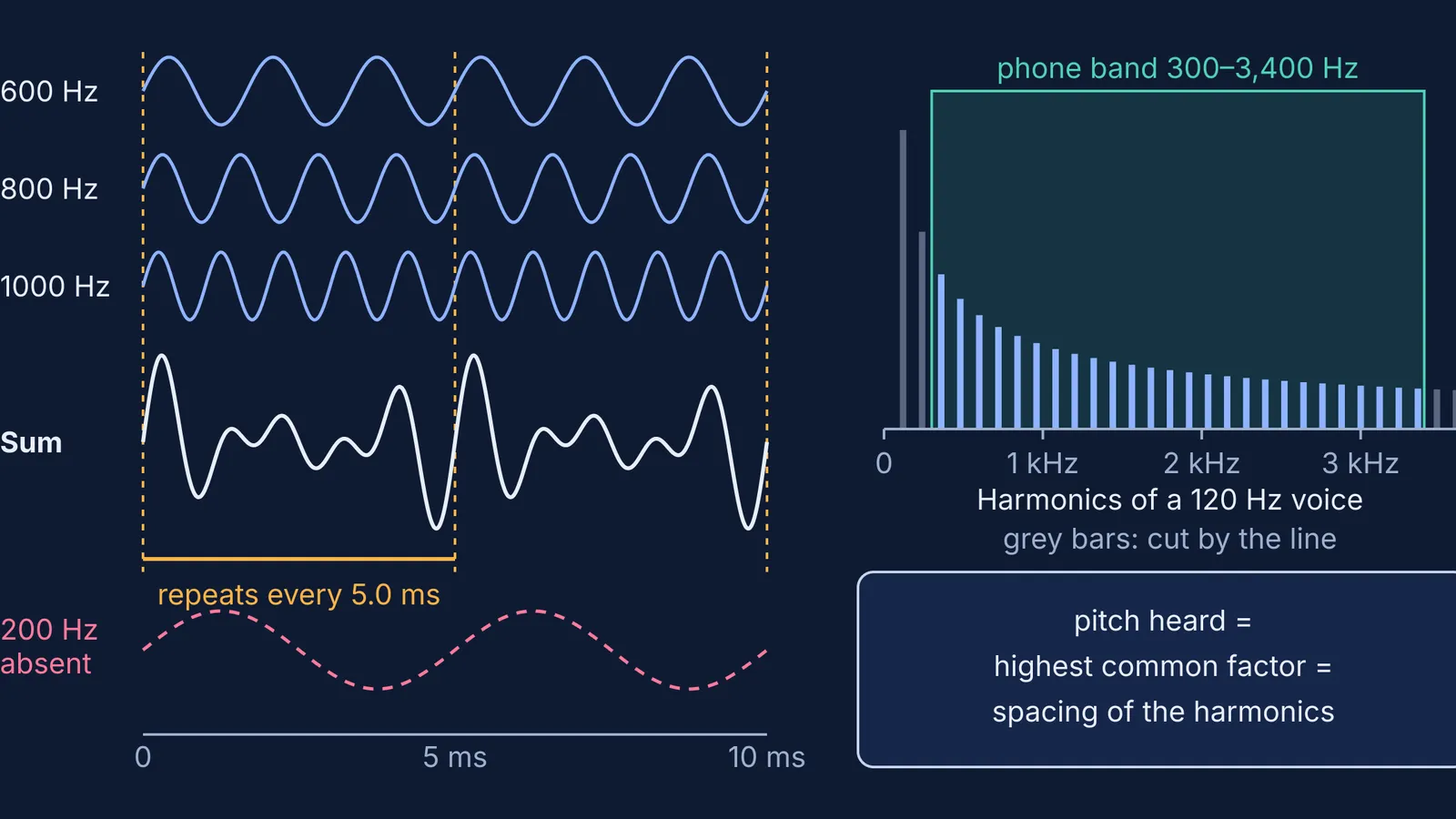
The classic narrowband telephone channel carries roughly 300 Hz to 3,400 Hz. The ITU-T, the international body that sets telecom standards, describes this as the telephone band (300–3400 Hz) in its Recommendation P.310 summary. The same band appears in the story of how Mihajlo Pupin used loading coils on telephone lines, where it set what the cable had to carry.
Newer systems can do more. Wideband coding such as ITU-T G.722 covers 50 to 7,000 Hz, and many modern calls use some form of wideband coding. But the old 300–3,400 Hz channel is still the standard case, and it is the one that makes the puzzle sharp.
Which harmonics of a 120 Hz voice get through?
A voiced sound such as a vowel is periodic. A periodic wave with fundamental f₀ is made of sine waves at f₀, 2f₀, 3f₀ and so on. That idea, and why the mix of harmonics gives each voice or instrument its colour, is covered in why two instruments sound different on the same note, so here we only count.
For f₀ = 120 Hz, the harmonics are 120, 240, 360, 480 Hz and upward in steps of 120 Hz.
The 1st harmonic (120 Hz) and the 2nd (240 Hz) are below 300 Hz. Both are cut.
The lowest that passes is the 3rd harmonic, 3 × 120 = 360 Hz.
The highest that passes is the 28th harmonic, 28 × 120 = 3,360 Hz. The 29th, at 3,480 Hz, is above 3,400 Hz.
That leaves 28 − 3 + 1 = 26 harmonics on the line, and none of them is at 120 Hz.
Why does the waveform still repeat at the missing frequency?
Every frequency that survives is a whole-number multiple of 120 Hz. A sine wave at n × 120 Hz completes exactly n cycles in 1/120 s. So after 1/120 s = 8.33 ms, every component is back where it started, and so is their sum. The waveform on the line still repeats every 8.33 ms, the period of the fundamental that is not there.
Put generally: if a set of frequencies has a highest common factor f, their sum repeats with period 1/f, whether or not a component at f is present. Removing the fundamental changes the shape of each cycle but not how often the cycles repeat.
The repetition is physics. Hearing it as a pitch is a property of the ear and brain, so the careful way to say it is that the perceived pitch follows the repetition rate. Your auditory system tracks how often the pattern comes round, not just which single frequency is loudest.
Worked example: three tones with no 200 Hz in them
Play three pure tones together at 600 Hz, 800 Hz and 1,000 Hz. What period does the sum have, and what pitch do listeners hear?
Find the highest common factor. 600 = 3 × 200, 800 = 4 × 200 and 1,000 = 5 × 200. No larger number divides all three, so the HCF is 200 Hz.
Read them as harmonics. The tones are the 3rd, 4th and 5th harmonics of 200 Hz. The 1st and 2nd harmonics (200 Hz and 400 Hz) are absent.
Find the period of the sum. In 1/200 s, the tones complete 3, 4 and 5 whole cycles. So the sum repeats every 1/200 s = 5.0 ms.
Check with beats. Neighbouring tones beat at 800 − 600 = 200 Hz and 1,000 − 800 = 200 Hz. The beat frequency f₁ − f₂ equals the spacing of the harmonics, and it gives the same 200 Hz. The beat idea itself is worked in beats in a simulation with two close notes.
Pitch heard. Listeners hear a pitch of about 200 Hz, even though no 200 Hz component exists. Check units: Hz is s⁻¹, and 1/(200 s⁻¹) = 0.005 s = 5.0 ms.
Apply the same steps to the phone call. The surviving harmonics run from 360 Hz to 3,360 Hz in steps of 120 Hz. Their HCF and their spacing are both 120 Hz, the period is 8.33 ms, and you hear your friend at about 120 Hz.
If you want more problems on harmonics and beats with each step explained, try the Fermi Problem Library, a step-by-step solver that explains the reasoning.
Does the rule always work?
It works cleanly when the tones are true harmonics of one frequency. Shift all three tones up by 50 Hz to 650, 850 and 1,050 Hz and the arithmetic changes: the HCF drops to 50 Hz, so the exact sum now repeats only every 20 ms. Listeners do not hear 50 Hz. They hear a pitch near 200 Hz, moved slightly from it, because the spacing between the tones is still 200 Hz. Working out exactly where that pitch lands is a question for psychoacoustics, the study of how we perceive sound, and goes beyond JEE and NEET.
So keep two statements apart:
The period of a sum of harmonics is 1/HCF. This is exact physics.
The perceived pitch usually matches that rate for harmonic sounds. This is about hearing.
Where else does the missing fundamental show up?
Small speakers. A phone or laptop speaker is too small to radiate much at 50–80 Hz. The higher harmonics of a bass note still come out, and they repeat at the bass note's rate, so you can follow a bass line that the speaker cannot really produce. Some audio processing adds extra harmonics on purpose for this reason.
Voices on old lines and radio. Any channel that cuts the low end leaves voices recognisable for the same reason.
Exam problems. Questions that give a set of resonant frequencies, such as 450, 750 and 1,050 Hz for a pipe, ask you to find the fundamental from their spacing or HCF. That is the same reasoning: the HCF of 450, 750 and 1,050 is 150 Hz, and these are the 3rd, 5th and 7th harmonics, which tells you the pipe is closed at one end.
To see how a waveform's shape changes as you add or remove harmonics while its repeat time stays fixed, the Simulation Lab has interactive simulations of waves and sound.
Quick checklist
A periodic sound with fundamental f₀ contains f₀, 2f₀, 3f₀ and so on.
A 300–3,400 Hz phone line passes the 3rd to the 28th harmonics of a 120 Hz voice: 26 of them.
The sum of harmonics repeats every 1/HCF, even with the fundamental removed.
600, 800 and 1,000 Hz have HCF 200 Hz, period 5.0 ms and beat frequency 200 Hz.
The waveform period is physics; the perceived pitch is the ear and brain following it.
For non-harmonic tones the simple HCF rule fails; that belongs to psychoacoustics.