

On this page
Play two notes that are almost, but not quite, the same pitch and you hear a slow wah-wah-wah. That throb is called beats. It is one of the easiest wave ideas to test yourself, because you can predict the beat rate before you press play, then check it by ear or on a graph.
What is the beat frequency of two close notes?
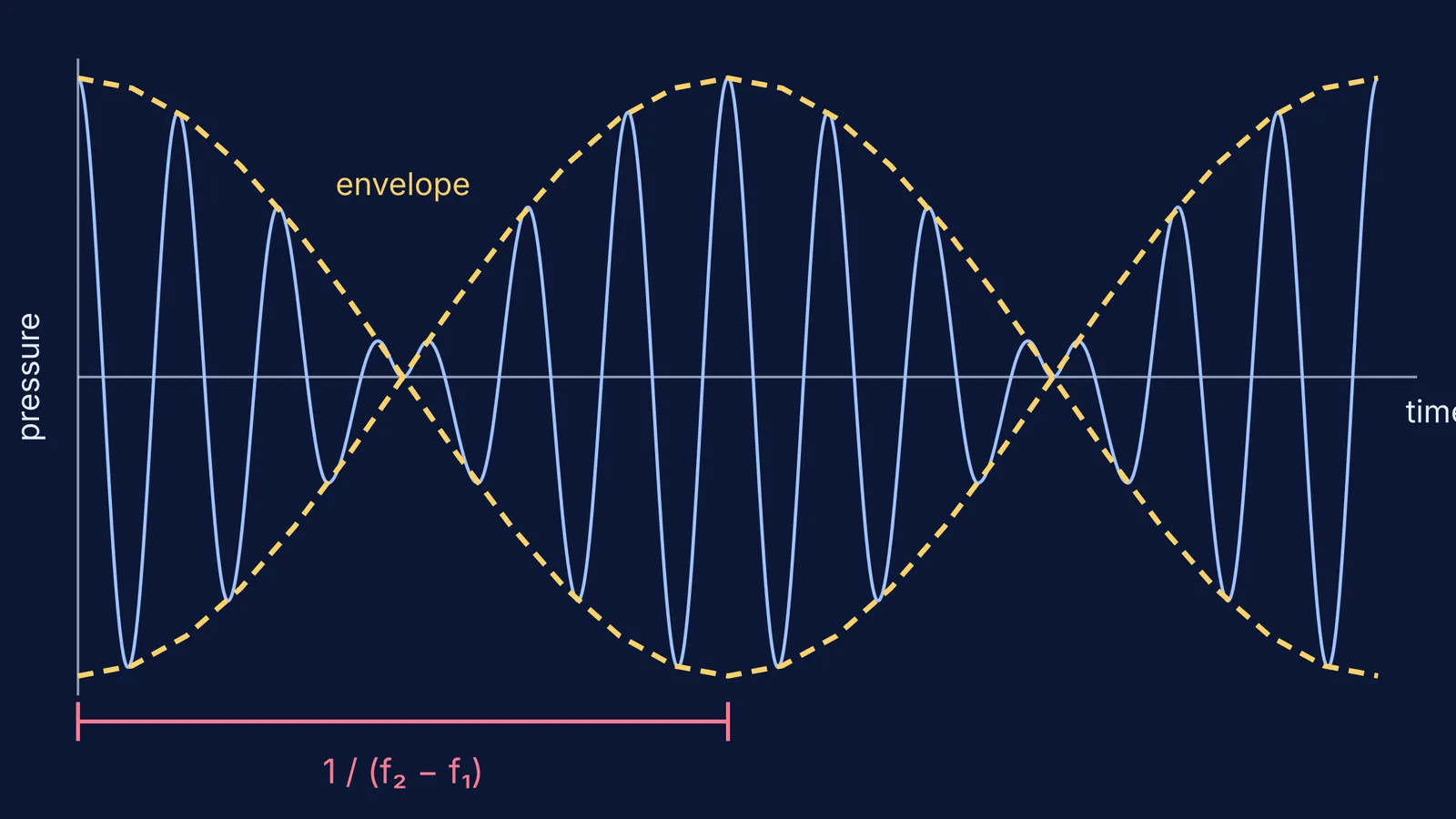
The beat frequency is the difference between the two frequencies: f_beat = |f2 − f1| (OpenStax University Physics, Beats).
The reason comes from adding the two waves. Using the identity cos u + cos v = 2 cos((u + v)/2) cos((u − v)/2), OpenStax writes the combined sound as a fast wave at the average frequency multiplied by a slow cosine at half the difference frequency (OpenStax). The fast part is the pitch you hear. The slow part is the envelope, the outline that makes the sound swell and fade.
One detail trips students up. The envelope cosine runs at |f2 − f1|/2, yet you hear |f2 − f1| beats a second. That is because loudness peaks whenever the envelope is at its largest size, and that happens twice in each of its cycles, once at the top and once at the bottom. The UNSW physics department's beats page describes the same thing: the envelope varies at Δf/2, giving beats at twice that rate.
How do you hear beats in a simulation?
You need two sound sources you can set to exact frequencies, played together. The UNSW beats page has ready-made sound files that pair a 400 Hz tone with 400.5, 401, 403, 410, 420, 430, 440 Hz and higher partners, so you can listen even without a simulator. On a graphing tool, plot cos(2π·400t) + cos(2π·403t) over one second and you will see the envelope.
Before you listen to each pair, write down three predictions: the beats per second, the time between loud moments, and the pitch you expect. Then check.
400 Hz with 400.5 Hz: 0.5 beats a second, so one loud moment every 2 seconds. Pitch near 400 Hz.
400 Hz with 401 Hz: 1 beat a second. A slow, clear pulse.
400 Hz with 403 Hz: 3 beats a second, loud moments 1/3 of a second apart. The envelope cosine runs at 1.5 Hz.
400 Hz with 410 Hz: 10 beats a second, a fast flutter that is still countable as a wobble.
400 Hz with 440 Hz: the formula says 40 beats a second, but you are unlikely to hear them as separate beats.
The last one is the interesting failure. According to the UNSW page, once beats come more often than roughly 20 or 30 times a second, we no longer hear them as beats, because our ears are not fast enough to respond to events that quickly. With a much larger gap, such as 400 Hz with 500 Hz, the page says you hear a chord of two notes rather than a wobble. The maths still works. Your ear is the limit.
If you would rather see the waves move than read about them, the Fermi Simulation Lab has interactive simulations for the ideas that are easier to see than to read.
Why do beats disappear when the notes match?
Set f1 = f2 and the difference is zero, so f_beat = 0. The slow envelope term becomes cos(0) = 1, a constant. Nothing swells or fades; you hear one steady tone. OpenStax describes this for piano tuning: as the tuner adjusts the string, the beats get slower as the note approaches the tuning fork's frequency (OpenStax).
This gives tuners a sensitive test. You do not need perfect pitch, only the ability to notice a wobble. Guitarists do the same thing with harmonics: the UNSW page describes matching the fourth harmonic of the low E string to the third harmonic of the A string, both an E4, and adjusting until they stop beating (UNSW).
Worked example: the tuning-fork method
A 512 Hz fork and a string sound together, and you count 4 beats a second. What is the string's frequency?
Beats give the size of the gap, not its sign: |f − 512| = 4.
So the string is at 508 Hz or 516 Hz. One reading cannot tell you which.
Change the string's tension slightly and listen again.
If the beats slow to 2 a second, you moved toward 512 Hz; keep going. If they speed up, you went the wrong way.
Stop when the wobble disappears.
For more numericals, see our post on beat frequency problems and the tuning fork method.
What to try next
Beats are interference that changes over time. If you want the steady version, where two waves of the same frequency add with a fixed phase, read about the resultant intensity of two coherent waves. For more experiments with frequency, wavelength and superposition, try our guide to learning waves with simulations.
If a step in the derivation still feels slippery, Fermi's AI tutor can work through it with you, drawing the figure and running the simulation as it checks your understanding.


