On this page
Play the same note on a flute and a violin, equally loud, and you can still tell them apart with your eyes shut. What differs is the recipe of frequencies inside the note, and you can change that recipe on paper.
What is timbre?
Timbre is the quality that lets you tell two sounds apart when their pitch and loudness are the same. That is the American National Standards Institute definition, quoted in a 2017 article on timbre by Kai Siedenburg and Stephen McAdams in Frontiers in Psychology, and its note adds that timbre "depends primarily upon the frequency spectrum" as well as on how the sound changes in time.
UNSW Sydney's music acoustics page on sound spectra puts it the other way round: if you change a sound without changing its loudness or its pitch, you have, by definition, changed its timbre.
Why do two instruments sound different playing the same note?
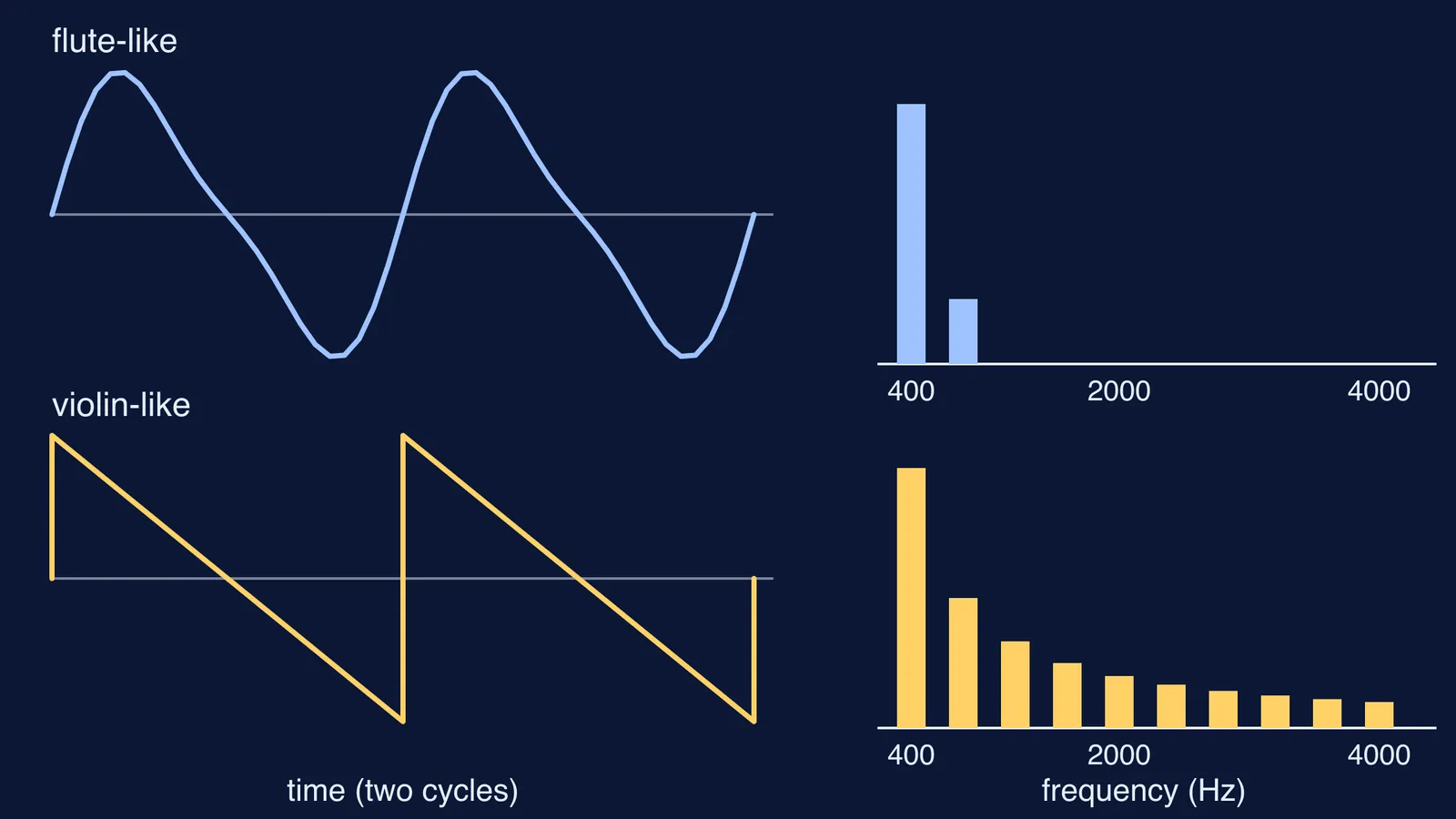
A note is a fundamental, the frequency you hear as pitch, plus harmonics at 2, 3, 4 and more times that frequency. The UNSW spectrum page shows a flute note with peaks at 400 Hz, 800 Hz, 1200 Hz, 1600 Hz and upwards. Any instrument playing that note puts its peaks in the same places. What differs is how tall each peak is.
Flute: UNSW's flute acoustics page says a softly played flute is "a little like a sine wave", with the fundamental dominating, and that the higher harmonics grow as the note is played louder.
Violin: the bow grips the string, drags it, then lets it slip, over and over. This stick-slip action drives the string with a sawtooth-like motion, and the UNSW spectrum page notes that bowed strings have harmonics that "decrease relatively slowly with frequency".
An ideal sawtooth wave contains every whole-number harmonic, and the nth harmonic has 1/n of the fundamental's amplitude, as its Fourier series shows. Hermann von Helmholtz worked out this kinked, back-and-forth motion of the bowed string in the 19th century, as Plus magazine's article on violin physics explains. For the Indian chapter, read how C. V. Raman studied the physics of bowed violin strings.
How do you turn a flute-like note into a violin-like one?
Fix the fundamental at 400 Hz, as in the UNSW flute example. Its period is 1/400 s, or 2.5 ms, and every version below repeats every 2.5 ms, so the pitch never moves. Only the heights of harmonics 2 to 6 change. Call the fundamental's amplitude 1.
Flute-like sketch: 1, 0.25, 0, 0, 0, 0. The wave is a sine that leans slightly, with rounded peaks.
Halfway mix: 1, 0.38, 0.17, 0.13, 0.10, 0.08. Each number is the average of the flute-like and violin-like values. The peaks start to tilt and sharpen.
Violin-like sketch: 1, 0.5, 0.33, 0.25, 0.2, 0.17 (the 1/n rule). The wave becomes a slow downward ramp with a sudden jump up, plus small ripples because you stopped at six harmonics.
In a spreadsheet, put time in seconds in column A, from 0 to 0.005 s in 0.00005 s steps. In column B add six terms, amplitude × SIN(2 × PI() × 400 × n × time) for each harmonic n, and plot B against A. New to adding sine waves? See how adding sine waves makes a square wave.
For waves you would rather watch than read about, the Fermi Simulation Lab has interactive simulations for ideas that are easier to see than to read.
What should you check when you compare the two sketches?
Put the waveforms side by side, then the spectra (harmonic height against frequency, as on the UNSW spectrum page):
Period: both repeat every 2.5 ms. Same period, same pitch.
Bar positions: both spectra have bars only at 400, 800, 1200 Hz and so on.
Bar heights: the flute-like bars fall away almost at once; the violin-like bars fall slowly.
Shape: rounded peaks against a ramp and a sudden jump. Link each sharp feature to the tall high bars.
If harmonics and overtones blur together for you, the post on the difference between overtones and harmonics in pipes sorts out the counting.
Is the overtone mix the whole story?
No. The UNSW spectrum page points out that if you filtered a violin note until its spectrum matched a trumpet's, it would still sound like a violin. The start of a note, the scrape of the bow and the way the harmonics change over time all carry timbre, which is why the ANSI note quoted in the Siedenburg and McAdams article mentions the sound's temporal characteristics. A bare sawtooth sounds "harsh and clear" (Wikipedia), not like a real violin.
If you get stuck linking a spectrum to a waveform, Fermi's AI tutor can draw the figure, run the simulation and check your understanding as you go. Next step: keep 400 Hz fixed, raise only the third harmonic, and predict the new shape before you plot it.