

On this page
How does a violin bow make a stretched string vibrate?
Class 11 wave mechanics introduces transverse waves as sinusoidal standing modes. In the NCERT Class 11 Physics textbook, counter-propagating waves superpose to form nodes and antinodes with speed v = √(T/μ) and fundamental frequency f₁ = v / (2L). Yet a bowed violin string does not vibrate in simple harmonic motion; it relies on non-linear stick-slip friction.
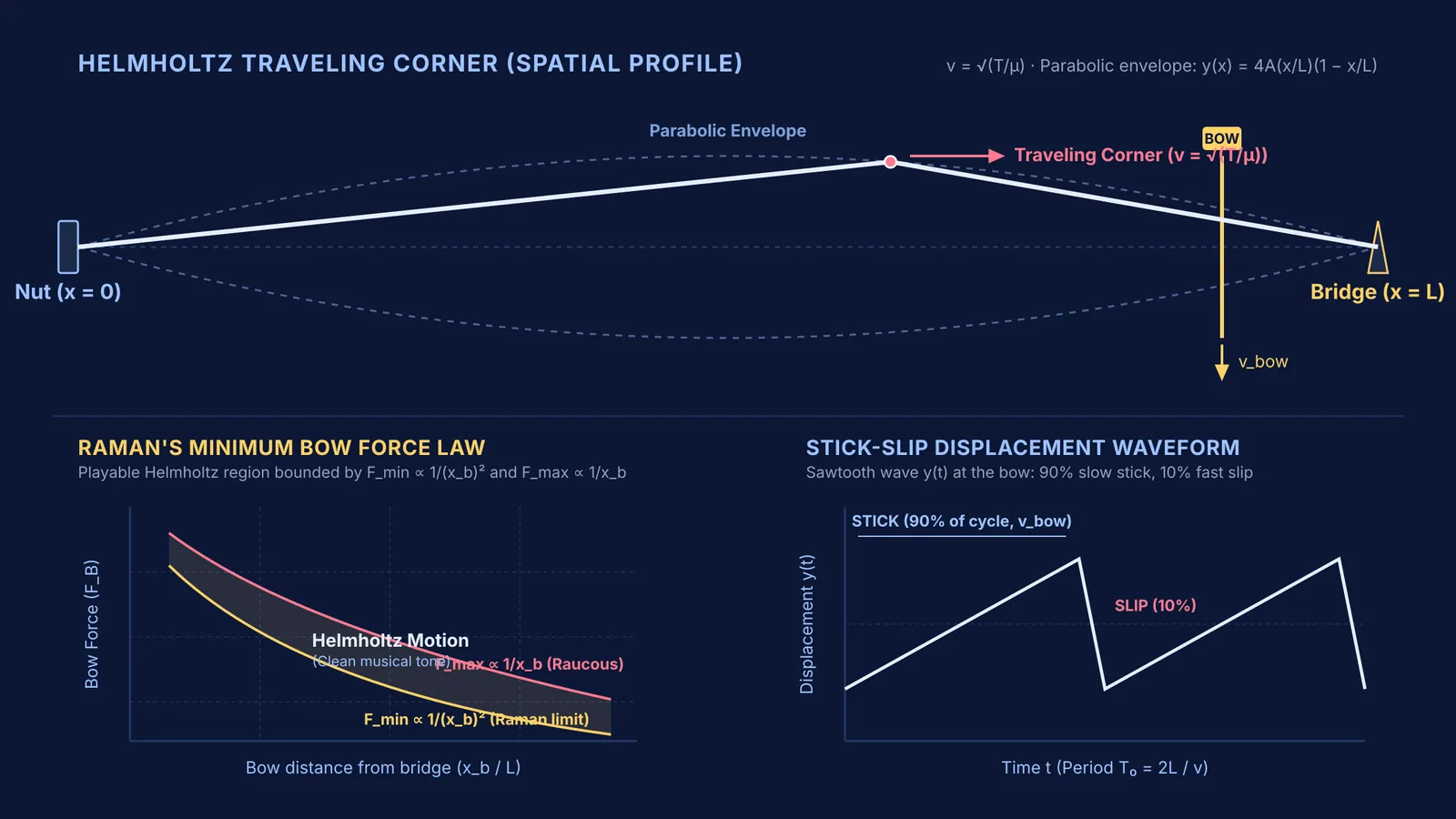
As rosined horsehair drags across the string, static friction grips the string and pulls it at the bow's speed. The string displaces sideways until restoring elastic tension exceeds the maximum static friction force. The string then snaps free, slipping backward rapidly against lower kinetic friction until the bow catches it again.
In 1860, Hermann von Helmholtz showed that the bowed string forms two straight lines meeting at a sharp traveling corner. This kink circulates along a parabolic envelope at wave speed v = √(T/μ) with round-trip period T₀ = 2L / v. At any fixed point, the string traces an asymmetric sawtooth wave that decomposes into all integer harmonics (1, 2, 3, ...), giving the violin its rich timbre.
For how boundary reflections produce stationary nodes, explore our guides on standing waves in strings and pipes and reflection of waves at fixed and free ends.
What did C.V. Raman discover about bowed string dynamics?
From 1907 to 1917, C.V. Raman worked as an Assistant Accountant-General in Calcutta while conducting acoustics research mornings and evenings at the Indian Association for the Cultivation of Science (IACS), before accepting the Palit Professorship of Physics at the University of Calcutta.
In 1918, Raman published his 158-page monograph, "On the Mechanical Theory of the Vibrations of Bowed Strings and of Musical Instruments of the Violin Family, Part I", as Bulletin No. 15 of the IACS. Raman proved that Helmholtz motion is merely the simplest case. Bowed strings can sustain "higher types" of periodic vibrations where two or more traveling corners circulate simultaneously, causing multiple slips per cycle and producing raspy or squeaky tones.
To test his equations without human player variability, Raman built a mechanical violin player, publishing his results in the Philosophical Magazine in 1920. He placed the violin on a motorized carriage moving beneath a stationary, balanced bow. Raman discovered that maintaining a clean Helmholtz tone requires a minimum bow pressure that varies inversely as the square of the distance from the bridge: F_min ∝ 1 / (x_b)². In 1973, John C. Schelleng expanded this in The Journal of the Acoustical Society of America to map the playable region between scratchy noise and surface whisper.
Why does the wolf-note disrupt violin resonance?
Fine cellos and violins often produce a jarring stutter known as the "wolf-note", typically near F-sharp on a cello. Before Raman, musicians assumed this was an acoustic beat between two sound waves.
In 1916, Raman published papers in Nature and the Philosophical Magazine proving that the wolf-note is a non-linear coupled resonance between the string and the instrument's body. When string frequency matches the resonance of the belly and bridge, the body absorbs energy faster than the bow's friction can supply it. Helmholtz motion collapses into a double-slipping mode. As vibration amplitude drops, body dissipation decreases, letting the bow restore the Helmholtz grip. This cycle repeats, creating an audible cyclic pulsation. Raman verified this by attaching a small mute to the bridge, which lowered the body resonance and shifted the wolf-note pitch downward.
How do Raman's bowed string findings appear in Class 11 physics?
Raman's experiments link directly to Class 11 standing wave formulas in the NCERT Class 11 Physics textbook and practical setups like the sonometer frequency experiment.
Consider a worked example for a violin A4 string:
Wave speed: For vibrating length L = 0.33 m and fundamental f₁ = 440 Hz, wave speed is v = 2 L f₁ = 2 × 0.33 m × 440 s⁻¹ = 290.4 m/s. The period is T₀ = 1 / f₁ ≈ 2.27 ms.
Stick-slip timing: With the bow at x_b = 3.3 cm from the bridge (β = x_b / L = 0.10), slip duration is τ_slip = β T₀ = 0.227 ms and stick duration is τ_stick = (1 − β) T₀ = 2.043 ms. The string sticks to the bow for 90% of each cycle.
Raman's pressure rule: Halving distance to the bridge (x_b' = 1.65 cm) scales required minimum bow force by (x_b / x_b')² = (2)² = 4 times. Bowing closer to the bridge requires 4 times more pressure to maintain the Helmholtz corner, as quantified in John C. Schelleng's bowing analysis in The Journal of the Acoustical Society of America.
Use this checklist to identify bowing regimes:
Helmholtz motion: Bow force above F_min; single slip per cycle yields full harmonic spectrum.
Higher Raman modes: Bow force below F_min; multiple slips per cycle cause squeaky surface noise.
Wolf-note: Bow frequency matches body resonance; cyclic collapse and recovery produces a beating howl.
Visualizing standing waves, phase shifts, and traveling corners makes wave mechanics far clearer. In the Fermi Simulation Lab, you can adjust string tension, linear density, and boundary reflections in interactive simulations for ideas that are easier to see than to read. When solving wave equations and overtone frequencies, the Fermi Problem Library offers worked problems with a step-by-step solver that explains the reasoning rather than printing an answer. You can also explore wave fundamentals and resonance across the Fermi Concept Library, which covers every concept in physics, chemistry, biology, mathematics and computing, each with its own lesson and its place in the map.


