On this page
Some satellites keep one face pointing at Earth with no fuel, no wheels and no electronics. They carry a long boom with a small weight on the end. Once the boom is out, the satellite settles with the boom vertical, pointing straight away from Earth, and if it is knocked it rocks gently back. The restoring push comes from the difference in gravity between the two ends of the boom, and it sets a rocking period you can work out with Class 11 gravitation and simple harmonic motion.
What is gravity-gradient stabilisation?
Engineers call it gravity-gradient stabilisation. NASA's design monograph Spacecraft gravitational torques (SP-8024) explains that a spacecraft meant to use this torque is built with very unequal moments of inertia, the opposite of what a spacecraft that wants to avoid it does. A long boom is the simplest way to do that.
Two named examples from NASA reports:
GEOS-A (Explorer 29), a 386.6 lb geodesy satellite built by the Johns Hopkins Applied Physics Laboratory, pointed at Earth using a single extendible boom with a damper at its end. Its boom was extended to 50 feet (about 15 m) in orbit, according to NASA CR-903.
The Radio Astronomy Explorer (RAE) used four 750-foot antennas both to receive radio signals and to hold itself steady by gravity, as SP-8024 describes.
Where does the 3ω₀²x tidal pull come from?
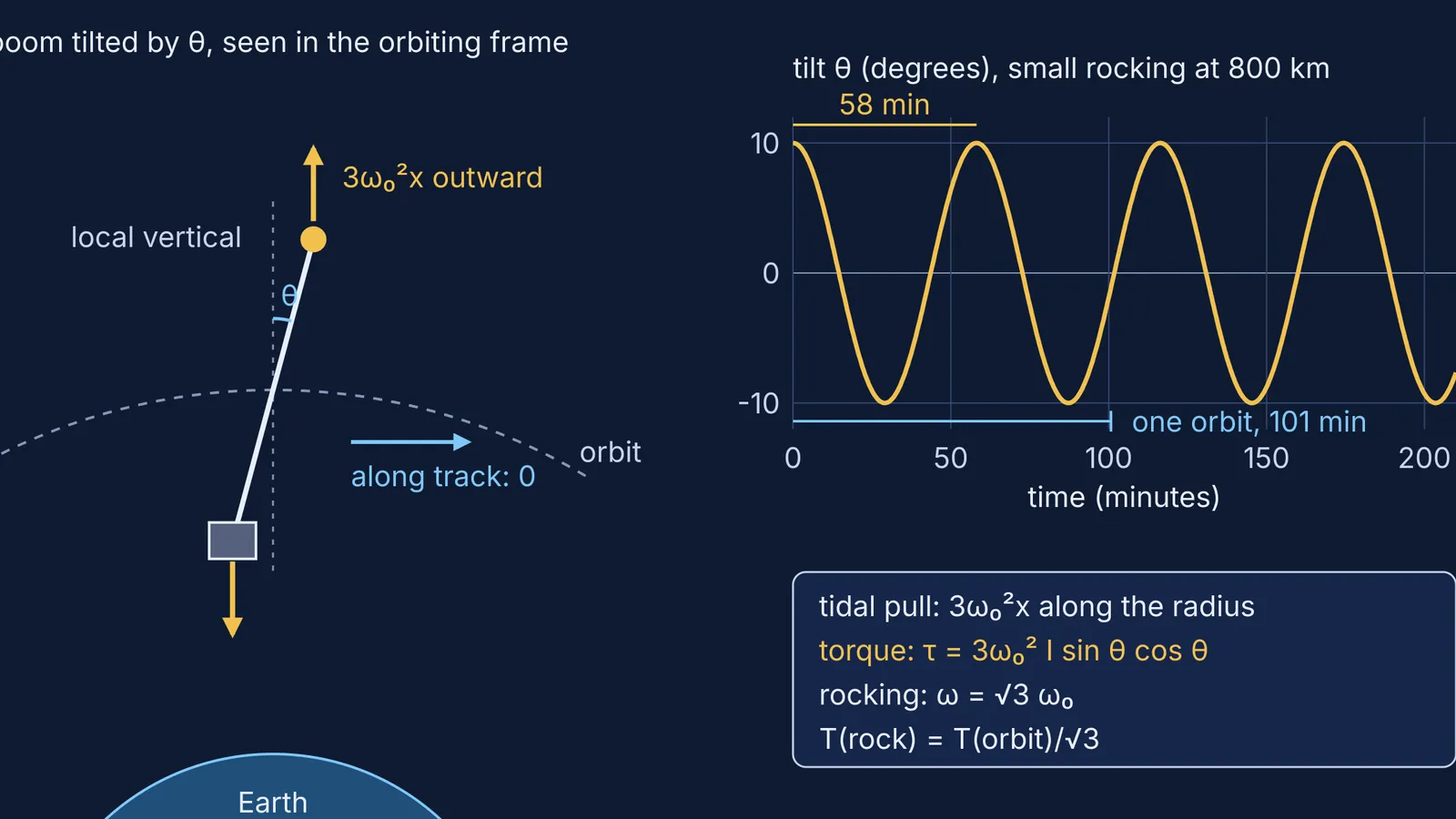
Picture a satellite in a circular orbit of radius r, moving round at angular speed ω₀, where ω₀² = GM/r³. Work in a frame that turns with the orbit, so the satellite's centre of mass is at rest. A piece of the boom a small distance x farther from Earth feels two extra outward pulls compared with the centre:
Weaker gravity. Gravity GM/r² falls off with distance. At r + x it is smaller by about 2GMx/r³ = 2ω₀²x. Compared with the centre, that is an outward pull of 2ω₀²x.
Stronger centrifugal pull. In the turning frame, the centrifugal acceleration is ω₀² times the distance from Earth's centre. At r + x it is larger by ω₀²x.
Total: 3ω₀²x outward. A piece closer to Earth by x is pulled inwards by the same amount. So the boom is stretched along the line to Earth.
Now move a piece sideways by y, along the direction of motion. Gravity now points slightly back towards Earth's centre, which adds a sideways part of ω₀²y back towards the centre line. The centrifugal term pushes it ω₀²y outwards. They cancel exactly: no force along the track.
For the ocean version, with no co-rotating frame, see why there are two high tides a day, drawn as arrows.
What torque pulls a tilted boom back to vertical?
Treat the satellite as a dumbbell: a heavy body at one end of a light boom and a tip mass at the other. Tilt it by θ from the vertical, in the orbit plane. A mass at distance ρ from the centre of mass along the boom sits at x = ρ cos θ along the radius and y = ρ sin θ along the track. Its force is 3ω₀²x m, pointing along the radius. The torque of this force about the centre of mass is −(y)(3mω₀²x) = −3mω₀²ρ² sin θ cos θ.
Add both masses. Σmρ² is the moment of inertia I about the centre of mass, so:
τ = −3ω₀² I sin θ cos θ
The minus sign means the torque always turns the boom back to the vertical. SP-8024 gives the same pitch torque in the form (3/2)ω₀²ΔI sin 2θ; for a dumbbell ΔI is just I, and sin 2θ = 2 sin θ cos θ.
How long does one rock take?
For small θ, sin θ cos θ ≈ θ, so Iθ″ = −3ω₀²Iθ. That is simple harmonic motion with angular frequency √3 ω₀. I cancels, so the period does not depend on the boom length or the masses:
T(rock) = T(orbit)/√3
A NASA Goddard study of gravity-gradient pitch libration, Fleig, NASA TR R-350, writes the pitch frequency for a general body in terms of its inertia ratios; the dumbbell is the limiting case that gives √3.
This result is for rocking in the orbit plane (pitch). Sideways rocking (roll) couples to the yaw motion and the orbit, and has a different period.
Worked example: a 10 m boom at 800 km
Take Earth's GM = 3.986 × 10¹⁴ m³/s² (the value in SP-8024) and Earth's radius 6,371 km.
Orbit radius. r = 6,371 + 800 = 7,171 km = 7.171 × 10⁶ m.
Orbital rate. ω₀ = √(GM/r³) = 1.040 × 10⁻³ rad/s.
Orbit period. T = 2π/ω₀ = 6,043 s = 100.7 min.
Rocking period. 100.7/√3 = 58.2 min. At 400 km the numbers are 92.4 min and 53.4 min.
Moment of inertia. A 100 kg body with a 5 kg tip mass on a light 10 m boom. The centre of mass is 5 × 10/105 = 0.476 m from the body, so the tip is 9.52 m out. I = (100 × 5/105) × 10² = 476 kg m².
Torque at 10°. τ = 3 × (1.040 × 10⁻³)² × 476 × sin 10° × cos 10° = 2.6 × 10⁻⁴ N m. At 30°, 6.7 × 10⁻⁴ N m.
Tidal pull on the tip. 3ω₀²x = 3 × (1.040 × 10⁻³)² × 9.52 = 3.1 × 10⁻⁵ m/s², against a gravitational acceleration of 7.75 m/s² at that height.
Units: ω₀² I has units s⁻² × kg m² = N m, as a torque should. The torque is tiny, but it never runs out.
What stops the satellite rocking for ever?
Nothing in the formula removes energy, so a real satellite needs a damper. GEOS-A carried an eddy-current damper at the tip of its boom. The same report notes the system is stable with the boom pointing either up or down, because the torque depends on sin θ cos θ, which is zero at both θ = 0 and θ = 180°. GEOS-A's team planned for an upside-down capture, which they could correct by retracting and re-extending the boom.
The same torque, acting over a very long time, turned the Moon until one face always points at Earth: see why we always see the same side of the Moon.
To see restoring torques and SHM side by side, try the Fermi Simulation Lab, which has interactive simulations for ideas easier to see than read. For the underlying ideas, the Concept Library covers every concept in physics.
Quick checklist
In the orbiting frame, the tidal pull is 3ω₀²x along the radius and zero along the track.
The factor 3 is 2 from gravity plus 1 from the centrifugal term.
Restoring torque on a tilted dumbbell: τ = −3ω₀²I sin θ cos θ.
Small pitch rocking has period T(orbit)/√3, independent of boom length.
At 800 km: 101 min orbit, 58 min rocking.
Real satellites need a damper, and the boom can settle pointing up or down.