On this page
Trigonometry is a short unit on paper and a large one in practice, because its identities come back inside calculus. Here is what the syllabus says, four ideas to own, the traps, and a fourteen-day plan.
What does the JEE Main syllabus include in trigonometry?
The official JEE Main 2027 syllabus published by NTA lists Unit 14, Trigonometry, as "Trigonometrical identities and trigonometrical functions, inverse trigonometrical functions their properties."
The same document also lists differentiation of trigonometric and inverse trigonometric functions (Unit 7) and "integration using trigonometric identities" (Unit 8), so these formulae earn marks in calculus too.
The NCERT chapters behind the unit are:
Class 11, Chapter 3, Trigonometric Functions: angles and radian measure, the six functions and their graphs, and the trigonometric functions of the sum and difference of two angles.
Class 12, Chapter 2, Inverse Trigonometric Functions: restricted domains, ranges and principal value branches.
How is JEE Main trigonometry different from JEE Advanced?
The JEE Advanced 2026 syllabus is wider. It lists "Trigonometric functions, their periodicity and graphs, addition and subtraction formulae, formulae involving multiple and sub-multiple angles, general solution of trigonometric equations", and inverse trigonometric functions "(principal value only) and their elementary properties". It states that the 2026 syllabus is the same as 2025; the 2027 syllabus page still said "coming soon" when we checked.
If you are sitting both exams, learn general solutions properly. If you are sitting only JEE Main, you can skip long drills on special equation types, but keep the skill of solving a simple equation on an interval: it is how you read a graph and check an identity.
Which trigonometry ideas should you master first?
Four ideas, each with a worked example we checked two ways.
1. Compound angles. Find sin 75°. sin 75° = sin(45° + 30°) = sin 45° cos 30° + cos 45° sin 30° = (√6 + √2)/4, about 0.9659. Check: sin 75° = cos 15° = cos(45° − 30°), which expands to the same value.
2. Tangent of a sum. If tan A = 1/2 and tan B = 1/3 with A and B acute, then tan(A + B) = (1/2 + 1/3)/(1 − 1/6) = 1. Since A + B lies between 0 and π, A + B = π/4. Check: tan⁻¹(1/2) is about 26.57° and tan⁻¹(1/3) about 18.43°, which add to 45°.
3. Principal values. sin⁻¹(sin 5π/6) is π/6, not 5π/6, because NCERT's chapter takes [−π/2, π/2] as the principal value branch of sin⁻¹. Check: sin 5π/6 = 1/2, and the only angle in that interval whose sine is 1/2 is π/6.
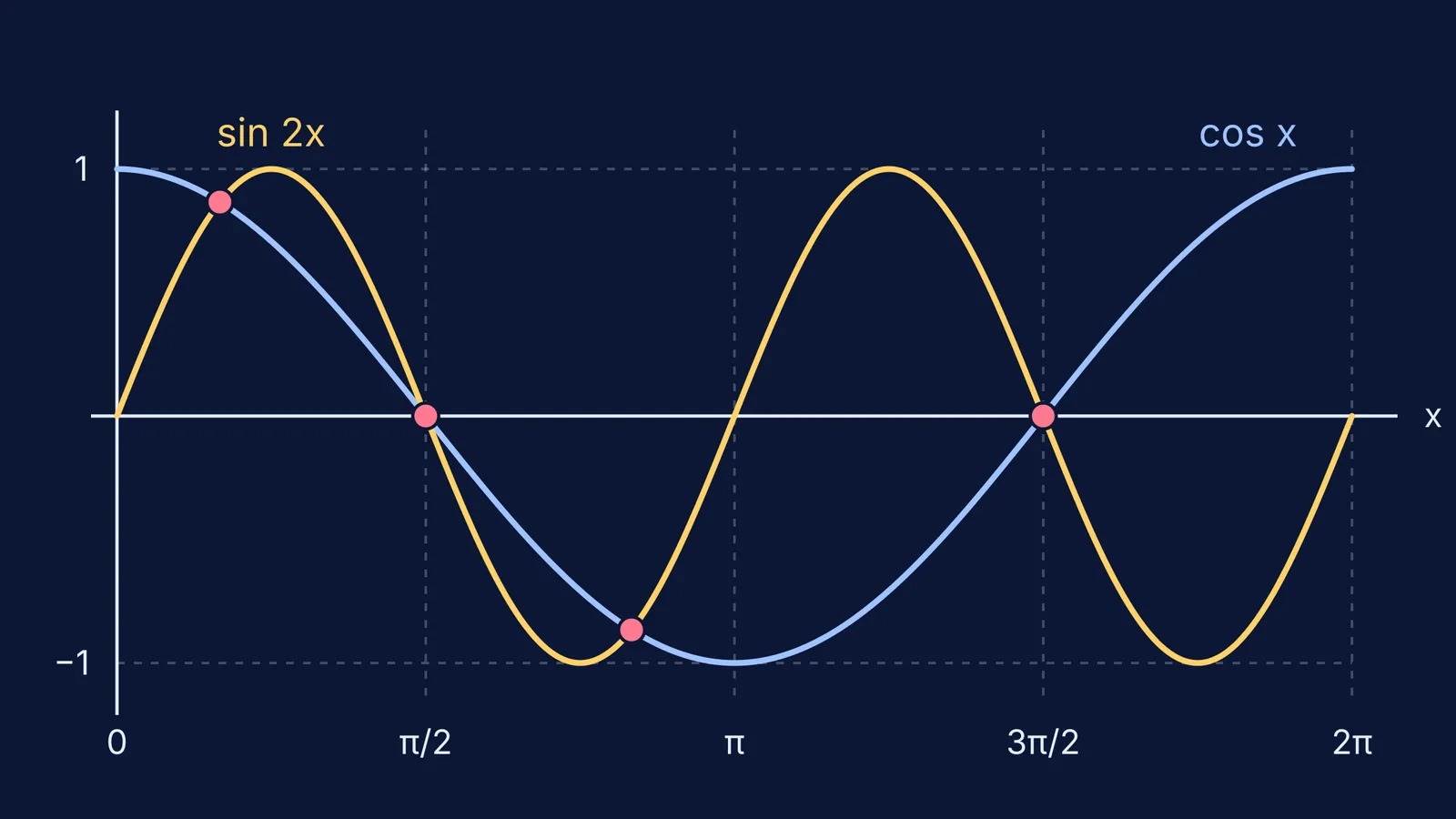
4. A trigonometric equation. Solve sin 2x = cos x for 0 ≤ x ≤ 2π. Write 2 sin x cos x − cos x = 0, so cos x (2 sin x − 1) = 0. Then cos x = 0 gives π/2 and 3π/2, and sin x = 1/2 gives π/6 and 5π/6: four solutions. In general form, x = (2n + 1)π/2 or x = nπ + (−1)ⁿπ/6 for any integer n. Check: at x = 5π/6, sin 2x = sin 5π/3 = −√3/2 and cos x = −√3/2. The diagram at the top of this page shows the four crossings.
What are the common trigonometry traps?
Dividing both sides by cos x in example 4. You get sin x = 1/2 and lose two of the four answers.
Taking a square root without the quadrant. Mark where the angle lies before you choose the sign.
Writing sin⁻¹(sin θ) = θ for every θ. It holds only inside the principal value branch.
Squaring both sides of an equation and keeping the extra roots it creates.
Mixing degrees and radians in one line, especially inside a derivative or an integral.
How should you practise trigonometry in two weeks?
Keep the NTA syllabus open and tick each phrase as you cover it.
Days 1 and 2: read NCERT Class 11 Chapter 3; write the sum, difference and multiple-angle formulae from memory until they come out right.
Days 3 and 4: the chapter's exercises and miscellaneous exercise, timed.
Days 5 and 6: NCERT Class 12 Chapter 2; sketch each inverse function's principal value branch from memory.
Day 7: a mixed set under time. Log every error by type: formula, sign, branch or algebra.
Days 8 and 9: equations on an interval. Draw both graphs, count the crossings, then solve and compare.
Days 10 and 11: trigonometry inside calculus, meaning derivatives of inverse functions and integrals that need an identity.
Days 12 and 13: the trigonometry questions from the past papers posted on NTA's JEE Main website, under exam timing.
Day 14: redo every question in your error log without looking at the solution.
When your log shows a method mistake rather than a forgotten formula, work a similar problem in the Fermi Problem Library, where a step-by-step solver explains the reasoning rather than printing an answer.
For the rest of your preparation, see Fermi Test Prep for JEE Main and Advanced.