On this page
Switch on a room heater on a December night in Delhi and the room goes from cold to comfortable. It is natural to think the heater has filled the air with energy. It has not. In an ordinary room, which is not airtight, the air holds the same total energy at 20 °C as it did at 10 °C. This post shows why, with numbers, and what the heater really changes.
The question is old. In May 1938 the physicist R. Emden published a short note in Nature titled "Why do we have winter heating?" (Nature 141, 908–909). His point was that the energy content of a room's air is fixed by the barometer, not the thermometer, and that the energy a heater supplies does not stay in the air. You can check his claim with two Class 11 formulas.
Why does the air in a heated room stay at the same pressure?
A real room has gaps under the door, round the windows and through vents. Air can leak in or out, so the pressure inside stays equal to the pressure outside, about 101.3 kPa near sea level. The volume is the room's volume, which does not change.
So when the air warms, it cannot build up pressure as it would in a sealed box. Instead some of it is pushed out through the gaps. This is the same effect as in air escaping from a heated open flask: with p and V fixed, the amount of gas n = pV/RT falls as T rises.
How can the energy stay the same if the air is hotter?
Treat air as an ideal diatomic gas. Its internal energy is U = nCᵥT, counted from absolute zero with a constant Cᵥ. The gas law gives n = pV/RT. Put the second into the first:
U = (pV/RT) × CᵥT = CᵥpV/R
The temperature cancels. Using Cₚ − Cᵥ = R and γ = Cₚ/Cᵥ (see why Cₚ is greater than Cᵥ), Cᵥ/R = 1/(γ − 1), so:
U = pV/(γ − 1)
For a leaky room p and V are both fixed, so U is fixed. Each molecule does carry more energy when the air is warmer, in proportion to T. But there are fewer molecules, in proportion to 1/T. The two effects cancel exactly.
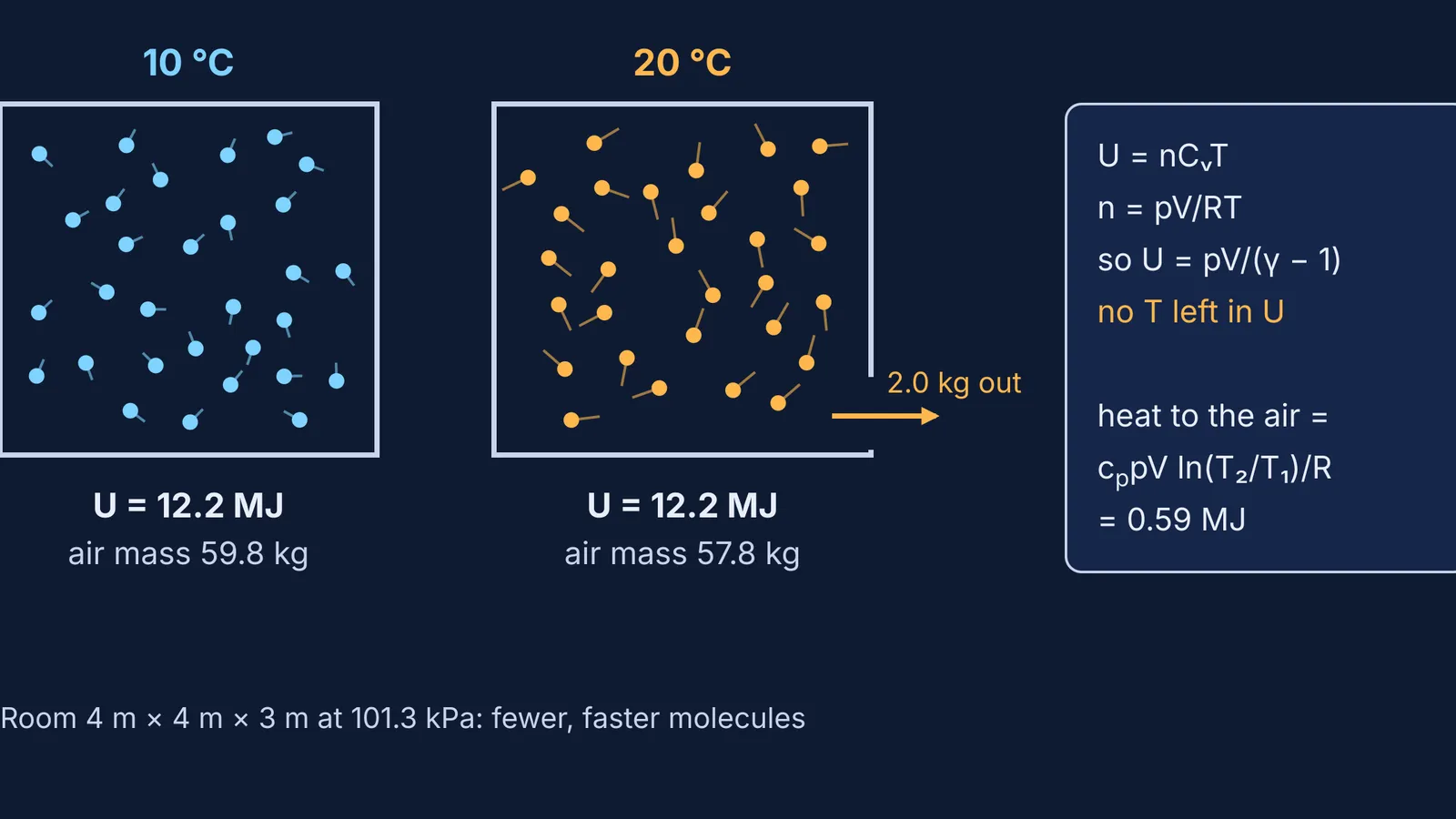
Worked example: a 4 m × 4 m × 3 m room heated from 10 °C to 20 °C
Take p = 101.3 kPa, γ = 1.4 for dry air, R = 8.314 J mol⁻¹ K⁻¹ and a molar mass of 28.96 g/mol. The room is illustrative.
Volume: V = 4 × 4 × 3 = 48 m³.
Energy of the air: U = pV/(γ − 1) = 101,325 × 48/0.4 = 1.22 × 10⁷ J, or 12.2 MJ, at both temperatures.
Moles at 10 °C (T₁ = 283.15 K): n₁ = pV/RT₁ = 101,325 × 48/(8.314 × 283.15) = 2,066 mol, a mass of 59.8 kg.
Moles at 20 °C (T₂ = 293.15 K): n₂ = 1,996 mol, a mass of 57.8 kg.
Air pushed out: 59.8 − 57.8 = 2.0 kg, which is 3.4% of the air. As a check, the fraction lost is 1 − T₁/T₂ = 10/293.15 = 0.034.
Energy per molecule: it rises in the ratio T₂/T₁ = 1.035, while the number of molecules falls in the ratio 1/1.035. The product is 1.
So the air ends up with the same 12.2 MJ it started with, carried by 3.4% fewer molecules that are each 3.5% more energetic.
Where does the heater's energy go?
The heater still has to supply heat to warm the air. At each moment the air in the room is warmed at constant pressure while a small amount escapes. Adding up the heat over the whole warming gives:
Q = Cₚ × (pV/R) × ln(T₂/T₁) = cₚpV ln(T₂/T₁)/R_air
Here cₚ = 1005 J kg⁻¹ K⁻¹ and R_air = 287 J kg⁻¹ K⁻¹ are the values per kilogram for dry air. For our room, Q = 1005 × 101,325 × 48 × ln(293.15/283.15)/287 = 0.59 MJ. That is 0.16 kWh, or about 5 minutes of a 2 kW heater.
Since U did not change, all 0.59 MJ left the room with the 2.0 kg of escaping air, which carries its enthalpy out with it. Emden's own phrase was that the energy escapes "through the pores of the walls". In a real room the walls, floor and furniture also have to be warmed, and they take far more heat than the air does, so a heater runs much longer than 5 minutes.
If the room were sealed, the air would keep all its molecules. Then ΔU = nCᵥΔT = 2,066 × 2.5 × 8.314 × 10 = 0.43 MJ, and the pressure would rise by about 3.6 kPa. The constant-energy result needs a room open to the outside air.
So why do we heat rooms at all?
Because comfort depends on temperature, not on the energy stored in the air. Your skin loses heat to the air and to the walls at a rate set by the temperature difference. Warm air, with faster molecules, takes heat from you more slowly. The heater's job is to keep the temperature up while heat keeps leaking out. Emden went on to describe the heater's role in terms of entropy, which goes beyond the Class 11 syllabus.
The same sum works in reverse. An air conditioner cooling a leaky room from 30 °C to 25 °C does not drain the room air's energy either; outside air flows in and U stays at pV/(γ − 1). Heaters and air conditioners are still useful: they set the temperature you feel. Room heaters also change how dry the air feels, which is covered in why room heaters make the air feel dry.
What does the model leave out?
Cᵥ is taken as constant down to absolute zero. That is an idealisation, but over 10–20 °C only the change matters, and the cancellation holds.
Moisture is ignored. Water vapour in the air changes the numbers slightly, not the conclusion.
Pressure changes with the weather. U follows the barometer: a 1% drop in pressure gives 1% less energy in the room air.
To revise internal energy, Cₚ, Cᵥ and the ideal gas law, try the Concept Library. For more problems on gases in open and closed containers, the Fermi Problem Library has a step-by-step solver that explains the reasoning.
Quick checklist
In a leaky room p and V are fixed, so n = pV/RT falls as T rises.
U = nCᵥT = pV/(γ − 1): no temperature in it.
48 m³ of air holds 12.2 MJ at 10 °C and at 20 °C; 2.0 kg (3.4%) leaves.
Heat to warm the air: cₚpV ln(T₂/T₁)/R_air = 0.59 MJ, all carried out by the escaping air.
A sealed room is different: its air energy rises by nCᵥΔT.
Heating sets the temperature, which is what your body feels.