

On this page
On a cold December night you switch on the heater, and by morning your lips are cracked. The heater did not "burn up" the moisture. The water in the room barely changed; what changed is how much water the air could hold.
What does relative humidity actually measure?
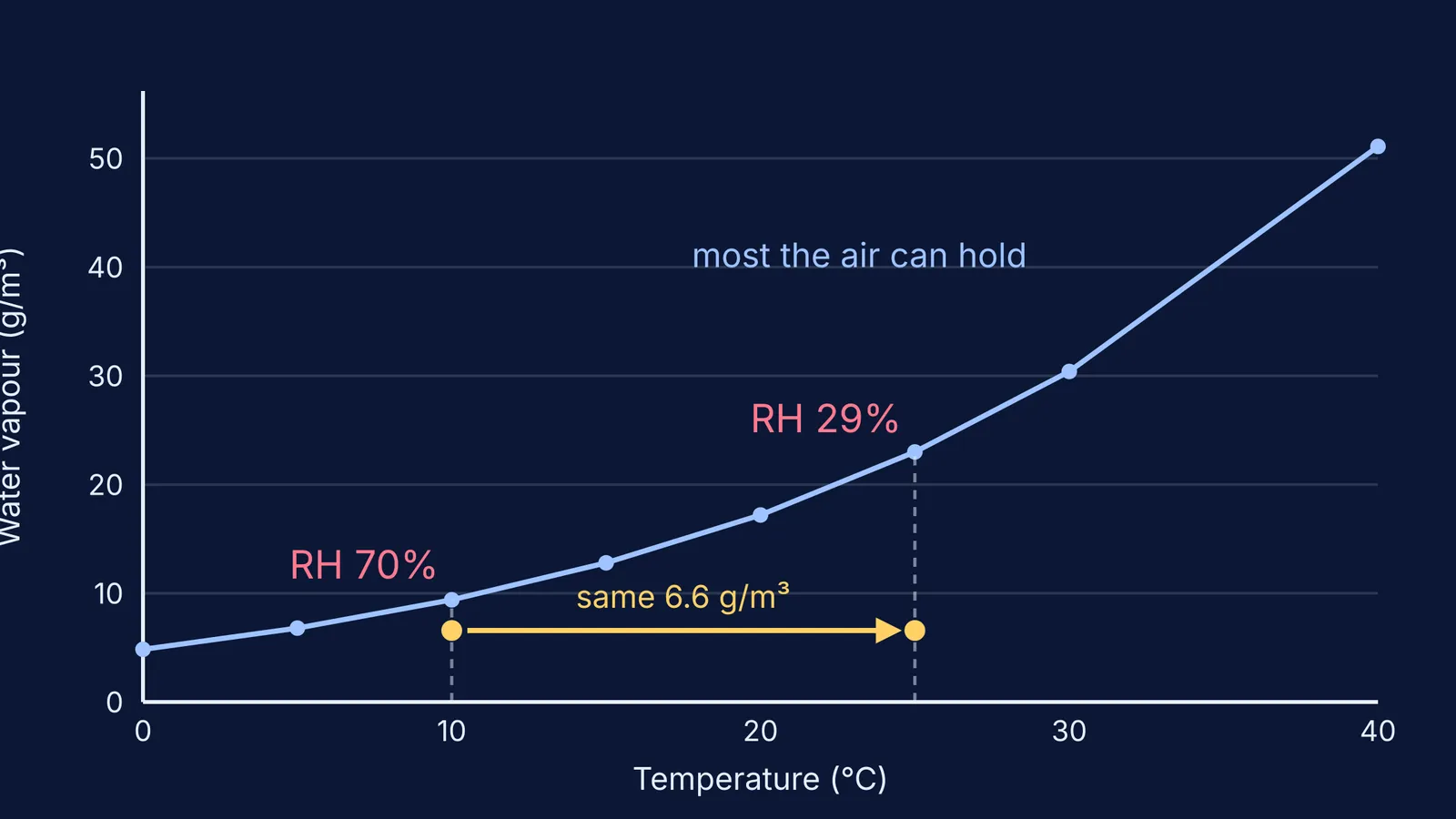
Relative humidity is the amount of water vapour in the air divided by the most it could hold at that temperature, times 100% (OpenStax College Physics, Humidity, Evaporation and Boiling/13:_Temperature_Kinetic_Theory_and_the_Gas_Laws/13.06:_Humidity_Evaporation_and_Boiling)). That maximum is called the saturation vapour density, and it rises steeply with temperature.
The same OpenStax table gives these values for saturated air:
10 °C: 9.40 g of water per cubic metre
20 °C: 17.2 g per cubic metre
25 °C: 23.0 g per cubic metre
30 °C: 30.4 g per cubic metre
So the air's capacity nearly doubles between 10 °C and 20 °C, while the water actually in the room stays the same. The bottom of the fraction grows, so relative humidity falls.
Why does a room heater make the air feel dry?
Here is the calculation, using the OpenStax values above. Take a closed bedroom at 10 °C with 70% relative humidity, a fairly damp winter night.
Water in the air now: 70% of 9.40 g/m³ = 6.58 g of water vapour in each cubic metre.
Switch on the heater. It adds heat but no water, so each cubic metre still holds about 6.58 g.
At 20 °C: 6.58 ÷ 17.2 = 0.38, so relative humidity is about 38%.
At 25 °C: 6.58 ÷ 23.0 = 0.29, so relative humidity is about 29%.
Nothing was removed, yet relative humidity fell from 70% to about 29%. (Warm air also expands and some leaks out, which makes the real figure slightly lower.)
The same numbers explain the wet window. Saturated air at 5 °C holds 6.80 g/m³ (OpenStax), so room air carrying 6.58 g/m³ becomes saturated against a pane colder than about 5 °C, and water condenses on the glass.
Why does dry air dry out your skin and lips?
Evaporation depends on the gap between how much water vapour is at a wet surface and how much is in the air around it. OpenStax notes that high humidity slows evaporation, which is why sweat cools you poorly on a muggy day, and that hot air dries wet hair faster because a higher temperature speeds up evaporation (OpenStax/13:_Temperature_Kinetic_Theory_and_the_Gas_Laws/13.06:_Humidity_Evaporation_and_Boiling)). A heater lowers relative humidity, and a fan heater also keeps moving that drier air across your face. The same evaporation physics is why a clay matka keeps drinking water cool and why alcohol evaporates faster than water.
The skin research is less tidy than the physics. A 2016 review by N. Goad and D. J. Gawkrodger in the Journal of the European Academy of Dermatology and Venereology found that studies link low indoor humidity with more eczema. In people, low humidity changed the water content of the outer skin layer, made skin less elastic and made it rougher. A humidifying mist raised the outer layer's water content. The authors also report some evidence that low humidity can strengthen the skin's barrier, and they call the overall literature inconclusive.
How can you keep a heated room from getting too dry?
The US Environmental Protection Agency suggests keeping indoor relative humidity below 60%, ideally between 30% and 50% (EPA, A Brief Guide to Mold, Moisture and Your Home). Our worked example, at 29%, is just below that range. Here is a simple plan:
Measure first. A cheap digital hygrometer shows whether the room is actually dry.
Heat only as warm as you need. Every extra degree pushes relative humidity down.
Add water gently. Drying clothes indoors or an open tray of water adds some vapour.
If you use a humidifier, follow the EPA's humidifier advice: don't go above 50%, empty and refill portable units daily, clean them every third day, and use water low in minerals, such as distilled water.
Watch the windows. The EPA says that if water condenses on windows, walls or pictures, you should move the humidifier, lower its setting or use it less.
Look after the surfaces that lose water. A moisturiser after bathing and lip balm at night are everyday steps. If dry skin itches, cracks or bleeds, or eczema flares, see a doctor or dermatologist.
How does this connect to what you study?
This is vapour pressure in everyday life, the same steep curve described by the Clausius-Clapeyron equation for vapour pressure. If a curve like this is easier to see than to read, the Fermi Simulation Lab has interactive simulations for ideas like these, and the Fermi Concept Library gives each concept in physics and chemistry its own lesson.
Next time the heater is on, try the four-step calculation with your own room's numbers.


