On this page
You heat an open flask of air from 27 °C to 127 °C. About a quarter of the air that was inside leaves through the mouth. Here is why, and a method for any two temperatures.
Why does air leave an open flask when it is heated?
An open flask is connected to the room, so the air inside stays at atmospheric pressure. Its volume also stays the same, because we ignore the very small expansion of the glass. That fixes two of the four quantities in the gas law.
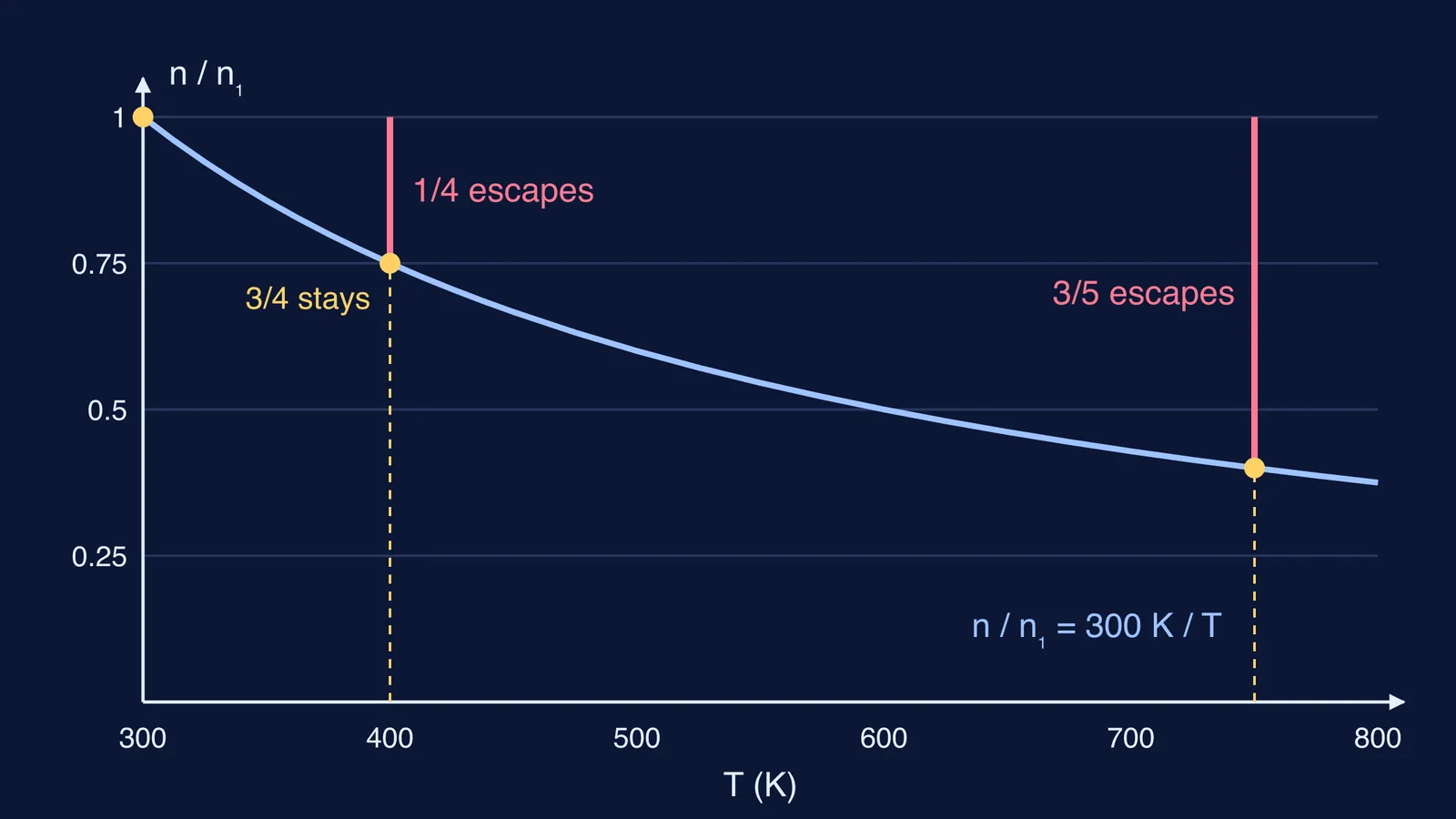
The ideal gas law is PV = nRT, and the temperature in it must be on the kelvin scale (OpenStax Chemistry 2e, section 9.2). Rearranged, n = PV/(RT). With P, V and R all constant, n ∝ 1/T: double the absolute temperature and the flask can hold only half as many moles.
As the air warms, its molecules move faster. In a sealed flask the pressure would rise; in an open one, air flows out until the inside pressure matches the room again. What leaves is the air the hotter flask can no longer hold.
How do you find the fraction of air that escapes?
Write the amount at the start (temperature T₁) and the end (T₂), and divide:
n₂ / n₁ = T₁ / T₂
The fraction that stays is T₁/T₂. The fraction that escapes is:
fraction escaped = (n₁ − n₂)/n₁ = 1 − T₁/T₂ = (T₂ − T₁)/T₂
The denominator is the final temperature, not the starting one.
To get kelvin, add 273.15 to a Celsius reading; zero degrees Celsius is 273.15 K (NIST, SI units of temperature).
Worked example: an open flask heated from 27 °C to 127 °C
Problem. A 1.00 L flask, open to the air at 1 atm, is heated from 27 °C to 127 °C. What fraction of the air escapes, and how many moles is that?
We use 1 atm = 101,325 Pa, which is 101.325 kPa (OpenStax Chemistry 2e, Table 9.1), and R = 8.314 kPa L mol⁻¹ K⁻¹ (OpenStax, section 9.2). For why this R fits litres and kilopascals, see which value of R to use with which units.
Convert to kelvin: T₁ = 27 + 273.15 = 300.15 K and T₂ = 127 + 273.15 = 400.15 K.
Fraction that stays: T₁/T₂ = 300.15/400.15 = 0.750.
Fraction that escapes: 1 − 0.750 = 0.250, or one quarter.
Moles at the start: n₁ = PV/(RT₁) = (101.325 × 1.00)/(8.314 × 300.15) = 0.0406 mol.
Moles at the end: n₂ = (101.325 × 1.00)/(8.314 × 400.15) = 0.0305 mol.
Moles that escaped: 0.0406 − 0.0305 = 0.0101 mol, and 0.0101/0.0406 ≈ 0.25 of the original.
Both routes agree. In an exam, steps 1 to 3 are enough unless the question asks for moles.
Why is the answer not one-third?
The most common slip is to write (T₂ − T₁)/T₁ = 100/300 = 1/3. That number is real, but it answers a different question.
Imagine the original air trapped in a stretchy bag at constant pressure, where volume is proportional to kelvin temperature (Charles's law, OpenStax section 9.2). Heated from 300 K to 400 K, it swells to 4/3 of the flask's volume. The extra 1/3 of a flask spills out of the mouth. But 1/3 is measured against the old volume. As a share of all that expanded air (4/3 of a flask), the part outside is (1/3) ÷ (4/3) = 1/4.
So a quick self-check: if your fraction escaped has T₁ in the denominator, look again.
How do you solve the reverse problems?
Find the final temperature. An open vessel at 27 °C is heated until 3/5 of its air has been expelled. Then 2/5 stays, so T₁/T₂ = 2/5. Taking 27 °C as 300 K, T₂ = 300 × 5/2 = 750 K, about 477 °C (NIST conversion).
Cooling instead of heating. When the open flask cools from T₂ back to T₁, room air flows in, and the amount inside rises back to n₁.
Two vessels or a balloon. The same n ∝ 1/T idea at fixed pressure and volume explains how a hot air balloon gets its lift, and a related moles balance solves the final pressure when two gas containers are connected.
Before you write an answer, run this four-line checklist:
Is the vessel open? Then P and V are fixed and only n and T change.
Are both temperatures in kelvin?
Stays = T₁/T₂; escapes = 1 − T₁/T₂.
Is the fraction between 0 and 1, with T₂ in the denominator?
If you keep putting the wrong temperature in the denominator, the Fermi Problem Library has worked problems with a step-by-step solver that explains the reasoning rather than printing an answer. If the gap is the ideal gas law itself, the Fermi Concept Library gives each concept its own lesson.