

On this page
If the Moon pulls the ocean towards it, you would expect one high tide a day, when your coast faces the Moon. Yet NASA notes that most shorelines get two high and two low tides per day. The puzzle is the second bulge, on the side facing away from the Moon. Drawing the Moon's pull as arrows solves it.
Why are there two high tides a day?
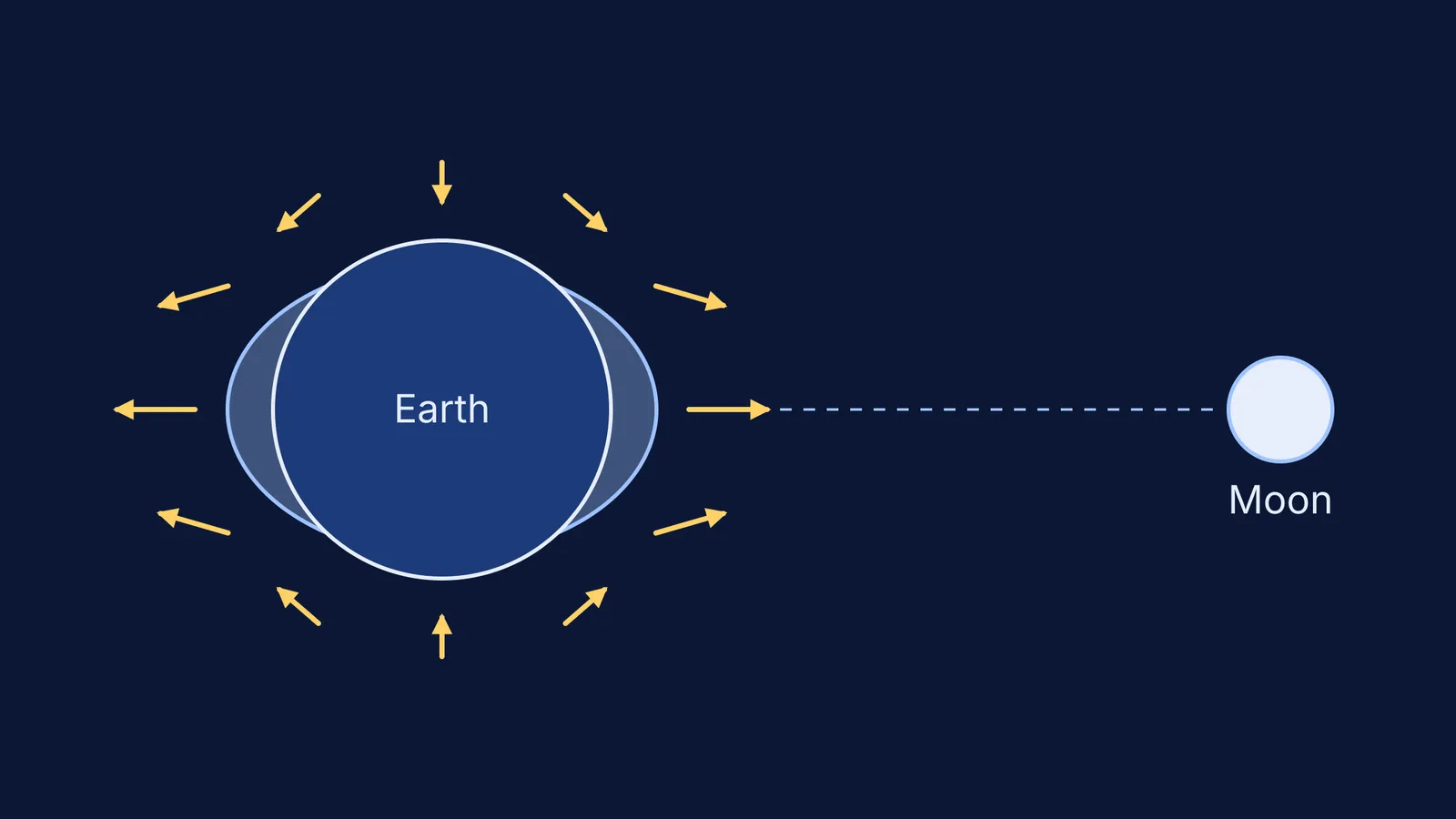
The oceans form two bulges: one on the side of Earth nearest the Moon and one on the side farthest from it (NOAA). Earth spins under both, so a point on the coast passes under a bulge twice per turn.
A lunar day lasts 24 hours and 50 minutes, because the Moon moves round Earth in the same direction Earth spins. On the same page, NOAA says high tides come 12 hours and 25 minutes apart, which is why high tide arrives about 50 minutes later each day.
Not every coast follows the textbook. NOAA describes three patterns: two equal highs per lunar day, two unequal highs, or just one high and one low, as in the Gulf of Mexico. Continents block the bulges, so each ocean basin sets up its own pattern.
Why does the far side of Earth bulge too?
The Moon pulls every part of Earth, but gravity weakens with the square of the distance, so the pulls differ. Here is a worked example. It uses the Moon's mass (7.346 × 10^22 kg) and mean distance (384,400 km) from NASA's Moon fact sheet, Earth's mean radius (6,371 km) from NASA's Earth fact sheet, and G from NIST.
Pull at Earth's centre: 3.318 × 10^-5 m/s^2
Pull on the near side (378,029 km from the Moon): 3.431 × 10^-5 m/s^2
Pull on the far side (390,771 km from the Moon): 3.211 × 10^-5 m/s^2
Now subtract the centre's arrow. Earth as a whole is already falling towards the Moon, so only the leftover stretches it. The near side is left with +1.13 × 10^-6 m/s^2, towards the Moon. The far side is left with −1.07 × 10^-6 m/s^2. It is pulled less than the centre, so it gets left behind, away from the Moon. Two nearly equal arrows point outward, making two bulges.
NOAA describes the far side another way: there, inertia exceeds the gravitational force. Same physics, different frame. The leftover arrow is about a ten-millionth of the 9.82 m/s^2 surface gravity in the NASA Earth fact sheet above. It moves water only because it acts across whole oceans. If g and G blur together here, read the difference between small g and big G.
Predict first: where will the bulges form?
Try this on paper first:
Draw Earth with the Moon to the right. Mark eight points around the edge.
At each point, draw the Moon's pull aimed at the Moon, slightly longer on the near side.
Subtract the centre's arrow. Predict which leftovers point out and which point in.
Shade where water piles up. Count the bulges a point on the equator passes in one turn.
Check: the near and far leftovers should be roughly equal and opposite. At the top and bottom, the leftovers should point inward.
Why do spring and neap tides follow the Moon's phases?
The Sun stretches Earth too. NASA gives the Sun about 27 million times the Moon's mass, at about 390 times the distance. Pull falls with the square of distance, so the Sun pulls Earth about 27,000,000 ÷ 390^2 ≈ 178 times harder than the Moon. But tide-generating forces vary inversely as the cube of the distance, so the Sun's stretch is 27,000,000 ÷ 390^3 ≈ 0.46 of the Moon's. That matches NOAA's "about half".
At new and full moon, Sun, Moon and Earth line up and the stretches add, giving spring tides with extra-high highs and very low lows. About a week later, at the quarter moons, the Sun and Moon pull at right angles and partly cancel, giving moderate neap tides. NOAA counts two of each per lunar month.
A prediction to test: in this model, the spring stretch is 1 + 0.46 = 1.46 and the neap stretch 1 − 0.46 = 0.54. That would make spring tides nearly three times the size of neap tides. Continents and the shape of each ocean basin reshape real tides, so test this against a tide table for a port near you.
How can you see this move?
A static diagram cannot show Earth turning under the bulges. The Fermi Simulation Lab has interactive simulations for ideas that are easier to see than to read. Keep the habit from our guide to planetary orbits with a gravity simulation: write your prediction down before you press play. If the inverse-cube step is not landing, the Fermi Concept Library gives each physics concept its own lesson.
Next time you see a tide table, find the full moon and check whether the biggest range sits close to it.


