

On this page
In mechanics and gravitation, the letters G and g look similar but represent completely different physical ideas. Confusing the two is a common error in early physics.
To put it simply: G is a property of the universe, and g is a property of a specific location.
What is big G?
Big G is the Newtonian constant of gravitation. It measures the fundamental strength of the gravitational force between any two masses in the universe.
According to the 2022 CODATA recommended values published by the National Institute of Standards and Technology (NIST), the value of G is 6.67430 × 10⁻¹¹ m³ kg⁻¹ s⁻².
Because it is a universal constant, G never changes. It is exactly the same whether you are measuring the attraction between two apples on a desk, or the orbit of the Moon around Earth. Because gravity is an extremely weak force at everyday scales, measuring G accurately is famously difficult; the first reliable measurement was achieved by Henry Cavendish using a delicate torsion balance.
What is small g?
Small g is the acceleration due to gravity. It tells you how much an object's velocity increases every second when it falls freely near a massive body like a planet.
In 1901, the 3rd General Conference on Weights and Measures (CGPM) defined the standard acceleration due to gravity as exactly 9.80665 m/s². This is a conventional average used for calculations and textbook problems.
However, the actual value of g is not a constant. It changes depending on which planet you are on, your altitude, and even your latitude.
Why does small g change from equator to poles?
If you travel across Earth, the local value of g shifts. According to data summarised on the Gravity of Earth, the acceleration due to gravity varies by about 0.7% across the surface. It is roughly 9.780 m/s² at the equator and increases to 9.832 m/s² at the poles.
This difference happens for two reasons:
The equatorial bulge: Earth is not a perfect sphere; it is an oblate spheroid. Because the planet bulges outward at its middle, the surface at the equator is further from the centre of mass than the surface at the poles. Gravity weakens with distance, so g is smaller at the equator.
Centrifugal force: As Earth rotates, an object at the equator experiences an outward centrifugal force. This force partially counteracts the inward pull of gravity, lowering the effective weight of the object. At the poles, the rotational radius is zero, so there is no centrifugal force to oppose gravity.
These variations mean that a simple pendulum in a lift or accelerating car or even one taken from the poles to the equator will swing at a different rate. Measuring g with a simple pendulum is a classic school experiment that shows how local this value really is.
The formula linking g and G
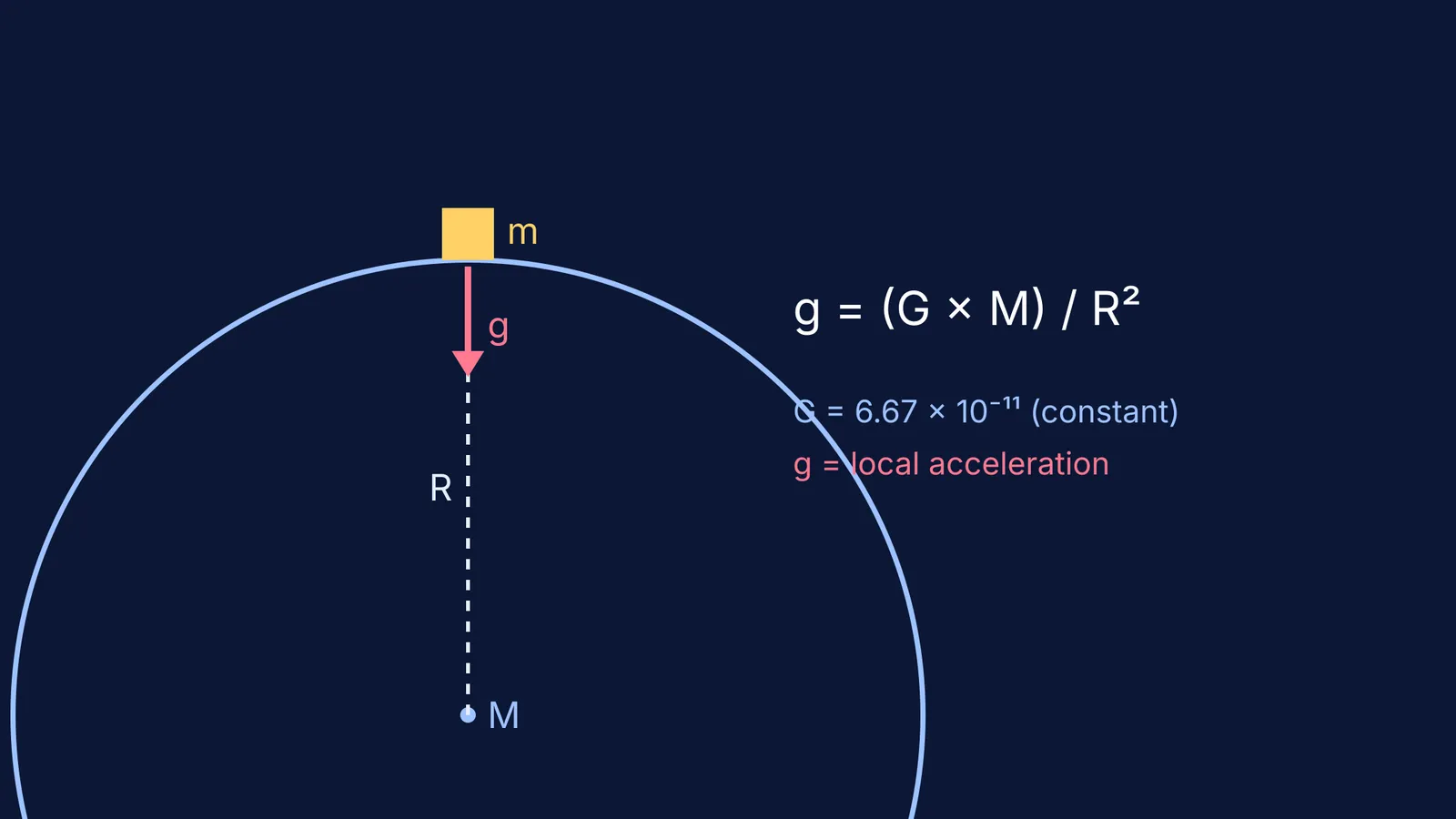
Newton's law of universal gravitation shows exactly how G creates the local acceleration g. For an object of mass m resting on the surface of a planet with mass M and radius R, the gravitational force F is:
F = (G × M × m) / R²
From Newton's second law, we know that force also equals mass times acceleration (F = mg). Setting these two equations equal gives:
mg = (G × M × m) / R²
The mass of the falling object (m) cancels out on both sides, leaving the fundamental link between the two constants:
g = (G × M) / R²
This equation proves why all objects fall at the same rate regardless of their mass, and it shows mathematically why g decreases if the radius R increases.
A worked example: calculating the mass of Earth
You can use the link between g and G to find the mass of Earth without putting it on a scale.
You know standard g is 9.80665 m/s².
You know Earth's mean radius R is roughly 6.371 × 10⁶ m.
You know G is 6.67430 × 10⁻¹¹ m³ kg⁻¹ s⁻².
Rearranging the formula to solve for M:
M = (g × R²) / G M = (9.80665 × (6.371 × 10⁶)²) / (6.67430 × 10⁻¹¹) M = (9.80665 × 4.05896 × 10¹³) / (6.67430 × 10⁻¹¹) M ≈ 5.96 × 10²⁴ kg
If you make a wrong-method mistake while rearranging these gravitation equations, the Fermi Problem Library has worked problems with a step-by-step solver that explains the reasoning rather than printing an answer. This helps you trace whether your error was in the physics setup or the algebra.
Understanding the difference between the universal G and the local g is the key to solving problems about satellites, Kepler's second law and changing gravity.


