On this page
The syllabus line for this chapter is short and the methods are few. Here is what is on it, each method on a worked example, and a two-week plan.
What does the JEE Main syllabus say about differential equations?
NTA's Syllabus for JEE (Main) 2027 puts the topic in Mathematics Unit 9: "Ordinary differential equations, their order and degree, the solution of differential equation by the method of separation of variables, solution of a homogeneous and linear differential equation of the type dy/dx + p(x)y = q(x)." Check the current file on the NTA JEE Main website before you plan.
The teaching behind that line is Chapter 9, Differential Equations, of the NCERT Class 12 Mathematics textbook. Do its exercises before any extra material.
How do you find the order and degree of a differential equation?
The order of a differential equation is the order of the highest derivative in it, and its degree is the highest power of that derivative, defined only when the equation is a polynomial in its derivatives (NCERT Chapter 9).
Worked example: y'' = (1 + (y')²)^(3/2). The highest derivative is y'', so the order is 2. The equation is not yet a polynomial in derivatives, so square both sides: (y'')² = (1 + (y')²)³. Now y'' appears squared, so the degree is 2, not 1. Check: no fractional power of a derivative remains, and nothing like sin(y') appears, which NCERT notes would leave the degree undefined.
How do you solve the three first-order types?
Variable separable
Problem: dy/dx = xy, with y(0) = 2.
Separate: dy/y = x dx.
Integrate: ln|y| = x²/2 + C, so y = A·e^(x²/2).
Use y(0) = 2: A = 2, so y = 2e^(x²/2).
Check 1: dy/dx = 2x·e^(x²/2) = x·y. Check 2: at x = 0, y = 2e⁰ = 2.
Homogeneous
Problem: dy/dx = (x² + y²)/(xy), with y(1) = 1.
Put y = vx, so dy/dx = v + x dv/dx.
The right side becomes (1 + v²)/v = 1/v + v, so x dv/dx = 1/v.
Separate: v dv = dx/x, so v²/2 = ln|x| + C, which gives y² = x²(2 ln|x| + K).
Use y(1) = 1: K = 1, so y² = x²(2 ln x + 1).
Check 1: differentiate y² = 2x² ln x + x² to get 2y·y' = 4x ln x + 4x, so y' = (2x ln x + 2x)/y, which is what (x² + y²)/(xy) simplifies to. Check 2: at (1, 1) both sides give a slope of 2.
Linear
Problem: dy/dx + y = x, with y(0) = 0.
Here P = 1, so the integrating factor is e^(∫1 dx) = e^x.
Multiply through: d/dx(y·e^x) = x·e^x.
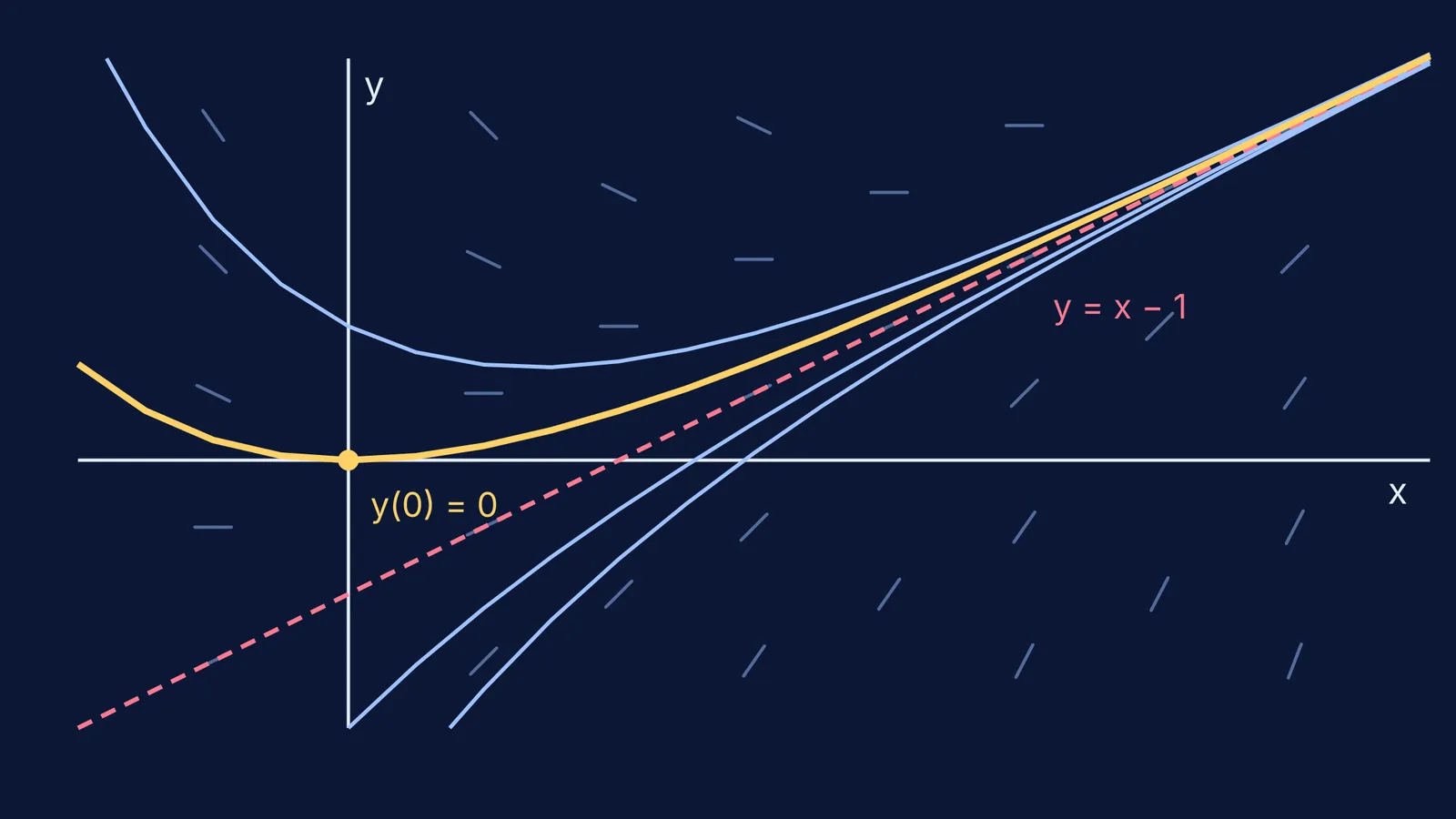
Integrate by parts: y·e^x = (x − 1)e^x + C, so y = x − 1 + Ce^(−x).
Use y(0) = 0: C = 1, so y = x − 1 + e^(−x).
Check 1: y' = 1 − e^(−x), and y' + y = x. Check 2: at x = 0, y = −1 + 1 = 0. The picture above shows this family bending towards y = x − 1 as Ce^(−x) dies away.
What are the common traps in this chapter?
Finding the degree before clearing radicals from the derivatives, as in the example above.
Forgetting to divide by the coefficient of dy/dx. In x dy/dx + 2y = x², P is 2/x, not 2, so the integrating factor is x² and y = x²/4 + C/x².
Dividing by y and losing y = 0. In dy/dx = xy, y = 0 is also a solution.
Missing an equation that is linear in x. If it fits dx/dy + P(y)x = Q(y), swap roles and use the integrating factor e^(∫P dy).
Substituting y = vx without testing homogeneity first: replace x and y by λx and λy and see whether λ cancels.
What about JEE Advanced?
The JEE (Advanced) 2027 syllabus page still says "Coming soon", so compare its line with NTA's once it is out. For harder practice, choose problems where you must form the equation yourself from a condition about a tangent, an area or a rate.
What does a two-week practice plan look like?
Work from NCERT Chapter 9 first, then the past JEE Main question papers on the NTA JEE Main website.
Days 1-2: read the chapter and do the order-and-degree exercises.
Days 3-4: variable separable, both checks on every answer.
Days 5-6: homogeneous equations, with the homogeneity test.
Days 7-8: linear equations, including ones linear in x.
Day 9: a mixed set; name the type before solving.
Days 10-11: past JEE Main questions from this unit, timed.
Day 12: sort every mistake by trap.
Days 13-14: redo every wrong question, then a timed mixed set.
If integration by parts is shaky, revise it in the Fermi Concept Library before day 7. When a step goes wrong, the Fermi Problem Library has worked problems with a step-by-step solver that explains the reasoning rather than printing an answer.
For the rest of your JEE Main and Advanced preparation, start at Fermi Test Prep.