On this page
NTA's syllabus describes Binomial Theorem in a single line, and most of its questions come from one formula. Learn exactly what is listed, then practise the four kinds of question it produces.
What does the JEE Main syllabus say about Binomial Theorem?
NTA's Syllabus for JEE (Main) 2027 names Unit 5 "Binomial theorem and its simple applications" and lists it in one line: "Binomial theorem for a positive integral index, general term and middle term and simple applications." Negative and fractional indices are not mentioned, so on the syllabus's wording the infinite binomial series is not part of JEE Main.
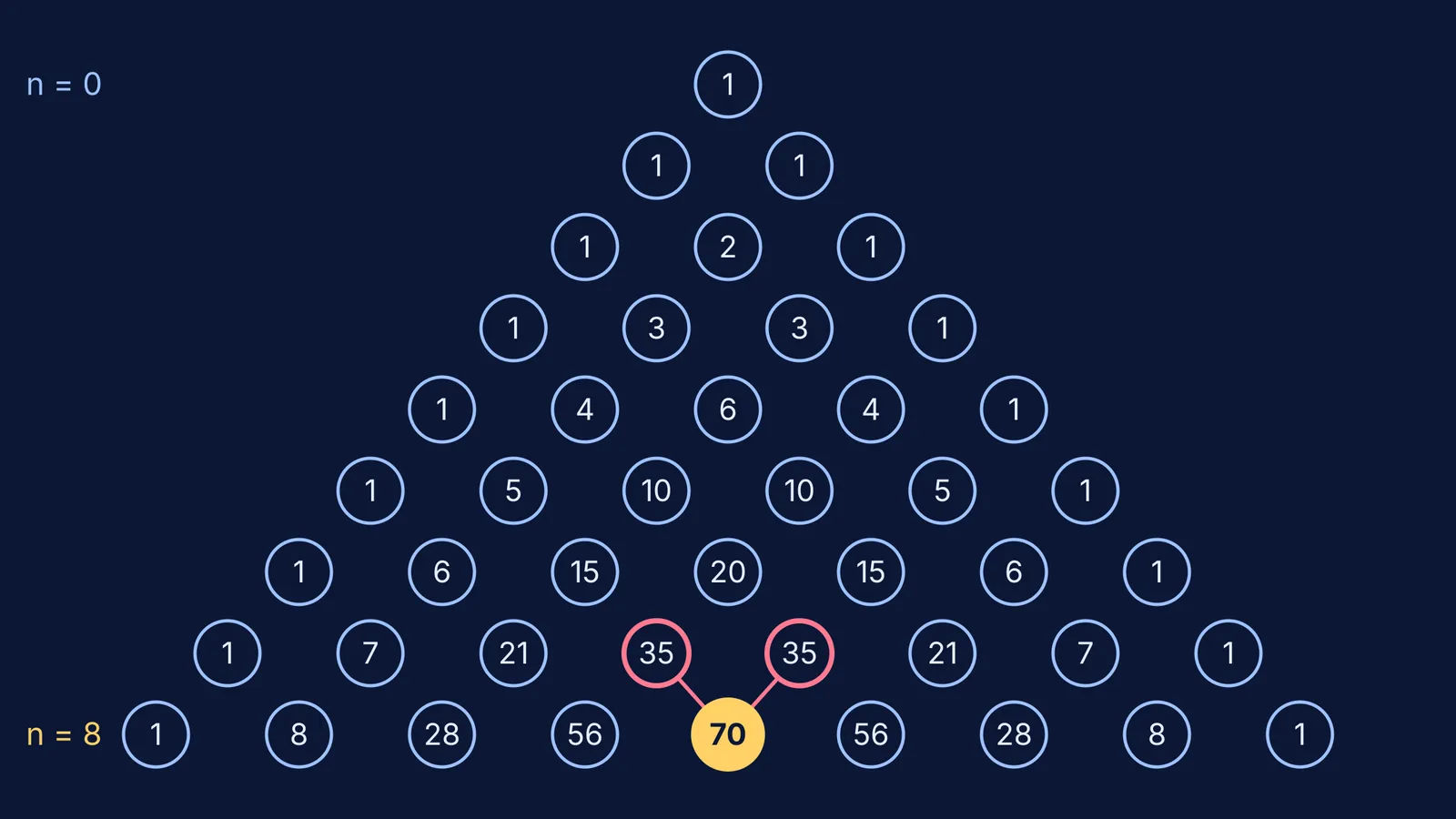
The NCERT source is Chapter 7, Binomial Theorem, in the Class 11 Mathematics textbook (reprint 2026-27). It proves the theorem for any positive integer n by induction, builds Pascal's triangle, and shows that putting x = 1 in (1 + x)^n gives nC0 + nC1 + ... + nCn = 2^n. Notice the gap: the current chapter has no separate section on the general term or the middle term, even though the NTA syllabus names both.
What are the core ideas, with worked examples?
NCERT writes the theorem as (a + b)^n = sum of nCk · a^(n−k) · b^k for k = 0 to n. Most questions in this unit come from one term of that sum, the general term: T(r+1) = nCr · a^(n−r) · b^r. Each example below is solved once with the formula and checked a second way.
1. A coefficient. Find the coefficient of x^5 in (2x − 1/x)^7.
T(r+1) = 7Cr · (2x)^(7−r) · (−1/x)^r = 7Cr · 2^(7−r) · (−1)^r · x^(7−2r). Set 7 − 2r = 5, so r = 1. The coefficient is 7 × 64 × (−1) = −448.
Check: the second term of the expansion is 7 · (2x)^6 · (−1/x) = 7 · 64x^6 · (−1/x) = −448x^5.
2. The middle term. (a + b)^n has n + 1 terms. If n is even there is one middle term, T(n/2 + 1); if n is odd there are two, T((n+1)/2) and T((n+3)/2). Find the middle term of (2x + 3)^8.
Here n = 8, so the middle term is T5, with r = 4: 8C4 · (2x)^4 · 3^4 = 70 × 16 × 81 · x^4 = 90720x^4.
Check: 8C4 = (8 × 7 × 6 × 5)/24 = 70; 16 × 81 = 1296; 1296 × 70 = 90720.
3. The term independent of x. Find it in (x^2 − 2/x)^6.
T(r+1) = 6Cr · (x^2)^(6−r) · (−2/x)^r = 6Cr · (−2)^r · x^(12−3r). Set 12 − 3r = 0, so r = 4, and the term is 15 × 16 = 240.
Check: T5 = 15 · (x^2)^2 · (−2/x)^4 = 15 · x^4 · 16/x^4 = 240.
4. Properties of binomial coefficients. NCERT puts x = 1 in (1 + x)^n to get 2^n, and x = 1 in (1 − x)^n to get nC0 − nC1 + nC2 − ... = 0. Add the two results and halve: nC0 + nC2 + nC4 + ... = 2^(n−1).
Check with n = 6: 1 + 15 + 15 + 1 = 32 = 2^5.
If your answer differs and you cannot see where, the Fermi Problem Library has worked problems with a step-by-step solver that explains the reasoning rather than printing an answer.
Which Binomial Theorem mistakes cost the most marks?
Off by one: the term with b^r is T(r+1), so "the 5th term" means r = 4.
Dropping the sign: in (a − b)^n the factor is (−b)^r, so the sign changes with r.
Confusing the binomial coefficient nCr with the coefficient of the term, which also carries the powers of a and b.
Forgetting that an odd n gives two middle terms.
Writing 2^n as the sum of coefficients of (2x + 3)^n. Put x = 1 instead: the sum is 5^n.
How is JEE Advanced different from JEE Main here?
JEE Advanced has its own syllabus. At the time of writing, the official JEE (Advanced) 2027 syllabus page says only "Coming soon", so check it when it is published rather than relying on an older list.
For Main, the NTA phrase "simple applications" is your boundary. If you are also preparing for Advanced, treat the four ideas above as the base and add longer problems that combine binomial coefficients with other chapters until the official list is out.
What is a good two-week plan for Binomial Theorem?
Days 1-2: Read NCERT Chapter 7, redo its four solved examples without looking, then Exercise 7.1.
Days 3-4: General term only. Write T(r+1) in full before every coefficient question.
Days 5-6: Middle terms and terms independent of x.
Day 7: A timed mixed set. Start an error log: question, wrong step, correct step.
Days 8-9: Coefficient properties: x = 1, x = −1, even and odd sums.
Days 10-11: Applications such as remainders (NCERT Example 4) and comparing large powers (NCERT Example 3).
Day 12: Previous years' JEE Main questions on the unit, timed.
Day 13: Redo every question in your error log.
Day 14: One final timed mixed set.
For the rest of the syllabus, Fermi Test Prep is our home for JEE Main and Advanced preparation.