On this page
Statistics in JEE Main rewards careful arithmetic more than clever ideas, and the whole unit rests on two NCERT chapters.
What does the JEE Main syllabus include in Statistics?
The NTA's syllabus for JEE (Main) 2027 lists Statistics and Probability as Unit 13 of Paper 1 mathematics. The statistics part reads: "Measures of dispersion; calculation of mean, median, mode of grouped and ungrouped data, calculation of standard deviation, variance and mean deviation for grouped and ungrouped data." Check the NTA JEE Main website before your exam in case it changes.
Two NCERT chapters cover all of it:
Class 10 Chapter 13: mean of grouped data by the direct, assumed-mean and step-deviation methods, plus median and mode of grouped data.
Class 11 Chapter 13: range, mean deviation, variance and standard deviation for ungrouped and grouped data.
How do you calculate mean, median, mode and standard deviation?
In NCERT Class 11 Chapter 13, variance is the mean of the squared deviations from the mean, σ² = (1/n)Σ(x − x̄)², and standard deviation is its positive square root. It divides by n, not n − 1. Work each example once, then check it a second way.
Example 1: ungrouped data
Eight mock-test scores: 6, 9, 9, 10, 12, 14, 17, 19.
Mean: 96 ÷ 8 = 12.
Median: the average of the 4th and 5th values, (10 + 12) ÷ 2 = 11.
Mode: 9, the only repeated value.
Variance: the squared deviations from 12 add to 136, so σ² = 17 and σ = √17 ≈ 4.12.
Check: Σx² = 1288, and 1288 ÷ 8 − 12² = 161 − 144 = 17.
Example 2: grouped data
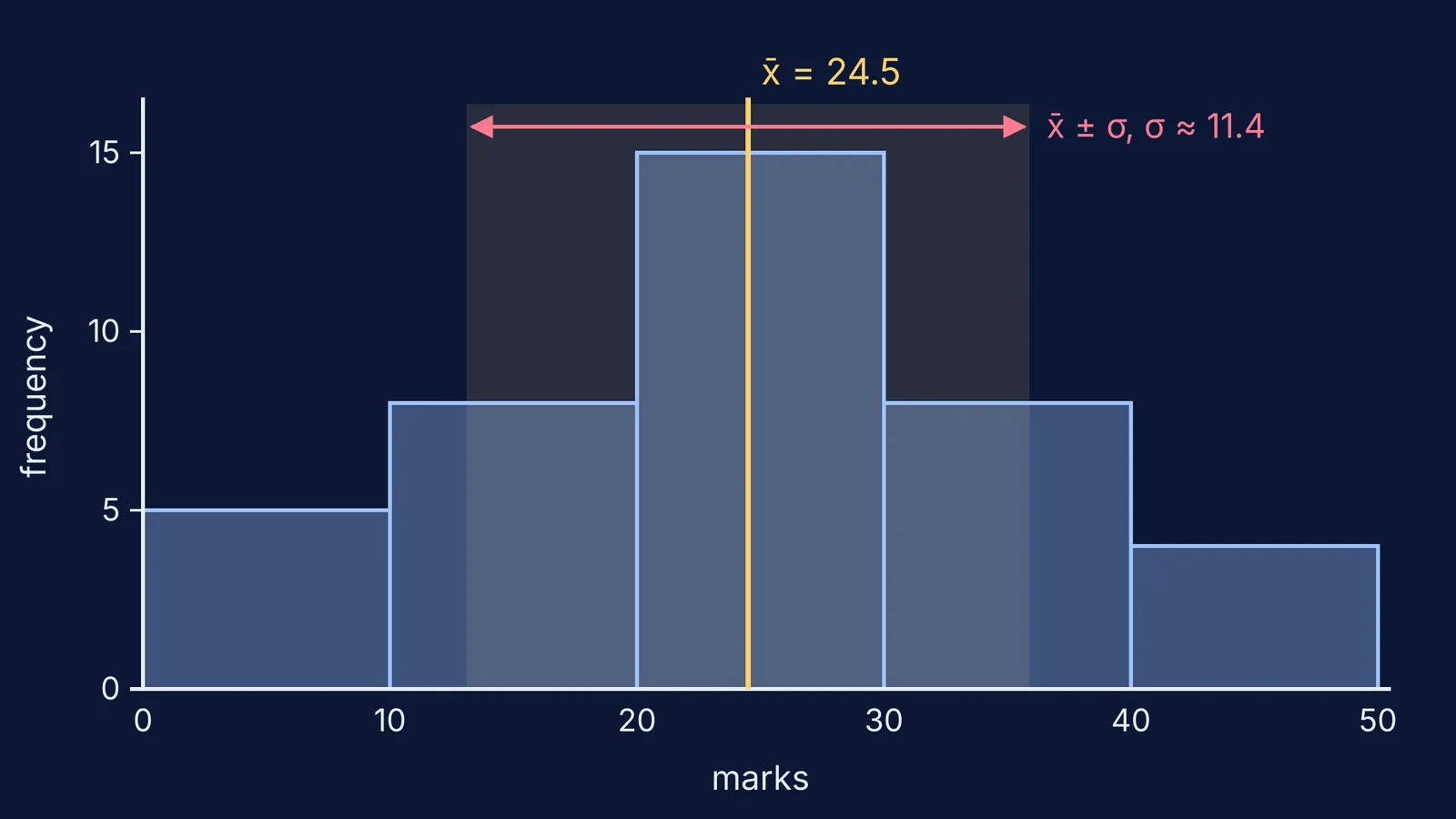
The marks of 40 students fall into classes 0–10, 10–20, 20–30, 30–40 and 40–50 with frequencies 5, 8, 15, 8 and 4, so the midpoints are 5, 15, 25, 35 and 45.
Mean by step deviation (a = 25, h = 10): Σfd = −2, so x̄ = 25 + (−2 ÷ 40) × 10 = 24.5. Check: Σfx = 980, and 980 ÷ 40 = 24.5.
Median: N/2 = 20 and the cumulative frequencies are 5, 13, 28, so the median class is 20–30. Median = l + ((N/2 − C) ÷ f) × h = 20 + (7 ÷ 15) × 10 ≈ 24.67.
Mode: in the modal class 20–30, f₁ = 15 and f₀ = f₂ = 8. Mode = l + ((f₁ − f₀) ÷ (2f₁ − f₀ − f₂)) × h = 20 + (7 ÷ 14) × 10 = 25.
Variance: Σfd² = 52, so σ² = h² × (Σfd²/N − (Σfd/N)²) = 100 × (1.3 − 0.0025) = 129.75, and σ ≈ 11.39.
Check: Σfx² = 29,200, and 29,200 ÷ 40 − 24.5² = 730 − 600.25 = 129.75.
What are the common mistakes in JEE Main statistics?
Class limits instead of midpoints. Grouped mean and variance use each class's midpoint.
The wrong C in the median formula. C is the cumulative frequency of the class before the median class.
Forgetting h² in step-deviation variance. You multiply by h to get the mean but by h² to get the variance.
Gaps between classes. For classes such as 16–20 and 21–25, NCERT subtracts 0.5 from each lower limit and adds 0.5 to each upper limit first.
Change of origin and scale. If every score x becomes 2x + 3, the mean becomes 2x̄ + 3 but the variance becomes 4σ². Adding 3 shifts the scores without changing their spread. In Example 1 this gives σ² = 68.
Corrected entries. When one value was misread, fix both Σx and Σx², then recompute.
If one method error keeps coming back, the Fermi Problem Library has worked problems with a step-by-step solver that explains the reasoning rather than printing an answer, so you can find the step where your table went wrong.
How is JEE Advanced statistics different from JEE Main?
The statistics topics are almost the same. The JEE (Advanced) 2026 syllabus, which says it is unchanged from 2025, lists mean, median, mode, mean deviation, standard deviation and variance of grouped and ungrouped data under Probability and Statistics. It adds "analysis of the frequency distribution with same mean but different variance" and the mean and variance of a random variable, under the same heading as conditional probability and Bayes' theorem.
So for JEE Advanced, practise comparing distributions with the same mean. NCERT Class 11 opens with a case like this: two batsmen with the same mean and median, 53, but very different spreads.
A two-week plan to prepare statistics for JEE Main
Use the Class 10 and Class 11 chapters as your base, about an hour a day.
Days 1–2: Class 10 Chapter 13. Learn the three mean methods, median and mode, then redo the solved examples unseen.
Days 3–4: Class 11 Chapter 13: range and mean deviation.
Days 5–6: Variance and standard deviation. Solve each problem both ways.
Day 7: Rest, then a timed mixed set of 20 questions.
Days 8–9: Change of origin and scale, corrected entries, and the combined mean of two groups.
Days 10–11: Statistics questions from past JEE Main papers, timed.
Day 12: Rewrite each mistake in your error log as a one-line rule.
Day 13: A mixed set with probability, which shares Unit 13.
Day 14: Write the formula sheet from memory and check it against NCERT.
When you want a plan for the rest of the syllabus, Fermi Test Prep is where we bring together JEE Main and Advanced preparation.