On this page
Spearmint and dill seed smell nothing alike, yet the main compound in both oils is carvone, C₁₀H₁₄O. The two plants make mirror images of the same molecule. That makes carvone a compact way to practise three exam skills: assigning R or S at a ring stereocentre, seeing why an R/S label can change without any inversion, and working out enantiomeric excess from a polarimeter reading.
Which carvone is in spearmint and which is in dill?
The Hazardous Substances Data Bank (HSDB) entry on carvone in PubChem, quoting Kirk-Othmer, gives these figures:
Spearmint oils usually contain 55–75% of (R)-(−)-carvone.
Dill oil (Anethum graveolens) contains 30–65% of (S)-(+)-carvone, and caraway oil (Carum carvi) 50–75%.
The l-form is described as having a spearmint-like odour. The d-form is described as caraway-like, with a "rye bread" odour and taste.
India grows a lot of spearmint. A 2022 field trial by CSIR-CIMAP at its Pantnagar research centre in Uttarakhand, published in the Indian Journal of Agricultural Sciences, calls India "probably the biggest producer of spearmint oil", at around 325 MT in 2015. It tested five spearmint cultivars. Their oils, obtained by 3 hours of hydrodistillation, contained 51.4–64.35% carvone and 16.65–35.1% limonene. The authors call these two compounds the marker compounds of the oil.
The trial measured carvone by gas chromatography on an ordinary column, and HSDB notes that standard chromatography cannot separate the two enantiomers. So the trial tells you how much carvone there is, and HSDB tells you which hand it is.
How do you assign R or S to carvone's stereocentre?
Carvone is 2-methyl-5-(prop-1-en-2-yl)cyclohex-2-en-1-one. C1 is the C=O, C2=C3 is the ring double bond, and C5 carries the isopropenyl group. C5 is the only stereocentre. Rank its four groups step by step:
First atoms. The isopropenyl carbon, C4 and C6 are all carbon. H is fourth.
Isopropenyl. Its first carbon is attached to (C, C, C), because the C=C double bond counts its partner twice. C4 and C6 are each (C, H, H). So isopropenyl ranks 1.
Break the tie between C4 and C6. Go one atom further along each arm. From C6 you reach C1, which carries (O, O, C) because the C=O oxygen is counted twice. From C4 you reach C3, which carries (C, C, H). O beats C at the first point of difference, so the C6 arm ranks 2 and the C4 arm ranks 3.
Orient and read. With H pointing away, trace 1 → 2 → 3. Clockwise is R.
PubChem names the spearmint enantiomer (5R)-2-methyl-5-prop-1-en-2-ylcyclohex-2-en-1-one, which is (R)-(−)-carvone. If you need a refresher on reading wedges, see our guide on R and S configuration from wedge-dash drawings.
Why can (S)-limonene give (R)-carvone with no inversion?
Limonene, C₁₀H₁₆, is 1-methyl-4-(prop-1-en-2-yl)cyclohexene. Its stereocentre is C4. PubChem lists (+)-limonene, also called d-limonene, as (4R).
Rank the groups at limonene's C4. Isopropenyl is still 1. The two ring arms are both CH₂ at the first atom. Go one step further. The C3 arm leads to C2, a =CH– carbon with (C, C, H). The C5 arm leads to C6, a plain CH₂ with (C, H, H). So in limonene, the arm toward the C=C ranks 2.
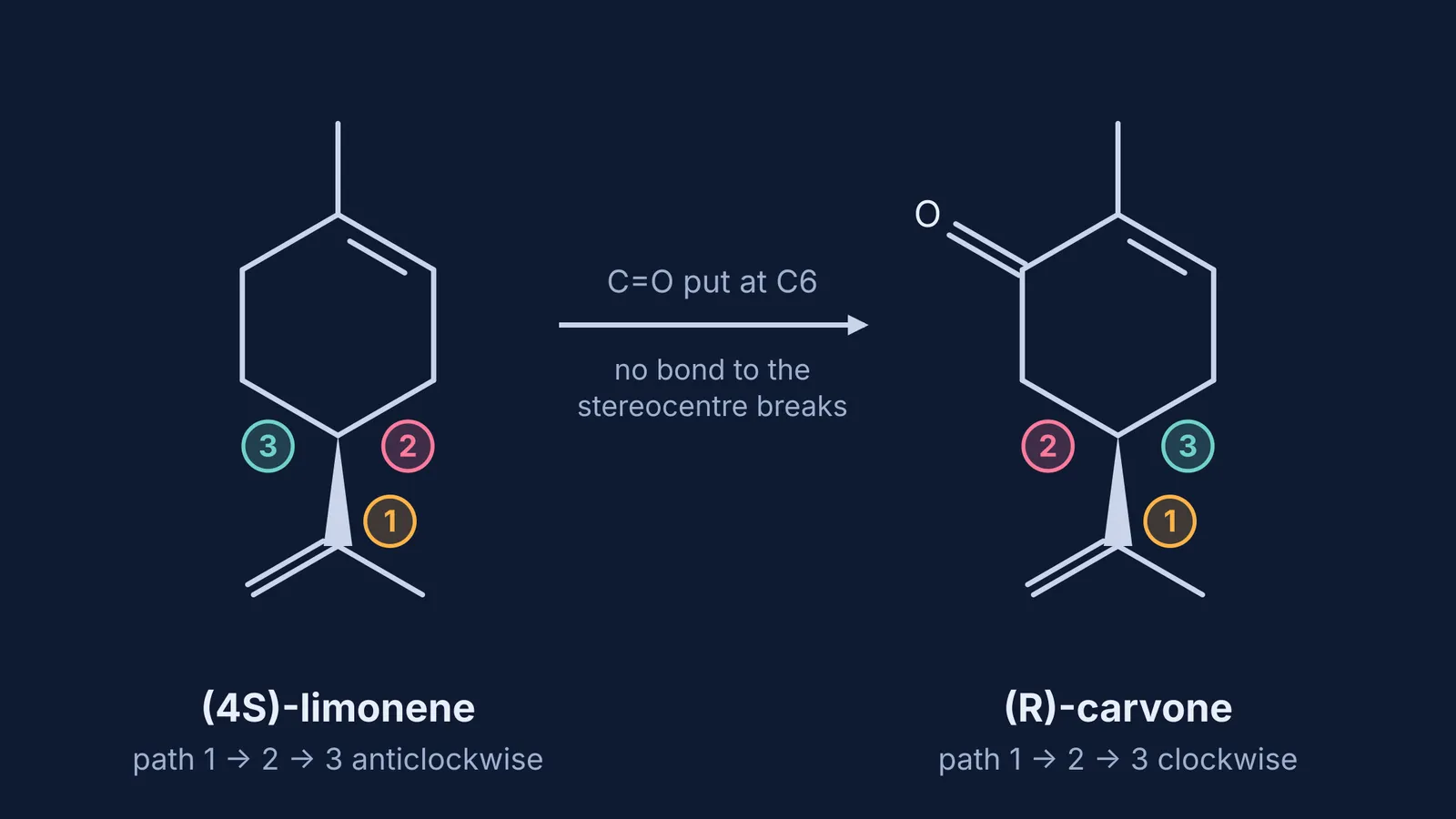
Now do the exercise in the figure above. Keep every atom where it is and put a C=O on limonene's C6. In carvone numbering that carbon becomes C1, and the old C4 becomes C5. The arm that used to rank 3 now leads to a carbonyl carbon (O, O, C) and outranks the arm toward the C=C. Priorities 2 and 3 have swapped, and 1 and 4 have not. A swap of two priorities flips the label. So (4S)-limonene would become (R)-carvone even though no bond to the stereocentre was touched.
The real industrial chemistry gives the opposite case. HSDB says l-carvone "is commercially synthesized from d-limonene". That is (4R)-(+)-limonene giving (R)-(−)-carvone: the R label is kept while the sign of rotation goes from (+) to (−). None of the steps breaks a bond to the stereocentre. So the label can only stay R if the new C=O sits on the arm that already ranked 2, the arm on the C3 side next to the old double bond. We checked both cases with a CIP-labelling program, and the results agree with this reasoning.
How do you find enantiomeric excess from carvone's rotation?
HSDB gives the specific rotation of l-carvone as −62.46° and of d-carvone as +61.2°, both at 20 °C with the sodium D line. Use the method from our post on enantiomeric excess and specific rotation.
Worked example. A carvone fraction from spearmint oil shows [α] = −58.0°. Find its ee and composition.
The sign is negative, so (R)-(−)-carvone is in excess.
ee = 58.0 ÷ 62.46 × 100 = 92.9%.
% (R) = (100 + 92.9) ÷ 2 = 96.4%, and % (S) = 3.6%.
Now use the d-form value, 61.2°, as the reference instead. ee = 58.0 ÷ 61.2 × 100 = 94.8%.
The two literature magnitudes differ by about 2%, so the answer changes by about 2 percentage points. A claim of "100% ee" only means something when the reference rotation is stated.
What links limonene and carvone in the oil?
Carvone (C₁₀H₁₄O, M = 150.22) and limonene (C₁₀H₁₆, M = 136.24) differ by one O gained and two H lost. As overall bookkeeping, not a mechanism:
C₁₀H₁₆ + O₂ → C₁₀H₁₄O + H₂O
Check it. Each side has 10 C, 16 H and 2 O, and each side totals 168.24 g/mol.
The CIMAP table also lets you ask a practical question: which cultivar gives the most carvone per hectare? Multiply the oil yield by the carvone percentage. The GC percentages are peak-area values, so treat the answers as approximate.
Arka: 54.70 kg/ha of oil × 64.35% = 35.2 kg/ha of carvone.
CIM-Mohak: 68.88 × 57.9% = 39.9 kg/ha.
MSS-5: 70.58 × 51.55% = 36.4 kg/ha.
Arka has the richest oil, but CIM-Mohak gives the most carvone per hectare because its oil yield is higher. For the other famous mint molecule, see menthol's eight stereoisomers and Indian mint.
What mistakes cost marks on carvone questions?
Assuming (+) means R, or that the sign of rotation follows the label.
Assuming a reaction "away from" the stereocentre keeps the R/S label. It keeps the arrangement, not the name.
Calling a label change an inversion. Inversion needs a bond to the stereocentre to break and re-form.
Reporting the major percentage (96.4%) as the ee (92.9%).
If R/S questions still trip you, Fermi's AI tutor for JEE prep can work out what you already know and build a plan for the session. For more practice, the Fermi Problem Library has a step-by-step solver that explains the reasoning.
Quick checklist
Spearmint: (R)-(−)-carvone. Dill and caraway: (S)-(+)-carvone.
At C5: isopropenyl > CH₂ toward C=O > CH₂ toward C=C > H.
In limonene the CH₂ toward the C=C ranks above the other CH₂.
Putting a C=O on the lower arm swaps priorities 2 and 3, so the label flips with no inversion.
d-limonene gives l-carvone commercially: label kept, sign changed.
ee = observed [α] ÷ [α] of the pure enantiomer × 100, and say which reference value you used.