On this page
Shellac, the refined resin of the lac insect, is a mixture of esters. Boil it with alkali and one acid separates out readily as its sodium salt: aleuritic acid. This one molecule tests several stereochemistry ideas at once. It has two stereocentres but no meso form. It shows what threo and erythro mean. Its synthesis shows how syn and anti hydroxylation decide the product. And periodic acid cleavage was used to fix where its OH groups sit.
What is aleuritic acid and how much is in shellac?
Aleuritic acid is 9,10,16-trihydroxyhexadecanoic acid, C₁₆H₃₂O₅, M = 304.4:
HOOC–(CH₂)₇–CH(OH)–CH(OH)–(CH₂)₅–CH₂OH
The facts below come from Processing, Chemistry and Applications of Lac, a 2010 ICAR book written at the Indian Institute of Natural Resins and Gums in Ranchi, Jharkhand (full scan on the Internet Archive). Its chapter on lac resin chemistry says aleuritic acid is "readily obtained as sodium salt from alkaline hydrolysate". It melts at 100–101 °C and was first isolated by Tschirch and Farner.
Table 3.1 of the book, checked here against the page scan, lists the yields reported by different research groups:
Shellac: 21.8% and 22.0% (two separate studies).
Hard resin: 40.0%.
Soft resin: 14.0%.
The book also calls aleuritic acid one of India's "lac-based value-added export materials". It reproduces the Indian Standard for it, IS 13160:1991. One requirement is a molecular mass of 303–308 calculated from the acid value.
How many stereoisomers does aleuritic acid have?
C9 and C10 each carry four different groups: OH, H, the other stereocentre, and a chain. So n = 2 and the maximum is 2² = 4.
Tartaric acid also has two stereocentres but only three stereoisomers, because its two ends are identical and one combination is meso. In aleuritic acid the ends differ. One side is (CH₂)₇COOH and the other is (CH₂)₅CH₂OH, so no form can have an internal mirror plane. All four stereoisomers are chiral and there is no meso form. PubChem has a separate record for each of the four: (9R,10S), (9S,10R), (9R,10R) and (9S,10S). The same "different ends, no meso" logic appears in our post on kokum's hydroxycitric acid and its four stereoisomers.
What do threo and erythro mean?
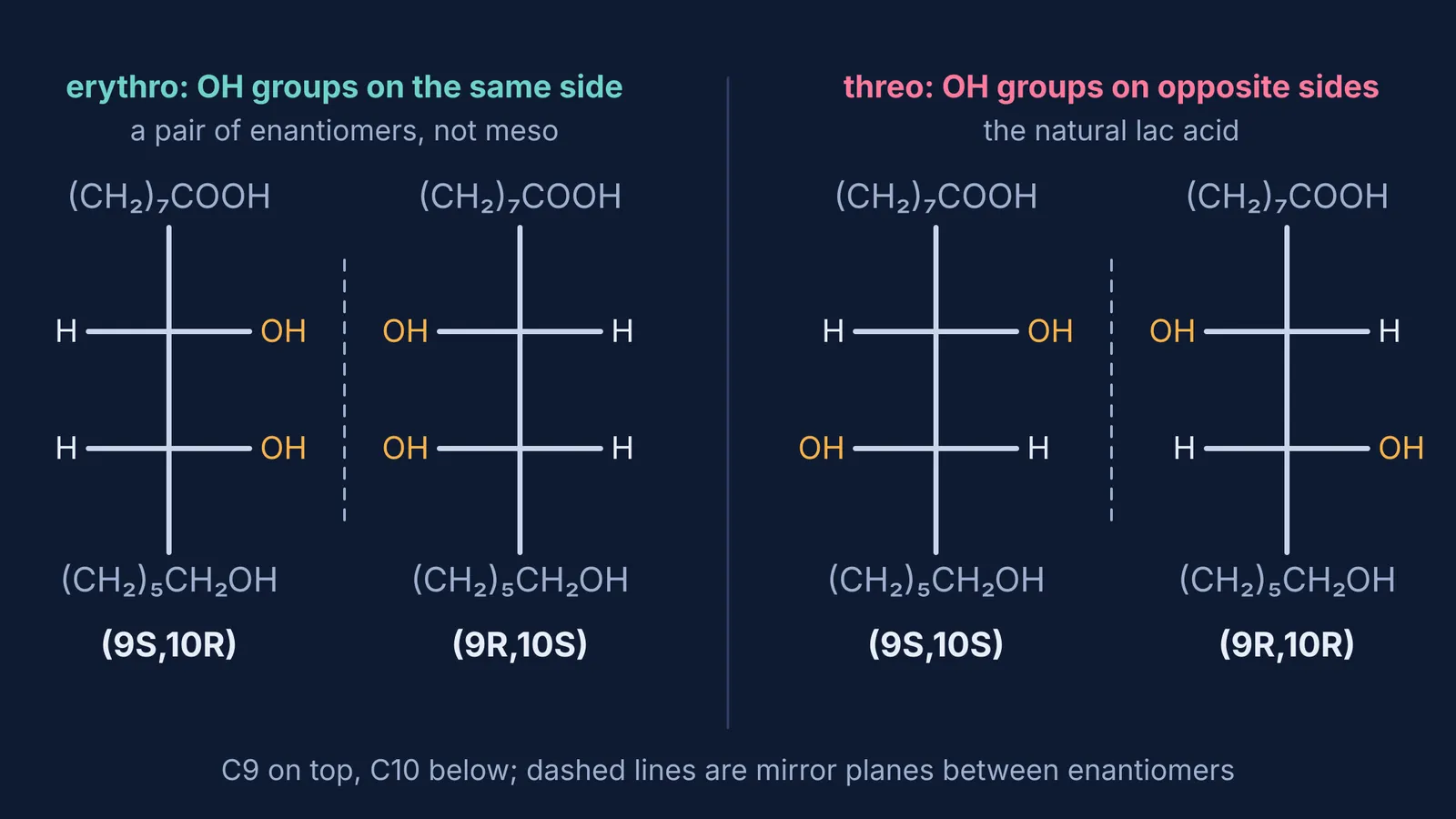
Draw the C9–C10 unit as a Fischer projection, with the chain running up and down, as in the figure above.
Erythro: the two OH groups are on the same side.
Threo: the two OH groups are on opposite sides.
Each stereocentre has the same priority pattern: OH > the other stereocentre > the CH₂ chain > H. So, as in butane-2,3-diol, erythro corresponds to (R,S)/(S,R) and threo to (R,R)/(S,S). PubChem's "threo-aleuritic acid" record is (9S,10S), and its "DL-erythro-aleuritic acid" record is (9R,10S).
The natural acid from lac is threo. The book gives several lines of evidence. Thin-layer chromatography on boric-acid plates and IR spectra both point to threo. Ames and co-workers turned the acid into an alkene through an iodo-acetate and found it was trans (an IR band at 970 cm⁻¹). The iodo-acetate step involves an inversion, so the starting diol must be threo.
The erythro isomer was later made from the natural acid through bromo or chloro derivatives. It melts at about 125–127 °C, far above threo's 100–101 °C. That is what diastereomers do: they have different physical properties. The two resolved threo enantiomers, by contrast, were reported by Eswaran and co-workers to melt at the same temperature, 102–103 °C.
How do syn and anti hydroxylation decide threo or erythro?
The book describes a synthesis by Ames and co-workers (1968). They made cis-16-hydroxyhexadec-9-enoic acid and hydroxylated its C9=C10 double bond in two ways. Cis-hydroxylation gave the erythro acid, and trans-hydroxylation gave (±)-threo.
The general rule for a 1,2-disubstituted alkene:
Cis alkene + syn addition (OsO₄ or cold dilute KMnO₄) → erythro.
Cis alkene + anti addition (epoxide, then ring opening with acid) → threo.
A trans alkene reverses both answers.
The reagent attacks either face of the alkene equally, so each product is a 50:50 pair of enantiomers. Here even the erythro product is racemic, because it has no meso form to collapse into. For the mechanisms, see why OsO₄ gives cis diols and epoxidation and anti dihydroxylation.
Why is natural aleuritic acid almost optically inactive?
The book says that "the acid is always obtained in inactive form". Ames (1961) saw only "a very small (+) rotation". The acid was resolved into its (+) and (−) forms through brucine and ephedrine salts. McGhie and co-workers (1971) reported [α] = +24.65° and −24.45°. Eswaran and co-workers (1971) reported +27° and −30°.
Worked example. The book gives no number for Ames's small rotation, so take [α] = +1.0° as an illustration.
ee = 1.0 ÷ 24.65 × 100 = 4.1%.
% (+) = (100 + 4.1) ÷ 2 = 52%, and % (−) = 48%.
A sample like that is fairly called nearly racemic threo-aleuritic acid. Which descriptor, (9R,10R) or (9S,10S), belongs to the (+) form is not settled in the sources used here.
How does periodic acid show where the OH groups are?
Periodic acid cuts a C–C bond only when both carbons carry OH. Aleuritic acid has one such pair, C9 and C10. The 16-OH has no OH neighbour, so it is not touched. For the general rules, see periodic acid cleavage of vicinal diols.
HOOC(CH₂)₇CH(OH)CH(OH)(CH₂)₅CH₂OH + HIO₄ → HOOC(CH₂)₇CHO + OHC(CH₂)₅CH₂OH + HIO₃ + H₂O
Check it. Each side has 16 C, 33 H, 9 O and 1 I. The products are azelaic semialdehyde (C₉) and 7-hydroxyheptanal (C₇). The book reports that Sengupta (1970) oxidised these further, methylated them and identified dimethyl azelate and dimethyl pimelate. A C₉ fragment and a C₇ fragment can only come from a cut between C9 and C10.
Worked example. How much periodic acid does the aleuritic acid in 1.00 g of shellac use?
Mass of aleuritic acid: 22% of 1.00 g = 0.22 g.
Moles: 0.22 ÷ 304.4 = 7.2 × 10⁻⁴ mol.
One diol per molecule, so it uses 7.2 × 10⁻⁴ mol HIO₄.
The same molar mass checks the IS 13160 limit. Acid value is mg KOH per g, and for a monobasic acid M = 56,110 ÷ acid value. Pure aleuritic acid should have an acid value of 56,110 ÷ 304.4 = 184.3. The standard's 303–308 range corresponds to acid values of about 182 to 185.
If diastereomers and Fischer projections still feel shaky, the Concept Library gives each concept its own lesson. For timed practice on questions like these, Fermi Test Prep covers JEE Main and Advanced preparation with an AI tutor.
Quick checklist
Aleuritic acid: C₁₆H₃₂O₅, stereocentres at C9 and C10, about 22% of the acids isolated from shellac.
Different chain ends mean no meso form and 4 stereoisomers.
Erythro: OH groups on the same side in Fischer projection, (R,S). Threo: opposite sides, (R,R)/(S,S).
Natural acid: threo, nearly racemic. Diastereomers differ in melting point; enantiomers do not.
Cis + syn gives erythro, and cis + anti gives threo.
HIO₄ cuts only the 9,10-diol: one mole per mole, giving C₉ and C₇ fragments.