

On this page
Converting an alkene into a 1,2-diol (a compound with two adjacent hydroxyl groups) is a common task in organic chemistry. However, you must choose your reagents carefully because the stereochemistry of the product depends entirely on the pathway you take.
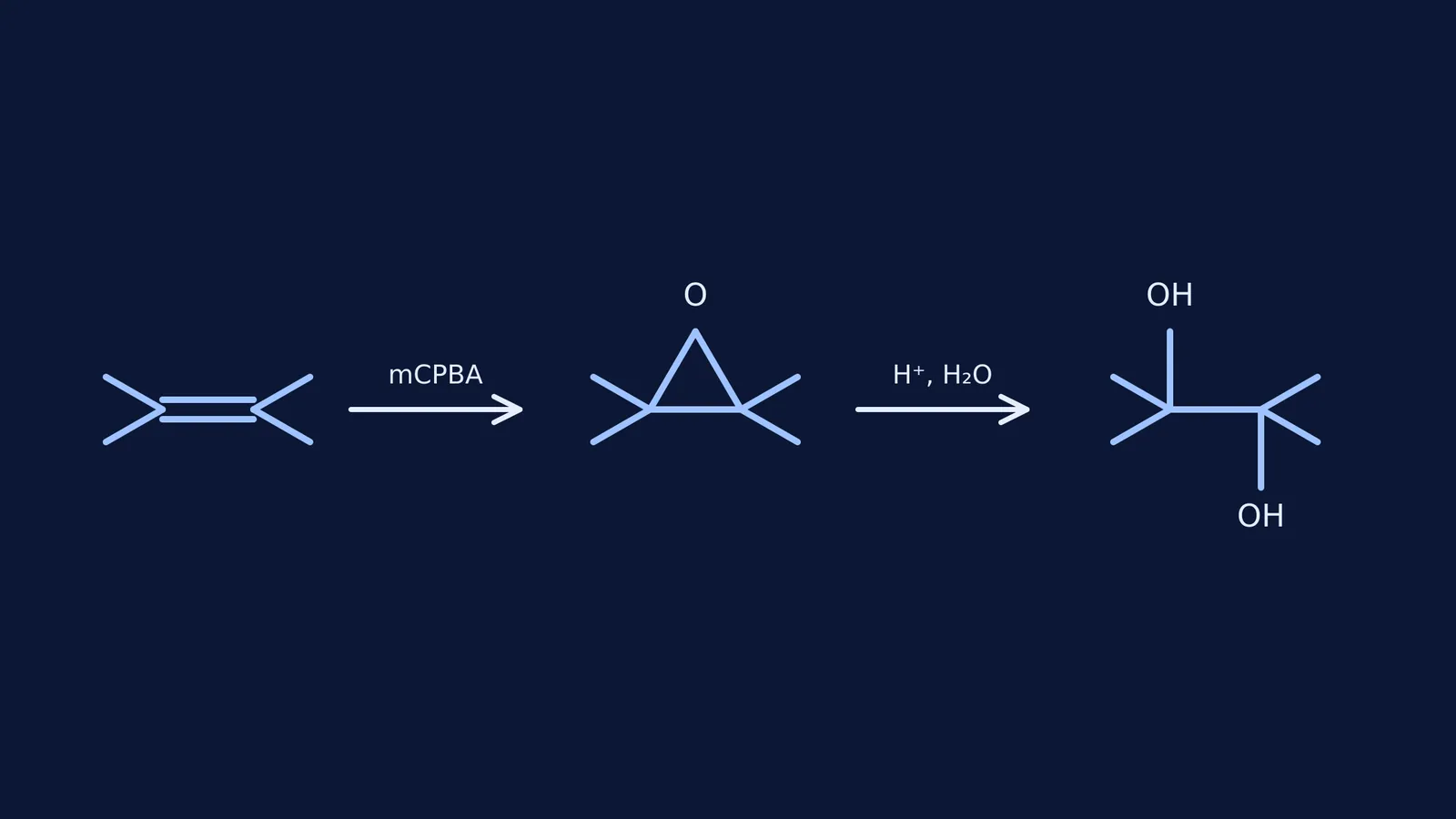
If you need the two hydroxyl groups on opposite sides of the carbon-carbon bond, you must use a two-step process: epoxidation followed by acid hydrolysis.
What is the epoxidation of an alkene with a peracid?
The first step is the reaction of the alkene with a peroxyacid (often written as peracid, such as mCPBA or peroxyacetic acid). The conversion of an alkene to an epoxide using a peroxyacid is known as the Prilezhaev reaction, and it proceeds via a concerted syn-addition (Wikipedia).
In this concerted reaction, the peroxyacid transfers an oxygen atom to the double bond to form a three-membered cyclic ether called an epoxide. Because the bonds break and form at the same time, the original geometry of the alkene is preserved. A *cis*-alkene will yield a *cis*-epoxide, and a *trans*-alkene will yield a *trans*-epoxide.
Understanding these concerted mechanisms can be challenging. If you are struggling to picture how the electrons move, the Fermi Concept Library has a dedicated lesson for electrophilic addition, showing its place in the map to help you trace the geometry changes.
How does acid hydrolysis open the epoxide to a diol?
Epoxides are highly strained three-membered rings, making them unusually reactive compared to normal ethers. When exposed to water and an acid catalyst, the ring opens to form a diol.
First, the acid protonates the oxygen atom of the epoxide. This creates a much better leaving group, activating the ring for attack (similar to how we evaluate leaving group ability in standard substitutions). Next, a water molecule acts as a nucleophile.
Because the protonated oxygen blocks the front face of the molecule, the water molecule must attack from the opposite side.
Why does this reaction give anti-dihydroxylation?
The stereochemistry of the final product is defined by the mechanism of the ring opening. The nucleophilic attack by water follows an SN2 mechanism, which requires a backside attack.
When the water attacks from the back, it pushes the existing oxygen to the front, resulting in inversion of stereochemistry at the attacked carbon. Because the first step (epoxidation) was a syn-addition and the second step is a backside attack, the overall process results in anti-addition. The two hydroxyl groups end up on opposite faces, giving an anti-diol. This mechanism is similar to the inversion you see when studying SN1 and SN2 stereochemistry.
If you need to practice predicting the products of these two-step synthesis problems, the Fermi Problem Library has worked problems with a step-by-step solver that explains the reasoning rather than printing an answer.
How does this compare to cold KMnO4?
Sometimes, an exam question will ask you to form a syn-diol instead. For this, peracids will not work. You must use reagents that deliver both oxygen atoms simultaneously to the same face of the alkene.
Cold, dilute potassium permanganate (KMnO4) is used to dihydroxylate alkenes via syn-addition (Wikipedia). The reaction must be kept mild; if it is too warm or concentrated, the alkene will undergo oxidative cleavage instead. Another option is osmium tetroxide (OsO4), which is highly reliable and efficient for producing syn-diols. Both of these reagents form a cyclic intermediate that forces the two oxygens to add to the same side.
Summary of reagents
Peracid (mCPBA) + H3O+: Anti-dihydroxylation (trans-diol).
Cold KMnO4 or OsO4: Syn-dihydroxylation (cis-diol).
Being able to choose the right reagent for the desired stereoisomer is a core skill for JEE Main and NEET-UG organic chemistry. Next time you see a double bond, check whether the product asks for a syn or anti addition before writing your mechanism. (And if you are reviewing stability, this is a great time to revise heat of hydrogenation).


