On this page
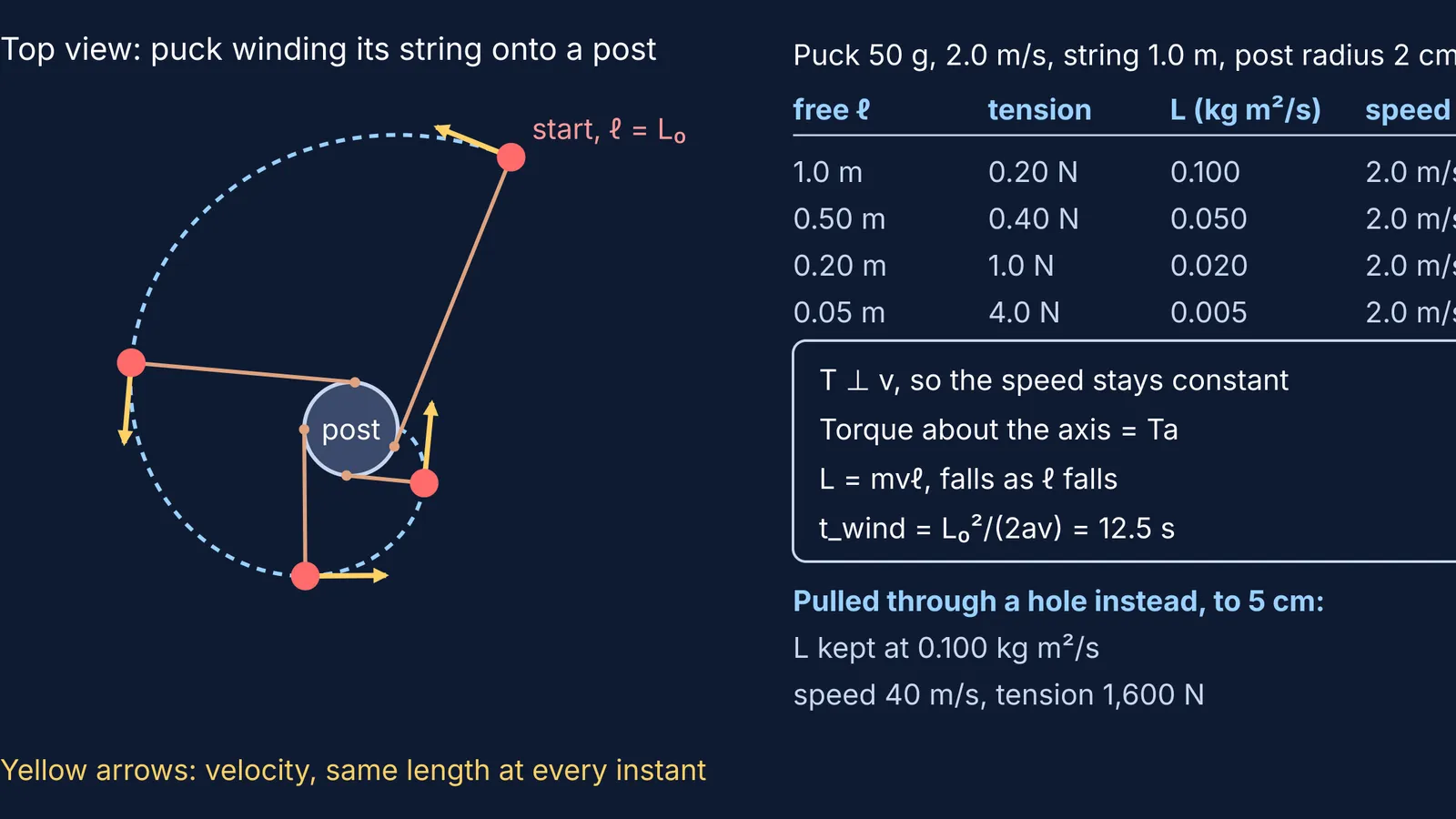
Tie a puck to a post with a string, set it moving on a smooth table, and let the string wind onto the post. Most people expect it to behave like an ice skater pulling in her arms: angular momentum kept, speed rising. It does not. The speed stays exactly the same, the angular momentum about the post falls steadily, and the string tension climbs as the free length shrinks. This post shows why, and works the numbers for a 1 m string on a post 2 cm in radius.
You may have seen the opposite case, a string pulled in through a hole in the table, where angular momentum is conserved and the puck speeds up. Winding onto a post looks similar, which is why it is a common trap.
Why does the puck keep its speed?
Look at the puck at any instant. The string leaves the post at a tangent point P and runs straight to the puck. For a short moment the puck moves on a circle of radius ℓ (the free length) centred on P. So its velocity is at right angles to the string.
The only horizontal force on the puck is the tension T, and it acts along the string. A force at right angles to the velocity does no work. So the kinetic energy, and with it the speed v, stays constant all the way in.
The path the puck traces is an involute of the circle, the same curve as unwinding thread from a reel, run backwards.
Why is angular momentum about the post not conserved?
Take angular momentum about the post's axis O. The line from O to the tangent point P is a radius, so it is at right angles to the string, and therefore parallel to the puck's velocity. The perpendicular distance from O to the line of the velocity is just the free length ℓ. So the angular momentum about O is
L = mvℓ
As the string winds on, ℓ falls while v stays fixed, so L falls.
The cause is a torque. The tension's line of action does not pass through O. It passes at distance a, the post's radius. So the tension has a torque Ta about the axis. Check it: the free length shrinks at the rate dℓ/dt = −aω, where ω = v/ℓ is the rate at which the string swings round. Then dL/dt = mv dℓ/dt = −(mv²/ℓ)a = −Ta. The torque accounts for the whole loss.
The lost angular momentum is not destroyed. It passes through the post into whatever holds it, in the end the Earth.
How long does the string take to wind up?
Since ω = v/ℓ, the free length obeys ℓ dℓ/dt = −av. Integrate from ℓ = L₀ at t = 0 to ℓ = 0:
t_wind = L₀²/(2av)
The string wraps on the post a total length L₀, which is L₀/(2πa) turns. The free length falls slowly at first and very fast at the end.
Worked example: a 50 g puck on a 1 m string
Take a puck of mass m = 50 g moving at v = 2.0 m/s at right angles to a string of length L₀ = 1.0 m. The post has radius a = 2.0 cm. The table is smooth and the string is light. These are illustrative numbers.
Wind-up time. t = L₀²/(2av) = 1.0²/(2 × 0.020 × 2.0) = 12.5 s.
Turns round the post. L₀/(2πa) = 1.0/(2π × 0.020) = 7.96 turns.
Tension at the start. T = mv²/ℓ = 0.050 × 2.0²/1.0 = 0.20 N.
Tension later. At ℓ = 0.50 m, T = 0.40 N. At ℓ = 0.20 m, T = 1.0 N. At ℓ = 0.05 m, T = 4.0 N, twenty times the starting value.
Angular momentum. At the start, L = mvℓ = 0.050 × 2.0 × 1.0 = 0.100 kg m²/s. At ℓ = 0.05 m it is 0.005 kg m²/s, one-twentieth.
Speed. Still 2.0 m/s, so the kinetic energy stays 0.10 J.
From ℓ² = L₀² − 2avt, the free length is still 0.71 m at 6.25 s, half time. It reaches 0.20 m at 12.0 s and 0.05 m at 12.47 s. Units check: L₀²/(av) is m²/(m × m/s) = s.
What changes if the string goes through a hole instead?
Now pull the same string in through a hole at the centre of the post, from 1.0 m down to 0.05 m. The tension points straight at the hole, so it has no torque about it, and angular momentum is conserved: mvr stays at 0.100 kg m²/s.
Speed at 0.05 m: v = 2.0 × (1.0/0.05) = 40 m/s.
Tension at 0.05 m: T = 0.050 × 40²/0.05 = 1,600 N.
Kinetic energy: from 0.10 J to 40 J. Your hand does that 39.9 J of work by pulling the string in.
With the hole, your hand supplies energy and angular momentum is kept. With the post, no energy comes in and angular momentum leaks out. The spinning skater is the hole case, not the post case.
Has this mistake appeared in textbooks?
Yes. In 1933, J. F. Evans and H. M. Zenor pointed out in the Proceedings of the Oklahoma Academy of Science that two college physics textbooks of the time used a mass winding round a stick as an example of conserved angular momentum. They showed that the speed cannot rise, since nothing does work on the mass, and that the angular momentum falls and passes to the rod. Edwin Berry returned to the same point in the American Journal of Physics in 1963, in a note titled Nonconservation of angular momentum of a weight on a string.
Does a real tetherball behave like this?
Only roughly. A tetherball hangs from the top of a pole, so gravity tilts the rope into a cone, and air drag slows the ball. The smooth-table puck is the clean version. The formula T = mv²/ℓ grows without limit as ℓ → 0, but a real puck hits the post first, and the string's stretch caps the force.
For a related case where a cable unwinds rather than winds and both energy and angular momentum are kept, see yo-yo despin on spacecraft.
The Fermi Problem Library has torque and angular momentum problems with a step-by-step solver that explains the reasoning. If you are preparing for JEE Main & Advanced, Fermi Test Prep offers personalised preparation with an AI tutor, live classes, adaptive mocks, mentorship and a study plan that updates based on mastery.
Quick checklist
The string is at right angles to the velocity, so the tension does no work and the speed stays constant.
About the post's axis, L = mvℓ, and it falls as ℓ falls.
The tension has a torque Ta about the axis because its line misses the axis by a.
Wind-up time t = L₀²/(2av): 12.5 s for 1 m, 2 cm and 2.0 m/s.
Tension T = mv²/ℓ rises twentyfold, from 0.20 N to 4.0 N, by ℓ = 5 cm.
Through a hole instead, angular momentum is kept and the puck would reach 40 m/s with 1,600 N of tension.