On this page
A spacecraft riding on a rocket's last stage is often spun like a rifle bullet, so that small misalignments of the engine average out during the burn. Once the burn is over, the spin has to go. The simplest way to remove it uses no fuel and no electronics: two small weights on cables, wound round the outside of the spinning body and then let go. Engineers call it a yo-yo despin, and the length of cable it needs comes straight out of two conservation laws you already know.
Which spacecraft have used a yo-yo despin?
NASA's Dawn mission to the asteroids Vesta and Ceres is a well documented case. According to NASA's Dawn launch press kit, about 4.7 minutes after the Delta rocket's third stage burned out, a yo-yo despin system reduced the spin of the spacecraft and third stage from about 50 rpm to zero, ending at about 3 rpm in the opposite direction.
Marc Rayman, Dawn's chief engineer at JPL, gave the hardware in his Dawn Journal before launch: two cables, each 12.15 m long, with a 1.44 kg weight at each end, wrapped round a stack spinning at 46 rpm. The cables were fully unwound after about 4 seconds, then let go. The idea is old; NASA Langley's Kenneth Bush describes it, first proposed by JPL, in Yo-yo despin mechanisms (1967).
How do two weights on cables take away the spin?
When the weights are released, they fly outwards and the cables start to unwind from the rim. The cable tension pulls back on the rim, against the spin, and the body slows. Angular momentum leaves the body and goes into the weights, which end up far from the axis and moving fast. When the body has stopped, the cables slip off the hooks and the weights fly away, taking all the angular momentum and all the energy with them.
Two things are conserved while the cables unwind:
Angular momentum about the spin axis, because the only forces are internal (cable tension) and there is no outside torque.
Kinetic energy, because the cables are light, do not stretch and do not slip. The tension does negative work on the body and an equal amount of positive work on the weights, and nothing turns into heat.
This is different from the skater in why a skater spins faster when pulling the arms in. There, the muscles do work, so angular momentum is conserved but kinetic energy is not. In the yo-yo, both are conserved, and that gives two equations, enough to solve for two unknowns.
What formula gives the spin as the cable unwinds?
Let the body have moment of inertia I and radius R, spinning at ω. Let m be the total mass of the two weights, and s the length of cable already unwound. Each weight sits at the end of a straight cable that leaves the rim along a tangent. Its velocity has two parts at right angles:
Rω along the cable, from the rim point the cable leaves from.
sΩ across the cable, where Ω = ω + ṡ/R is the rate at which the cable's direction turns.
Write J = I + mR². The two conservation laws become:
Angular momentum: Jω + ms²Ω = Jω₀
Energy: Jω² + ms²Ω² = Jω₀²
Move the J terms to the right: ms²Ω = J(ω₀ − ω) and ms²Ω² = J(ω₀² − ω²). Divide the second by the first: Ω = ω₀ + ω. Put that back into the first:
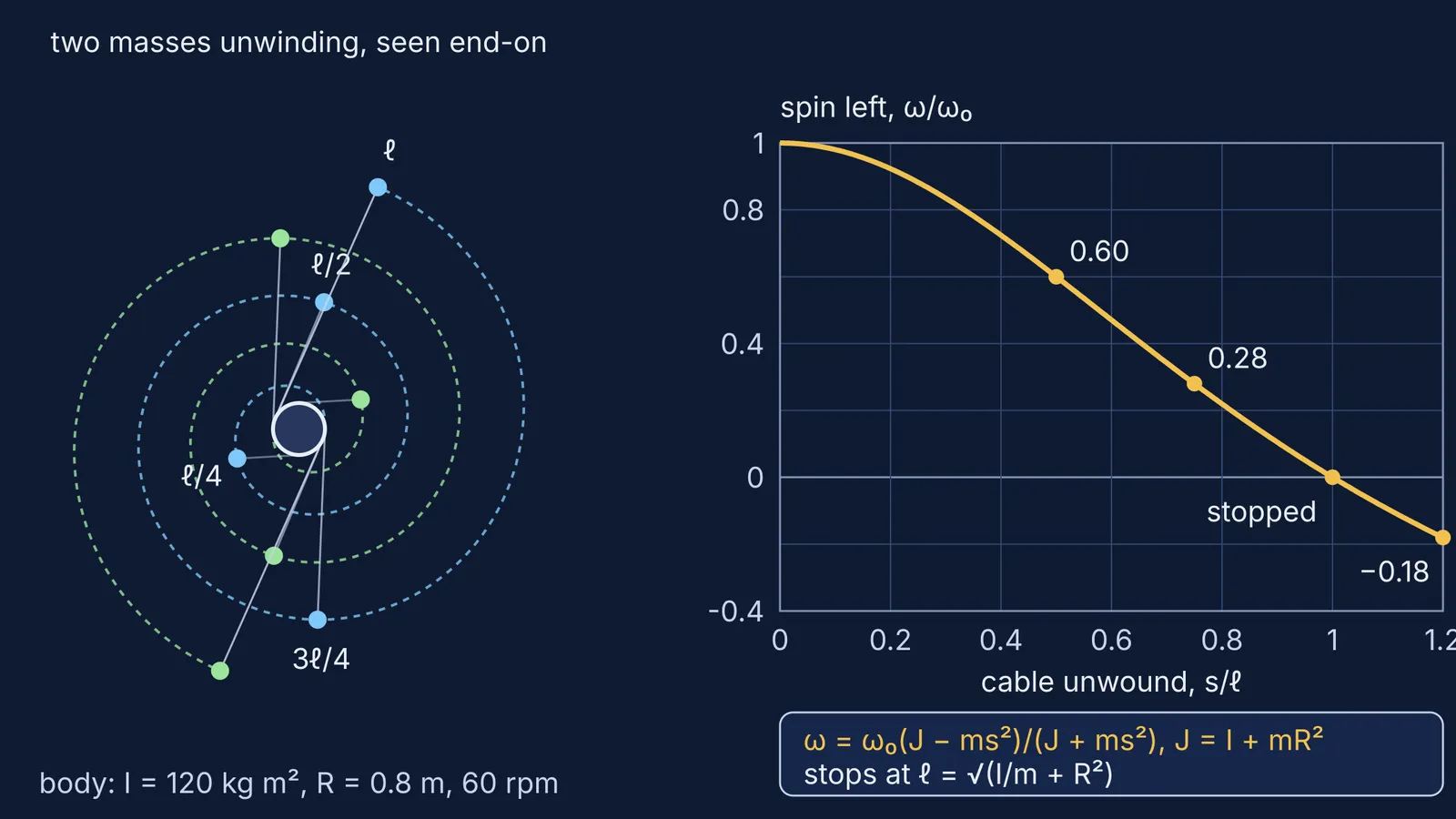
ω = ω₀ (J − ms²)/(J + ms²)
The same expression appears in Ryan Cooper's engineering dynamics notes on yo-yo despin. NASA's Robert Collins treats this "tangential" unwinding phase in NASA TN D-3848 and notes that a flat, two-dimensional analysis is enough to predict cable length, tension and despin time when the body is not wobbling.
Two results drop out:
The spin is zero when ms² = J, so the cable length needed is ℓ = √(J/m) = √(I/m + R²). The starting spin ω₀ has cancelled.
The cable unwinds at a steady rate. Since ṡ = R(Ω − ω) = Rω₀, the unwinding takes ℓ/(Rω₀).
Worked example: stopping a 60 rpm body
A body has I = 120 kg m² and radius R = 0.8 m. It spins at 60 rpm. Two 1 kg weights (m = 2 kg) are wound on its rim. These numbers are for illustration.
Starting spin. ω₀ = 60 × 2π/60 = 6.28 rad/s.
J. J = 120 + 2 × 0.8² = 121.28 kg m².
Cable length. ℓ = √(121.28/2) = √60.64 = 7.79 m.
Unwinding speed. Rω₀ = 0.8 × 6.28 = 5.03 m/s.
Time. t = 7.79/5.03 = 1.55 s.
Speed of the weights at release. The body has stopped (ω = 0), so the weights move only across the cable, at ℓΩ = ℓω₀ = 7.79 × 6.28 = 48.9 m/s.
Check energy. At the start, ½Jω₀² = ½ × 121.28 × 6.28² = 2,394 J. At release, ½mv² = ½ × 2 × 48.9² = 2,394 J. All of it has gone into the weights.
Two 1 kg weights can carry off the spin of a 120 kg m² body because they end up nearly 8 m from the axis.
Why must the cable be exactly the right length?
Write x = s/ℓ. Then ω/ω₀ = (1 − x²)/(1 + x²), which depends on nothing else:
Half-length cables (x = 0.5) leave 0.75/1.25 = 60% of the spin.
Three-quarter length leaves 28%.
Cables 20% too long (x = 1.2) give −18%: the body is spun the other way.
Mission planners use this on purpose. Dawn ended at about 3 rpm backwards from 46 rpm, a ratio of −0.065, which the formula reaches at x ≈ 1.07. If you put Rayman's figures into the formula, the 4 s unwinding at 46 rpm implies a rim radius near 0.63 m, and the ratio implies J ≈ 370 kg m². These are our back-calculations, not NASA figures, but they are sensible for a launch stack of that size.
The formula assumes light cables that leave the rim along a tangent and let go the moment they are fully unwound. Some designs hinge the cable at its end and let it swing out until it points straight away from the axis before release. Collins describes that second phase; it changes the length needed, so the formula above is for tangential release only.
For a different way of turning a craft, see how reaction wheels turn a satellite.
To practise more problems that need two conservation laws at once, the Fermi Problem Library has a step-by-step solver that explains the reasoning. For a full plan, Fermi Test Prep offers personalised preparation for JEE Main & Advanced with an AI tutor, live classes, adaptive mocks, mentorship and a study plan that updates based on mastery.
Quick checklist
Spin is removed by moving angular momentum into weights far from the axis.
Both angular momentum and kinetic energy are conserved, since the cables do no net work.
ω = ω₀(J − ms²)/(J + ms²), with J = I + mR².
Full stop when ℓ = √(I/m + R²), independent of the starting spin.
The cable unwinds at a steady Rω₀.
Too short leaves spin; too long reverses it.