On this page
In March 1879 the German chemical journal Berichte received a short paper from the chemical laboratory of Johns Hopkins University. C. Fahlberg and Ira Remsen had oxidised a methyl group on a benzene ring with potassium permanganate, expecting an ordinary carboxylic acid. The analysis said otherwise. The product had lost a molecule of water and closed into a ring. That compound is saccharin. Its story is a clean exercise in three syllabus skills: side-chain oxidation, KMnO₄ stoichiometry and percentage composition.
We read the paper, "Ueber die Oxydation des Orthotoluolsulfamids" (On the oxidation of ortho-toluenesulphamide), Berichte 12, starting on page 469, in the Internet Archive scan of the volume. The OCR prints the second author as "Ira Bernsen"; he is Ira Remsen. The translations below are ours.
What were Fahlberg and Remsen trying to make?
Remsen had tried a few years earlier to oxidise ortho-toluenesulphonic acid to ortho-sulphobenzoic acid with chromic acid, and it failed. The 1879 paper quotes his earlier remark: "It is possible that other oxidising agents, such as potassium permanganate, may give better results." A preliminary test "in alkaline solution showed that oxidation takes place easily."
So they started from the sulphonamide, o-CH₃C₆H₄SO₂NH₂. They made the ortho sulphonyl chloride and separated it "by cooling and filtration" from the solid para chloride. The amide melted at 153–154 °C, and fused with potash it gave "only salicylic acid", a check that it was the ortho isomer.
The reaction they reported: 10 g of amide with 40 g of KMnO₄ dissolved in a litre of water, warmed on a water bath for 8 to 10 hours. Leftover permanganate was decolourised with a few drops of alcohol and the hydrated manganese oxide was filtered off. Acidifying the concentrated filtrate with hydrochloric acid gave a precipitate.
What does KMnO₄ do to the methyl group?
This is the side-chain oxidation you know from NCERT: a benzylic CH₃ becomes COOH, as covered in KMnO₄ oxidation of alkylbenzenes. The SO₂NH₂ group has no benzylic hydrogen and is not touched.
Here the solution starts neutral and turns alkaline as the reaction runs, and the paper filters off a manganese oxide, so permanganate stops at MnO₂. Writing Ar for the ring with its SO₂NH₂ group:
Ar–CH₃ + 2MnO₄⁻ → Ar–COO⁻ + 2MnO₂ + OH⁻ + H₂O
Check it. Oxygen: 8 on the left, 2 + 4 + 1 + 1 = 8 on the right. Hydrogen: 3 and 3. Charge: −2 and −1 − 1 = −2.
The electrons agree. Carbon goes from −3 in CH₃ to +3 in COOH, a 6-electron oxidation. Mn goes from +7 to +4, gaining 3 electrons. So 2 MnO₄⁻ per CH₃. Why the medium matters is explained in KMnO₄ in neutral or alkaline medium.
Worked example: how much KMnO₄, and what yield?
Molar masses: o-toluenesulphonamide C₇H₉NO₂S = 171.21, KMnO₄ = 158.03, saccharin C₇H₅NO₃S = 183.18 g mol⁻¹.
Moles of amide. 10 ÷ 171.21 = 0.0584 mol.
KMnO₄ needed. 2 × 0.0584 = 0.117 mol, which is 0.117 × 158.03 = 18.5 g.
KMnO₄ used. 40 ÷ 158.03 = 0.253 mol. That is 0.253 ÷ 0.117 = 2.2 times the amount the equation needs, which is why the excess had to be destroyed at the end.
Yield. They obtained 5 g of the ring compound: 5 ÷ 183.18 = 0.0273 mol. Percentage yield = 0.0273 ÷ 0.0584 × 100 = 47 %.
The other half went somewhere. The acid filtrate gave a potassium salt that "contains no nitrogen", 4 g of it, which the analysis showed to be potassium hydrogen o-sulphobenzoate, C₇H₅KO₅S (240.27 g mol⁻¹). That is 4 ÷ 240.27 = 0.0166 mol, or 28 % of the amide. The authors thought it "very probable" that the two products form in equal amounts, "from two molecules of ortho-toluenesulphamide one molecule" of each, with the more soluble salt partly lost. Together the two account for about 75 % of the starting amide.
How did % sulphur prove it was a ring?
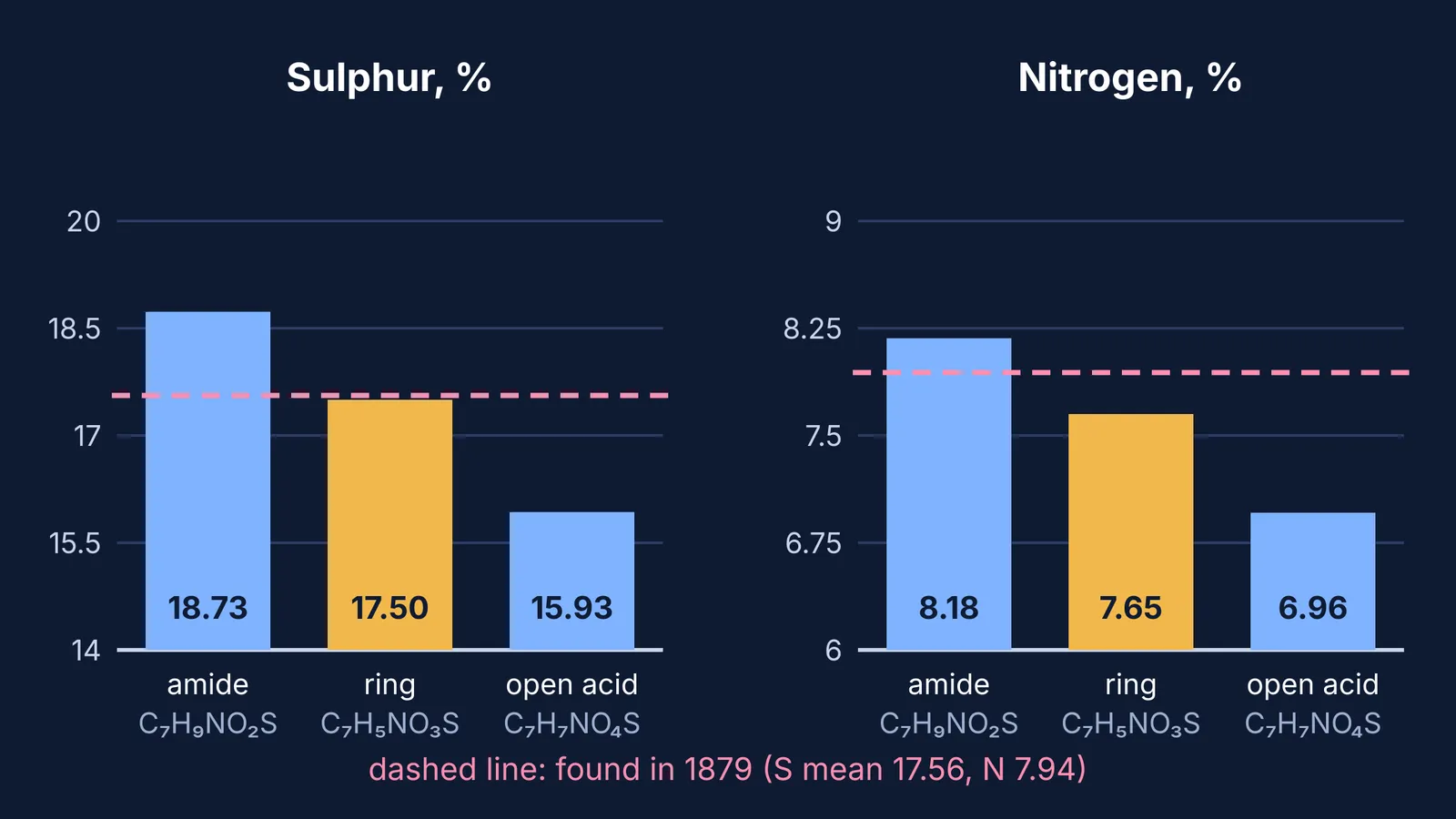
Three sulphur determinations gave 17.61, 17.40 and 17.67 % (mean 17.56 %). One nitrogen determination gave 7.94 %. Compare three candidates, with modern atomic masses:
Unchanged amide, C₇H₉NO₂S: S 18.73 %, N 8.18 %.
Expected acid, o-sulphamoylbenzoic acid, C₇H₇NO₄S (201.20): S 15.93 %, N 6.96 %. The paper prints 15.92 and 6.97.
Acid minus water, C₇H₅NO₃S: S 17.50 %, N 7.65 %. The paper prints 17.48 and 7.65.
Sulphur settles it. 17.56 % sits right on 17.50 % and far from both 15.93 and 18.73. In the authors' words, the product "has the composition of ortho-sulphaminbenzoic acid minus water".
Nitrogen alone could not. 7.94 % is 0.24 from the amide and 0.29 from the ring compound. The melting point also rules out the amide: 220 °C (uncorrected) against 153–154 °C.
The ring forms because the COOH and SO₂NH₂ groups are ortho, so they can condense:
C₇H₇NO₄S → C₇H₅NO₃S + H₂O
Check: C 7, H 7, N 1, O 4, S 1 on both sides. They named it "anhydro-ortho-sulphaminbenzoic acid" and drew CO and SO₂ joined through one NH.
What else did the paper prove about the ring?
No OH group. Phosphorus pentachloride did not react, cold or hot, which "speaks for the absence of hydroxyl". PCl₅ reacts with alcohols and carboxylic acids, so a free COOH would have shown.
Ortho, again. Fused with potash it went entirely to salicylic acid.
An acidic N–H. "The compound is admittedly not an acid, but also not really an anhydride." It still behaved as an acid in water and formed salts with carbonates. The N–H sits between C=O and SO₂, much like the N–H between two C=O groups in phthalimide, which is why the Gabriel phthalimide synthesis can deprotonate it with KOH.
The open acid cannot be isolated. Its salts are salts of the open sulphamoylbenzoic acid, but stronger acids give back the ring, so "the acid in the free state is not capable of existence".
The paper also records, among the physical properties, that the compound "tastes pleasantly sweet, even sweeter than cane sugar". It gives no multiple, and we make no claims about its use as a sweetener.
For more yield and percentage composition problems, the Fermi Problem Library has a step-by-step solver that explains the reasoning. If you are preparing for JEE Main and Advanced, Fermi's AI tutor for JEE prep can take you through KMnO₄ questions like these.
Quick checklist
Fahlberg and Remsen, Berichte 12, 469 (received 14 March 1879), Johns Hopkins.
KMnO₄ turned the ring CH₃ into COO⁻; Mn went to MnO₂, so 2 MnO₄⁻ per CH₃.
10 g amide needs 18.5 g KMnO₄; they used 40 g, about 2.2 times.
5 g of product is a 47 % yield; the N-free potassium salt took another 28 %.
S found 17.56 % fits C₇H₅NO₃S (17.50 %), not the open acid (15.93 %).
No reaction with PCl₅, so no OH; KOH fusion to salicylic acid, so ortho.