On this page
Every pair and question here follows NCERT Class 12 Biology, Chapter 9, Biotechnology: Principles and Processes (Reprint 2026-27). The NEET (UG) 2026 syllabus places "Principles and process of Biotechnology" in Biology Unit 9. No item is from a past paper.
What are the NCERT exceptions in Biotechnology: Principles and Processes?
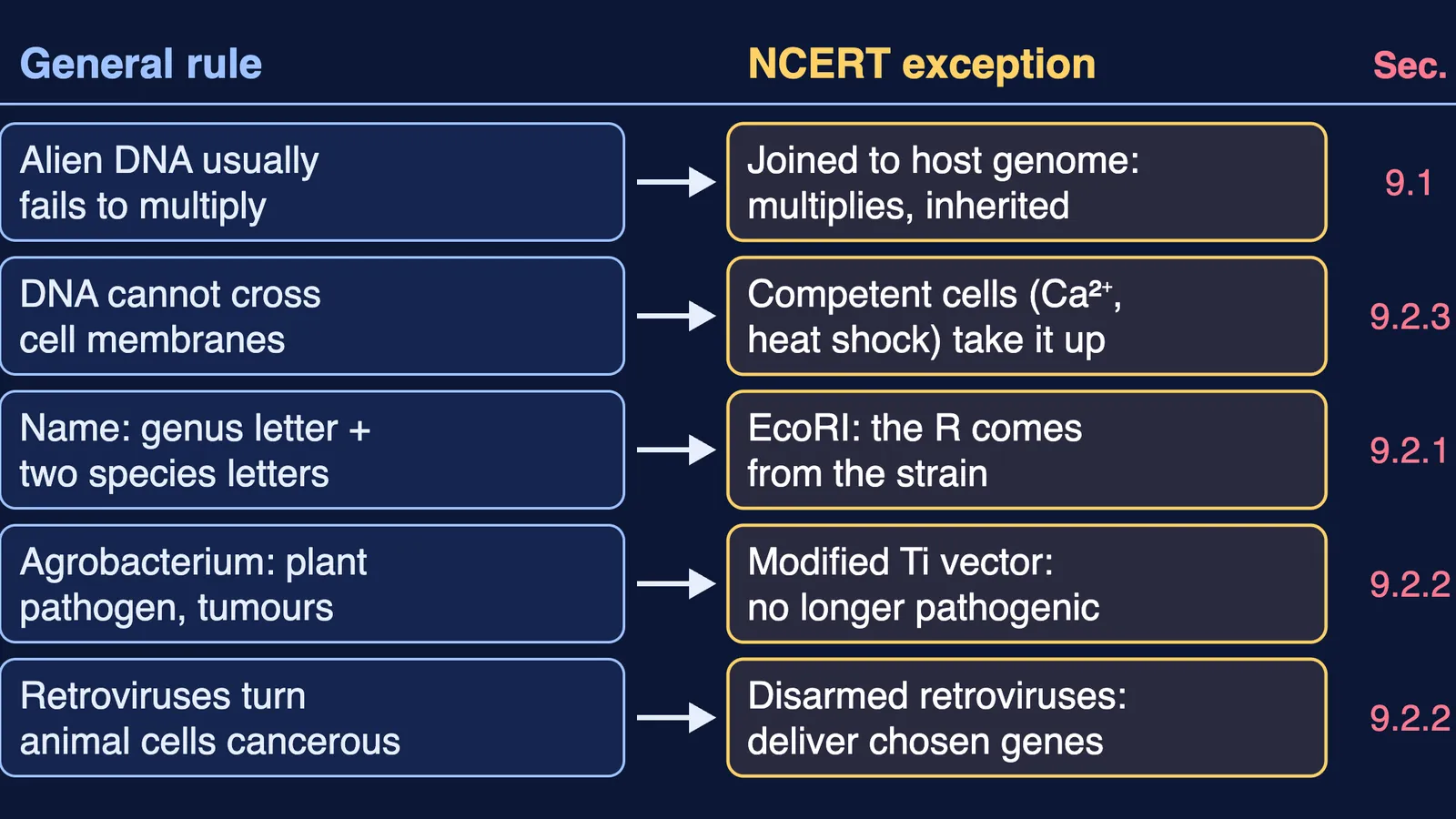
Each line gives a rule NCERT states, then the case NCERT itself sets apart from it.
In its restricted modern sense, biotechnology means processes that use genetically modified organisms at a larger scale; NCERT still names in vitro fertilisation, gene synthesis, DNA vaccines and correcting a defective gene as part of it (chapter opening).
Alien DNA moved into an organism most likely cannot multiply in its progeny cells; once integrated into the recipient's genome, it can multiply and be inherited with the host DNA (9.1).
Restriction enzyme names take the genus initial and two species letters; in EcoRI, NCERT notes, the R comes from the strain, RY 13 (9.2.1).
Unstained DNA fragments stay invisible under ordinary light; stained with ethidium bromide and exposed to UV, they show up as orange bands (9.2.1).
*Agrobacterium tumifaciens*, a pathogen of several dicots, turns plant cells into a tumour; its modified Ti plasmid is no longer pathogenic yet still delivers chosen genes (9.2.2).
Retroviruses turn normal animal cells cancerous; disarmed retroviruses carry desirable genes into animal cells (9.2.2).
DNA is hydrophilic and cannot cross cell membranes; bacteria made competent with a divalent cation such as calcium, then heat-shocked between spells on ice, take up recombinant DNA (9.2.3).
Two other NCERT routes skip that barrier: micro-injection puts DNA straight into an animal cell's nucleus, and biolistics fires DNA-coated gold or tungsten particles into plant cells (9.2.3).
How do you handle odd-one-out and exception questions?
Read the basis in the stem first and test all four options against it alone.
Re-sort by a second feature; a fair item still leaves one outsider.
In "NOT an exception" items, hunt for an ordinary rule dressed as a special case.
In wrong-pairing items, check the exception belongs to the same host or step as its rule.
Odd-one-out and "NOT an exception" questions
Q1. Judged by NCERT's wording, which claim carries no hedge? (1) Vector and source DNA must be cut with the same enzyme to form a recombinant vector (2) Alien DNA in an organism will not multiply in progeny cells (3) DNA is the genetic material of organisms (4) Every organism uses nucleic acid as its genetic material
Answer: (4). NCERT adds "without exception"; the others carry normally, most likely and "in majority of organisms" (9.1, 9.2.1, 9.3.1).
Q2. Judged by NCERT's list of techniques included in biotechnology besides GMO-based processes, which is the odd one out? (1) In vitro fertilisation (2) Making curd (3) Developing a DNA vaccine (4) Synthesising a gene and using it
Answer: (2). Curd is a microbe-mediated process that counts only in the broad, traditional sense (chapter opening).
Q3. Judged by NCERT's examples of products that bioprocess engineering manufactures, which is the odd one out? (1) Agarose (2) Antibiotics (3) Vaccines (4) Enzymes
Answer: (1). Agarose is a natural polymer obtained from seaweeds, used as the gel matrix (9.1, 9.2.1).
Q4. Judged by NCERT's list of key tools of recombinant DNA technology, which is the odd one out? (1) Ligases (2) Vectors (3) The bioreactor (4) The host organism
Answer: (3). Section 9.2 lists restriction enzymes, polymerases, ligases, vectors and the host; bioreactors come later, at scale-up (9.3.5).
Q5. Which is NOT a case NCERT sets apart from a rule? (1) EcoRI's R taken from the strain name (2) DNA fragments moving towards the anode (3) A modified Ti plasmid delivering genes without disease (4) Alien DNA multiplying after joining the host genome
Answer: (2). Negatively charged DNA moving to the anode is the plain rule (9.3.2).
Q6. Judged by the steps NCERT lists after the biosynthetic stage, before a product is marketed, which is the odd one out? (1) Separation and purification (2) Formulation with suitable preservatives (3) Spooling DNA after adding chilled ethanol (4) Strict quality control testing
Answer: (3). Spooling belongs to isolating DNA (9.3.1), not to the finishing steps (9.3.6).
Two-statement and single-correct questions
Judge each statement alone. Options for Q7 to Q10: (1) both right (2) both wrong (3) only I is right (4) only II is right.
Q7. Statement I: NCERT's two core techniques of modern biotechnology are genetic engineering and PCR. Statement II: NCERT defines genetic engineering as altering the chemistry of DNA alone, never RNA.
Answer: (2). The second core technique is bioprocess engineering, and the definition names DNA and RNA (9.1).
Q8. Statement I: Some plasmids have one or two copies per cell, others 15-100. Statement II: Bacteriophages have low copy numbers because few sit in each cell.
Answer: (3). Phages are numerous per cell, so their copy numbers are very high (9.2.2).
Q9. Statement I: NCERT says the ultimate aim of every recombinant technology, without exception, is a desirable protein. Statement II: Bioreactors became necessary because a small lab culture cannot give appreciable amounts of product.
Answer: (4). NCERT says "almost all", not every (9.3.5).
Q10. Statement I: The European Federation of Biotechnology's definition covers both the traditional view and modern molecular biotechnology. Statement II: A selectable marker helps eliminate non-transformants and lets transformants grow.
Answer: (1). Both match NCERT (chapter opening, 9.2.2).
Q11. Why does NCERT call recombinant selection by antibiotic gene inactivation cumbersome? (1) It needs simultaneous plating on two plates with different antibiotics (2) The antibiotics destroy the plasmid (3) It needs a chromogenic substrate (4) Recombinants die on ampicillin
Answer: (1). Hence the colour-based markers (9.2.2).
Q12. Which is NOT one of NCERT's three basic steps for genetic modification? (1) Identifying DNA with desirable genes (2) Introducing it into the host (3) Keeping it in the host and passing it to progeny (4) Downstream processing
Answer: (4). The three steps end with maintenance and inheritance (9.1).
What should you do after this set?
Redo all 12 with answers covered and log each miss beside its row above. Then switch formats: the statement and match-the-list set on this chapter, the diagram-based biotechnology principles questions and the biotechnology principles assertion-reason set.
Which rule-and-exception pair keeps slipping away? Fermi's AI tutor works out what you already know and builds a plan for the session.