On this page
On 19 December 1867 Henry Roscoe read the Bakerian Lecture to the Royal Society, "Researches on Vanadium". It was printed in Philosophical Transactions, volume 158, pages 1 to 27 (DOI), and the scan is free on the Internet Archive. His claim was unusual. Berzelius's measurements on vanadium were right, but his formulas were wrong. Vanadic acid is V₂O₅, not VO₃, and the atomic weight of vanadium is about 51.3, not 68.5. All quotations below are from that paper. The paper's header gives only "Henry E. Roscoe, B.A., F.R.S.", so we leave out other details of his life.
What did Berzelius get wrong about vanadium?
Berzelius published his study of vanadium in 1831. The story of its first discovery in Mexico is told in how Andrés Manuel del Río found vanadium first. Roscoe lists the two experiments Berzelius relied on:
"the constant loss of weight which vanadic acid undergoes on reduction in hydrogen at a red heat".
Chlorine on the reduced oxide gives "a volatile chloride", and the vanadic acid left behind "is found to be exactly one-third of the quantity originally taken".
Berzelius assumed the reduced oxide held one atom of oxygen. The 1 : 3 ratio then made vanadic acid VO₃, with V = 68.5 on his scale where O = 8. Roscoe kept every number and changed the reading: "whilst confirming these fundamental results in every particular, I still arrive at a totally different conclusion". The substance Berzelius took for the metal "is not the metal but an oxide with an atomic weight of 67.3". His "terchloride" VCl₃ was really an oxychloride, VOCl₃.
The same chlorine experiment fits the new formulas. Roscoe wrote it as:
3V₂O₃ + 6Cl₂ → V₂O₅ + 4VOCl₃
Check the balance: 6 V, 9 O and 12 Cl on each side. One V₂O₅ is left from three V₂O₃, which is exactly the one-third Berzelius saw.
What clue made Roscoe doubt the formula VO₃?
Crystal shape. The lead mineral vanadinite has the same hexagonal crystals as apatite, pyromorphite and mimetesite, which are phosphates and arsenates. Roscoe quotes the terminal angles of the crystals: 142° 30′ for vanadinite, 142° 20′ for apatite and 142° 15′ for pyromorphite. Another mineralogist described a single crystal with an upper half of vanadinite and a lower half of pyromorphite. Phosphorus and arsenic form P₂O₅ and As₂O₅, so vanadium should form V₂O₅.
He then gave chemical evidence too:
Native vanadates contain three equivalents of base to one of vanadium pentoxide, as phosphates do.
Fused with sodium carbonate, vanadic acid "displaces three molecules of carbon dioxide", so the normal salt is Na₃VO₄, like Na₃PO₄: V₂O₅ + 3Na₂CO₃ → 2Na₃VO₄ + 3CO₂. Check: 2 V, 6 Na, 3 C and 14 O on each side.
VOCl₃ "corresponds to POCl₃, phosphorus oxychloride".
Isomorphism is no longer in your syllabus. Treat it as the clue here. The skill you need is the arithmetic that follows.
How did Roscoe find the atomic mass of vanadium?
He heated weighed V₂O₅ in a stream of dry hydrogen until the weight stopped changing:
V₂O₅ + 2H₂ → V₂O₃ + 2H₂O
Check: 2 V, 5 O and 4 H on each side. The mass lost is oxygen, two atoms for every V₂O₅.
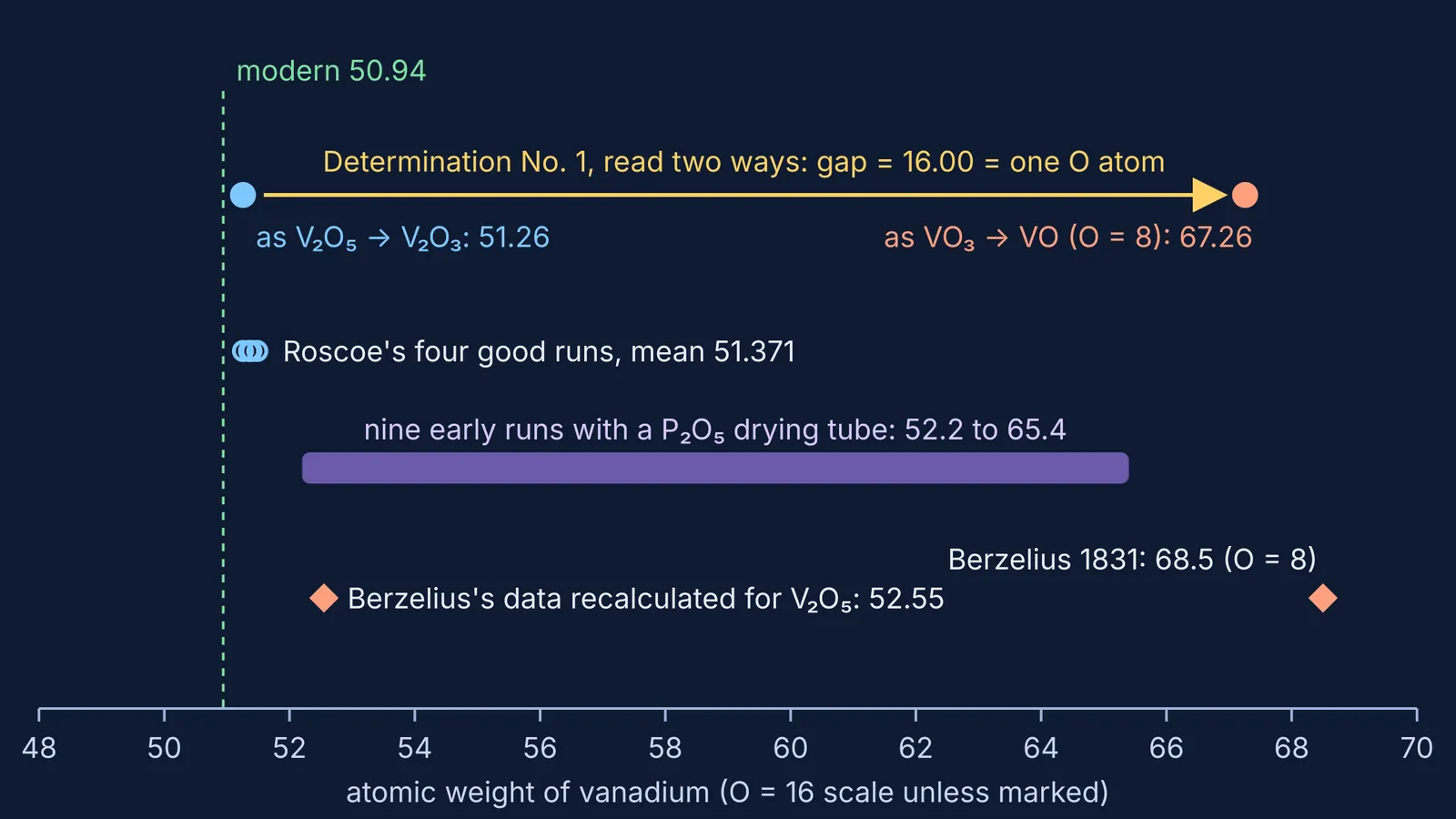
The first results were a mess. "No less than nine determinations" ranged "from 52.2 to 65.4". The cause was the drying tube. Specks of phosphorus pentoxide blew into the sample, and even traces stopped the reduction from finishing. A test mixture with 1 per cent P₂O₅, weighing 1.5888 g, "lost only 0.0007 grm." when it should have lost 0.2784 g. Once a sulphuric acid drier replaced it, "the numbers became constant". His four good runs gave 51.257, 51.391, 51.485 and 51.353, with a mean of 51.371.
Worked example: Roscoe's Determination No. 1
These are his own weighings.
Mass of V₂O₅. Boat and tube: 19.6287 g. With vanadic acid: 27.3684 g. So a = 27.3684 − 19.6287 = 7.7397 g.
Mass of V₂O₃. After reduction: 26.0114 g. So b = 26.0114 − 19.6287 = 6.3827 g.
Oxygen lost. a − b = 1.3570 g. Each V₂O₅ loses 2 O, or 32 g per mole.
Moles of V₂O₅. 1.3570 ÷ 32 = 0.042406 mol.
Molar mass of V₂O₅. 7.7397 ÷ 0.042406 = 182.51 g mol⁻¹.
Atomic mass of V. 2V + 80 = 182.51, so V = 51.26. Roscoe printed 51.257.
Now read the same numbers Berzelius's way. On his scale VO₃ → VO loses two atoms of O = 8, so 16 g per formula.
Moles: 1.3570 ÷ 16 = 0.084813.
"VO₃" = 7.7397 ÷ 0.084813 = 91.26.
"V" = 91.26 − 24 = 67.26.
That is Roscoe's 67.3. And 67.26 − 51.26 = 16.00, exactly one oxygen atom. Berzelius's "metal" was VO.
A quick check: V₂O₅ → V₂O₃ should lose 32 ÷ 181.88 = 17.59% of its mass with today's atomic masses. Determination No. 1 lost 1.3570 ÷ 7.7397 = 17.53%.
For the basic version of this skill, see how to find the equivalent mass of a metal from oxide data.
Why was Berzelius's own number too high?
Roscoe recalculated Berzelius's data for V₂O₅ and got 52.55. He blamed phosphorus. All natural vanadium ores contain it, and in small traces it "can only be detected … by molybdic acid, a test unknown in Berzelius's time". You still use that test in salt analysis: ammonium molybdate with nitric acid gives a yellow precipitate with phosphate. Roscoe used it to check his own samples until no "yellow precipitate was produced by molybdenum".
The modern atomic mass of vanadium is 50.94. Roscoe's mean of 51.371 is about 0.8% high.
What do Roscoe's formulas mean for the d-block?
His oxide list, with V = 51.3, was V₂O₂, V₂O₃, V₂O₄ and V₂O₅. Today these are VO, V₂O₃, VO₂ and V₂O₅, the +2 to +5 oxidation states you learn for vanadium. He also reduced a sulphuric acid solution of the pentoxide with zinc. The liquid passed "through all shades of blue and green" until it reached "a permanent lavender or violet tint". To see why each colour appears and where zinc stops, read vanadium's four colours and how far zinc reduces it.
This paper does not describe making vanadium metal. It corrects the atomic weight and the formulas.
If you want more atomic mass and equivalent mass problems, the Fermi Problem Library has a step-by-step solver that explains the reasoning. For JEE practice on the d-block, Fermi's AI tutor for JEE prep is part of Fermi Test Prep for JEE Main and Advanced.
Quick checklist
Berzelius (1831): vanadic acid VO₃, V = 68.5 with O = 8.
Roscoe (1867): vanadic acid V₂O₅, V = 51.3. Berzelius's "metal" was VO.
Clue: vanadinite has the same crystals as phosphate minerals, and Na₃VO₄ matches Na₃PO₄.
Method: V₂O₅ + 2H₂ → V₂O₃ + 2H₂O. Oxygen lost ÷ 32 gives moles of V₂O₅.
Determination No. 1: 7.7397 g gave 6.3827 g, so V = 51.26.
The same data read as VO₃ give 67.26, which is 16 higher.
Atomic mass = equivalent mass × valency, so check the formula before you multiply.