

On this page
Dissolve a little ammonium vanadate in dilute sulfuric acid and you get a yellow solution. Add zinc and the colour changes to blue, then green, then violet. Each colour is a different oxidation state of vanadium, from +5 down to +2. This makes vanadium one of the clearest ways to practise standard electrode potentials, because you can see where each reaction stops. Here is how to use E° values to predict how far zinc, tin(II), iodide and iron(II) can take it.
What colours do vanadium's oxidation states have?
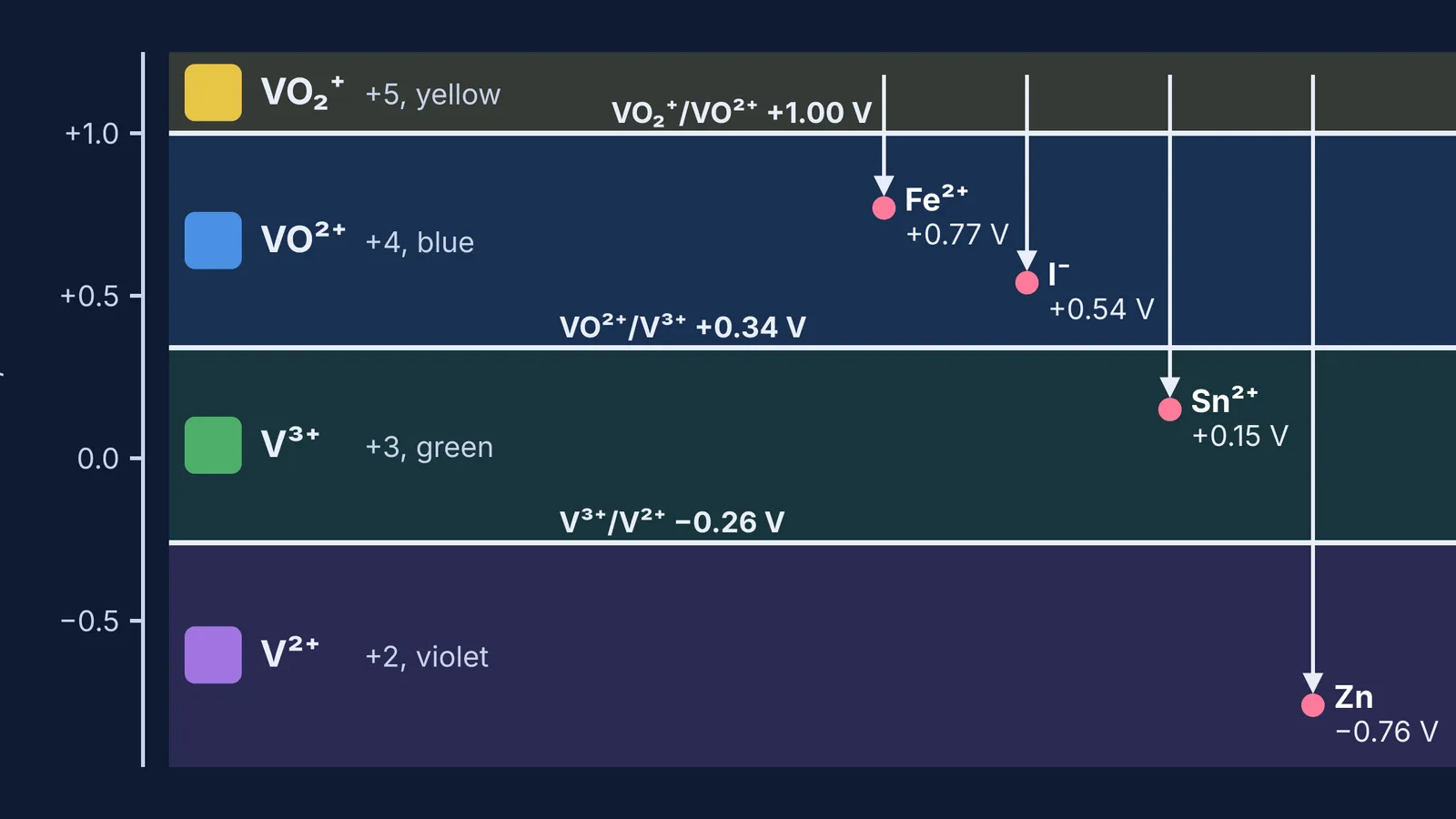
In acid solution, each oxidation state of vanadium exists as a particular ion, and each ion has its own colour:
+5: VO₂⁺, the dioxovanadium(V) ion. Yellow.
+4: VO²⁺, the oxovanadium(IV) or vanadyl ion. Blue.
+3: V³⁺. Green.
+2: V²⁺. Violet.
Write the first two carefully. VO₂⁺ has two oxygens and a 1+ charge. VO²⁺ has one oxygen and a 2+ charge. Mixing them up is the most common way to lose a mark here.
The colours come from d–d transitions. V(V) is d⁰, so it has no d–d transitions, and its pale yellow comes from charge transfer instead. V(IV) is d¹, V(III) is d² and V(II) is d³. Chromium shows the same link between oxidation state and colour; see colours and oxidation states of chromium compounds. The element itself was named for its colourful compounds, a story told in who discovered vanadium.
What are the E° values for the vanadium couples?
Each step down is a one-electron reduction. In acid:
VO₂⁺ + 2H⁺ + e⁻ → VO²⁺ + H₂O, E° ≈ +1.00 V
VO²⁺ + 2H⁺ + e⁻ → V³⁺ + H₂O, E° ≈ +0.34 V
V³⁺ + e⁻ → V²⁺, E° ≈ −0.26 V
Tables differ slightly (some give +0.337 V and −0.255 V), so treat these as approximate. The small differences never change the answers below.
Notice the pattern. Each step is harder than the one before, because the E° gets lower each time. V(V) is a fairly strong oxidising agent. V³⁺ is reluctant to take one more electron. So a reducing agent can be strong enough for the first step but not for the last.
How do you predict how far a reducing agent goes?
Use the same test as for any redox reaction. Write the reducing agent's couple as a reduction, then for each vanadium step:
E°cell = E°(vanadium couple) − E°(reducing agent's couple)
If E°cell is positive, that step is feasible. Check the steps in order, top to bottom. The reaction stops at the first step that gives a negative value. For single-step predictions with common couples, see using the electrochemical series to predict redox reactions. Here we chain the steps.
A quicker way to see it: on a vertical E° scale, a reducing agent can reduce every vanadium couple that sits above it, and none below it.
Worked example: which reducing agent stops where?
Four reducing agents, with standard values you can find in any table: Fe³⁺/Fe²⁺ +0.77 V, I₂/I⁻ +0.54 V, Sn⁴⁺/Sn²⁺ +0.15 V, Zn²⁺/Zn −0.76 V.
Zinc. Step 1: 1.00 − (−0.76) = +1.76 V. Step 2: 0.34 − (−0.76) = +1.10 V. Step 3: −0.26 − (−0.76) = +0.50 V. All three are positive, so zinc takes vanadium all the way down to violet V²⁺.
Tin(II). Step 1: 1.00 − 0.15 = +0.85 V. Step 2: 0.34 − 0.15 = +0.19 V. Step 3: −0.26 − 0.15 = −0.41 V. Tin(II) gets to green V³⁺ and stops.
Iodide. Step 1: 1.00 − 0.54 = +0.46 V. Step 2: 0.34 − 0.54 = −0.20 V. Iodide stops at blue VO²⁺.
Iron(II). Step 1: 1.00 − 0.77 = +0.23 V. Step 2: 0.34 − 0.77 = −0.43 V. Iron(II) also stops at blue VO²⁺.
The balanced equations for zinc, one step at a time:
2VO₂⁺ + Zn + 4H⁺ → 2VO²⁺ + Zn²⁺ + 2H₂O
2VO²⁺ + Zn + 4H⁺ → 2V³⁺ + Zn²⁺ + 2H₂O
2V³⁺ + Zn → 2V²⁺ + Zn²⁺
And for the reactions that stop early:
2VO₂⁺ + Sn²⁺ + 4H⁺ → 2VO²⁺ + Sn⁴⁺ + 2H₂O, then 2VO²⁺ + Sn²⁺ + 4H⁺ → 2V³⁺ + Sn⁴⁺ + 2H₂O
2VO₂⁺ + 2I⁻ + 4H⁺ → 2VO²⁺ + I₂ + 2H₂O
VO₂⁺ + Fe²⁺ + 2H⁺ → VO²⁺ + Fe³⁺ + H₂O
Check any one: in the iron equation, the charge is 1 + 2 + 2 = 5 on the left and 2 + 3 = 5 on the right.
How decisive is the stop? For tin(II) and V³⁺, ΔG° = −nFE° = −2 × 96485 × (−0.41) ≈ +79 kJ per mole of Sn²⁺, and log K = 2 × (−0.41)/0.0591 ≈ −13.9. With K around 10⁻¹⁴, practically no V²⁺ forms.
If you want more chained redox problems like this, the Fermi Problem Library has a step-by-step solver that explains the reasoning at each stage.
Why does the solution look green before it turns blue?
When zinc first reduces the yellow solution, you often see green well before any V³⁺ exists. This green is a mixture: some yellow VO₂⁺ is still there, alongside the new blue VO²⁺, and yellow plus blue looks green. Only when all the V(V) is gone does the solution turn fully blue. The true green of V³⁺ comes later, after the blue stage.
So if a question asks for the order of colours during zinc reduction, the answer is yellow, (green mixture), blue, green, violet. The first green is not a new oxidation state.
What else should you know about this reaction?
V²⁺ does not last in air. Its E° is negative, so oxygen dissolved from the air quickly oxidises it back to V³⁺. The violet solution has to be kept away from air, for example with a loose plug of cotton wool on the flask.
E° tells you whether, not how fast. A positive E°cell means a step is thermodynamically possible. It says nothing about rate. Some feasible steps are slow.
Zinc also makes hydrogen. In acid, zinc reacts with H⁺ too, so you see bubbles. That does not change which vanadium state you end up with.
The method is general. Any element with several oxidation states, such as manganese or chromium, can be treated the same way: list the couples, then test each step against your reducing agent.
To see how electrode potentials connect to cell voltage and ΔG, the Concept Library has short explanations of each idea.
Quick checklist
VO₂⁺ (+5) yellow, VO²⁺ (+4) blue, V³⁺ green, V²⁺ violet.
Couples: +1.00 V, +0.34 V, −0.26 V (approximate).
Test each step: E°cell = E°(vanadium couple) − E°(reducing agent).
Zn reaches V²⁺. Sn²⁺ stops at V³⁺. I⁻ and Fe²⁺ stop at VO²⁺.
Never average the steps into one overall E°.
The early green is yellow plus blue, not V³⁺.
V²⁺ is reoxidised by air, and E° says nothing about rate.


