

On this page
Chromium gets its name from the Greek word *chroma*, meaning colour. In the laboratory, chromium compounds create a vivid palette that changes based on their oxidation states and the pH of their environment. From the green of chromium(III) to the bright yellow of chromate and the deep blue of chromium peroxide, these colour changes are not just beautiful—they are visual clues to the underlying chemistry.
What is the colour of Cr3+?
The +3 oxidation state is the most stable form of chromium. In an aqueous solution, chromium(III) ions (Cr³⁺) typically form green or violet solutions (Wikipedia, Chromium).
The hexaaquachromium(III) ion is violet, but in a typical school laboratory setting, you will often see green chromium(III) solutions. This green colour occurs when other ligands, such as chloride ions from hydrochloric acid, replace some of the water molecules around the central chromium atom.
This stability makes Cr³⁺ the common endpoint for many redox titrations. When you use a strong oxidising agent like dichromate, it reduces down to the stable, green chromium(III) ion.
Why do chromate and dichromate change colour?
The chromate ion (CrO₄²⁻) and the dichromate ion (Cr₂O₇²⁻) both feature chromium in the +6 oxidation state (Wikipedia, Chromium). However, they look very different and exist in a delicate, pH-dependent equilibrium.
Chromate is a bright yellow ion that dominates in alkaline (basic) conditions. If you add acid to a yellow chromate solution, the increasing concentration of hydrogen ions shifts the equilibrium, and the solution turns the vivid orange of dichromate.
The equation for this shift is:
2CrO₄²⁻ + 2H⁺ ⇌ Cr₂O₇²⁻ + H₂O
Because the oxidation state of chromium remains +6 on both sides of this equation, this colour change is not a redox reaction. It is simply an acid-base equilibrium. You can push the reaction back and forth—adding a base to orange dichromate will pull the hydrogen ions away, shifting the equilibrium back to the yellow chromate.
What is the blue chromium compound?
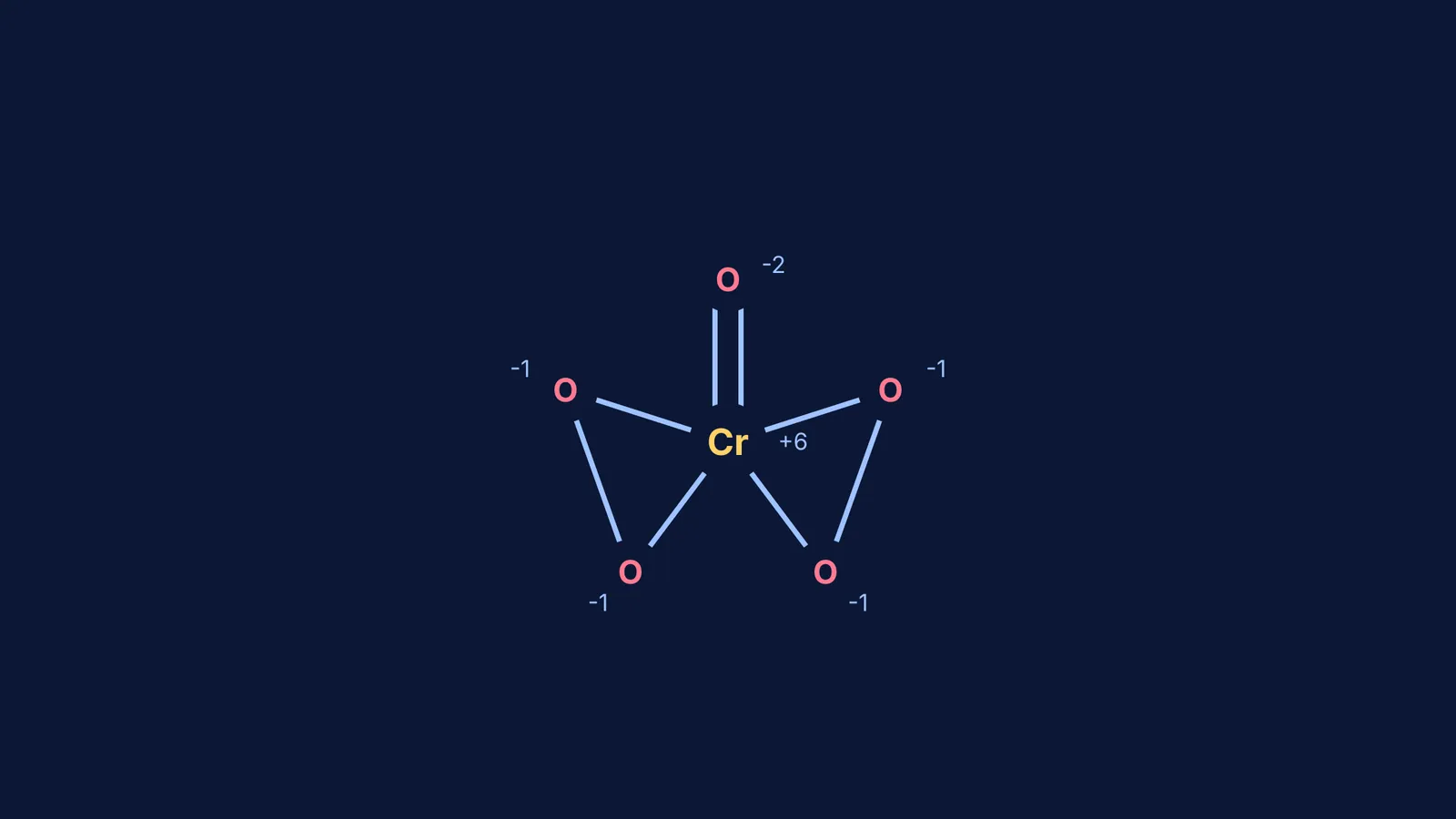
When you add hydrogen peroxide (H₂O₂) to an acidified solution of dichromate, you get a striking deep blue colour. This blue compound is chromium(VI) peroxide, or CrO₅.
Despite having five oxygen atoms attached to a single chromium atom, the oxidation state of chromium in CrO₅ is still +6. This can be confusing if you assume every oxygen atom has an oxidation state of -2.
The secret lies in the molecule's "butterfly" structure. In CrO₅, four of the oxygen atoms are arranged in two peroxo groups (-O-O-). In a peroxo group, oxygen has an oxidation state of -1. Only the fifth oxygen atom is double-bonded to the chromium with a standard -2 oxidation state.
Chromium(VI) peroxide is highly unstable in water and quickly decomposes into green Cr³⁺ ions and oxygen gas. To preserve the deep blue colour for longer, chemists often extract the CrO₅ into an organic layer, such as ether.
How can you remember chromium oxidation states?
Keeping track of these colours and states is a common hurdle in exam preparation. Here is a quick summary list to help you map the colours to their chemical forms:
Green or Violet: Cr³⁺ (Oxidation state: +3)
Yellow: Chromate, CrO₄²⁻ (Oxidation state: +6)
Orange: Dichromate, Cr₂O₇²⁻ (Oxidation state: +6)
Deep Blue: Chromium peroxide, CrO₅ (Oxidation state: +6)
Understanding the structure of molecules like CrO₅ helps you move beyond rote memorisation. By looking at how the atoms connect—just like when you are comparing bond angles or calculating the average bond order from resonance—the oxidation numbers make logical sense.
If you are stuck on how to balance these redox reactions, Fermi's AI tutor can build a plan for the session and work through the steps with you. You can also explore more transition metal chemistry in the Fermi Concept Library.


