On this page
In the spring of 1818 the Annals of Philosophy printed a short letter from the Swedish chemist Jöns Jacob Berzelius to the physician Alexander Marcet. Its first news was about Arfwedson: "A young chemist of great merit ... who works in my laboratory, has just discovered a new fixed alkali." The alkali was lithia, the oxide of lithium. The letter is worth reading for two things: the discovery came from a weighing that was too heavy, and its four distinguishing marks match the "anomalous lithium" list you learn for the s-block.
We read the letter (Article XI of volume 11, April 1818 number) and the editor's follow-up notes in two Internet Archive scans of the same volume, annalsphilosoph13thomgoog and bub_gb_nhcAAAAAMAAJ. Both OCR texts are badly damaged, so we compared them line by line and quote only what is legible. The scans spell the name Arvedson, Arfredson and Arfvedson; we use the modern Arfwedson.
What did Berzelius's letter announce?
The alkali came from a mineral from the mine of Utö in Sweden, called petalite. In the letter's round numbers it is "80 parts of silex, 17 of alumina, and three of the new alkali". Silex is silica, SiO₂, and alumina is Al₂O₃.
Berzelius then listed how the new alkali differed from potash and soda:
Fusible salts. "Its sulphate and muriate liquefy before they arrive at a red heat, the carbonate at the moment when it begins to become red."
A deliquescent chloride. Its muriate (chloride) "is deliquescent, like the muriate of lime", that is, like calcium chloride.
A poorly soluble carbonate. The carbonate "does not readily dissolve in water", and at red heat in a platinum crucible it "attacks the platinum".
A large capacity for saturating acids, "in which it even surpasses magnesia".
The name lithion marked that it was found in the mineral kingdom, unlike the two older alkalies (we paraphrase, as the passage is garbled). The same letter announced selenium, which is told in how Berzelius discovered selenium, cerium and silicon.
How did a heavy sulphate reveal a new alkali?
The May number added details from another Berzelius letter. The alkali "was discovered in consequence of its great capacity for saturating acids; for the salt with an alkaline base, which was obtained in the analysis of the petalite, very much exceeded in weight what it ought to have done, had it been composed either of soda or potash."
The salt was not precipitated by tartaric acid, which ruled out potash, so soda was the natural guess. That was Arfwedson's first opinion, "but after repeating the analysis of the petalite three times, he was led to suspect that it contained something peculiar".
Worked example: why was the sulphate too heavy?
Each alkali oxide reacts 1 : 1 with sulphuric acid:
Li₂O + H₂SO₄ → Li₂SO₄ + H₂O
Check the balance: 2 Li, 2 H, 1 S and 5 O on each side.
Use molar masses Li₂O = 29.88, Na₂O = 61.98, K₂O = 94.19 and MgO = 40.30 g mol⁻¹.
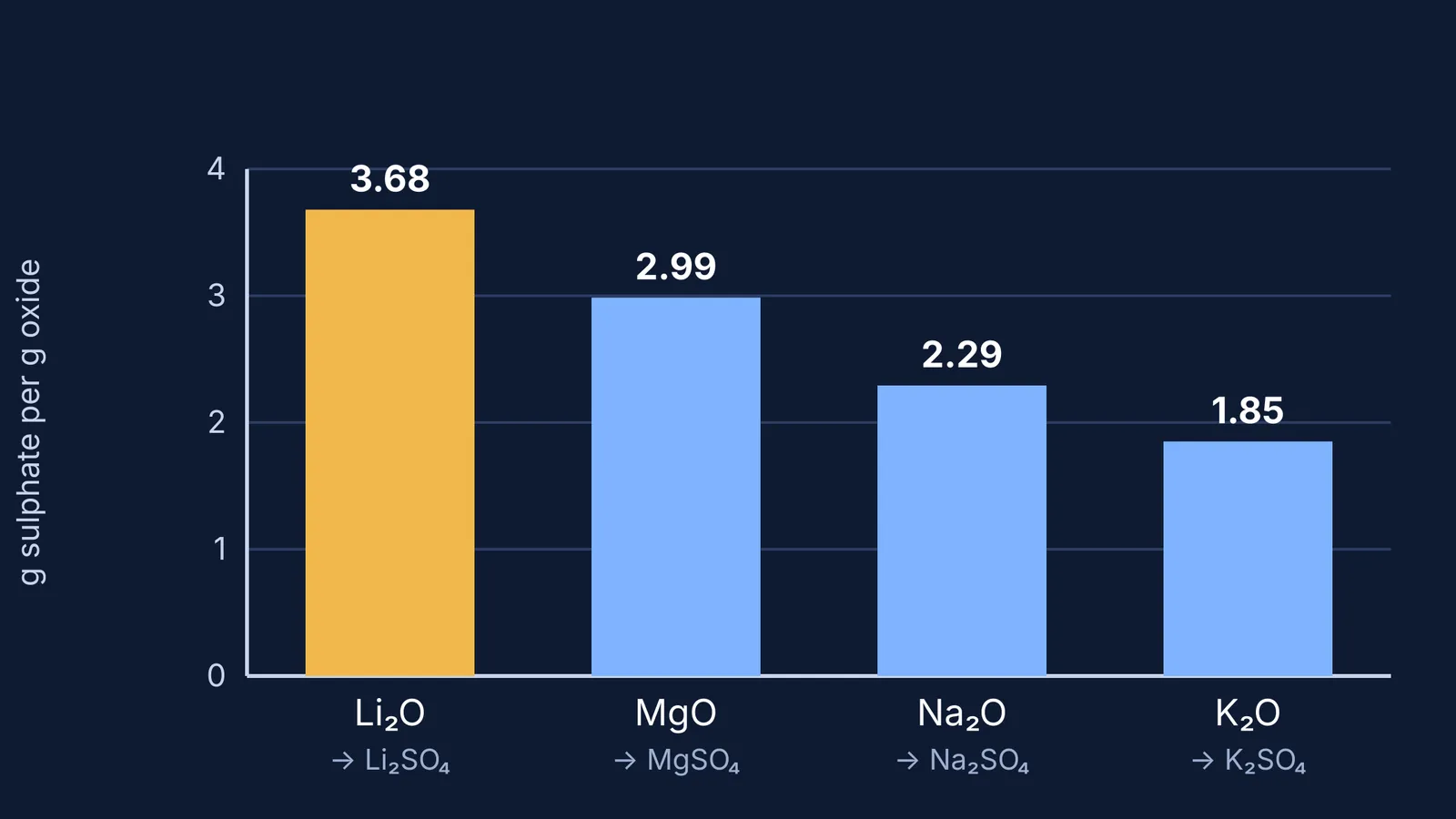
Sulphate per gram of oxide. Li₂SO₄ (109.94) ÷ Li₂O (29.88) = 3.68 g. For soda, Na₂SO₄ (142.04) ÷ Na₂O = 2.29 g. For potash, K₂SO₄ (174.25) ÷ K₂O = 1.85 g.
Take 1.000 g of petalite. With the letter's 3 parts of alkali, that is 0.0300 g of Li₂O, which gives 0.0300 × 3.68 = 0.1104 g of Li₂SO₄.
Read it as soda. An analyst who assumes the sulphate is Na₂SO₄ works back to 0.1104 ÷ 2.29 = 0.0482 g of Na₂O, or 4.82 % of the mineral.
Add up. 80 + 17 + 4.82 = 101.8 %. An analysis that totals more than 100 % tells you a molar mass is wrong. Read as potash it is worse: 103.0 %.
Light lithium means more moles of oxide per gram, so more sulphate per gram.
Check with modern formulas. Petalite is LiAlSi₄O₁₀. Its ideal composition, worked out from the formula, is 78.5 % SiO₂, 16.6 % Al₂O₃ and 4.9 % Li₂O. The 1818 round numbers are close. Berzelius's later letter reports that Arfwedson found 8 % lithion in spodumene; ideal spodumene, LiAlSi₂O₆, has 8.0 % Li₂O.
Why does lithium "surpass magnesia" at neutralising acid?
"Capacity of saturating acids" means how much acid one gram of base neutralises. With H₂SO₄ (98.07 g mol⁻¹):
Li₂O: 98.07 ÷ 29.88 = 3.28 g of acid per gram
MgO: 98.07 ÷ 40.30 = 2.43 g
Na₂O: 1.58 g
K₂O: 1.04 g
So lithia beats magnesia, as the letter says, and soda by about two times. The cause is its low equivalent mass.
Which of the four marks are on your syllabus?
Deliquescent chloride. LiCl absorbs water from air and forms hydrates, unlike NaCl. Berzelius compared it with calcium chloride, an alkaline earth salt. See the anomalous behaviour of lithium for the reason: the very small Li⁺ ion attracts water strongly.
Sparingly soluble carbonate. Li₂CO₃ dissolves much less than Na₂CO₃ or K₂CO₃, like MgCO₃.
Fusible salts. Lithium salts tend to melt lower than sodium salts. Approximate melting points: LiCl about 605 °C against NaCl about 801 °C; Li₂CO₃ about 723 °C against Na₂CO₃ about 851 °C. The usual reason is the covalent character that small, polarising Li⁺ gives its compounds.
Resemblance to an alkaline earth. Two of the four marks compare lithium with lime and magnesia. That is the diagonal relationship between lithium and magnesium, noticed in the first description of the element.
What did the 1818 oxygen figure get wrong?
Berzelius wrote that "Lithion contains 43.9 per cent of oxygen". Today Li₂O is 53.5 % oxygen, against 25.8 % for Na₂O and 17.0 % for K₂O.
Treat 43.9 % as an exam question. Per 8 g of oxygen, the metal is 8 × 56.1 ÷ 43.9 = 10.2 g. That is the equivalent mass, and for univalent lithium also the atomic mass the figure implies. The modern value is 6.94. The 1818 number already put lithium far below sodium (23), but it is too high.
Which error pushes it up? Any heavier alkali, such as soda, left in the sample would lower the oxygen percentage and raise the apparent mass. The sources do not say what went wrong, so treat that as a reasoning exercise, not history.
What happened next?
The May note says Arfwedson's discovery "has been confirmed by Sir H. Davy", who also "succeeded in reducing it to the metallic state". That is the editor's report; we did not read Davy's own account. Neither text says Arfwedson isolated the metal. The discovery is usually dated 1817, a date not given in these pages.
To revise polarising power and hydration as ideas rather than lists, the Concept Library gives each concept its own lesson. If you are preparing for JEE Main and Advanced, Fermi Test Prep has practice for these s-block questions with an AI tutor.
Quick checklist
Arfwedson found lithia in petalite (LiAlSi₄O₁₀) in Berzelius's laboratory.
The clue: the alkali sulphate weighed far more than soda or potash could give.
1 g of Li₂O gives 3.68 g Li₂SO₄; Na₂O gives 2.29 g; K₂O gives 1.85 g.
The letter's four marks: fusible salts, deliquescent chloride, poorly soluble carbonate, acid capacity above magnesia.
43.9 % oxygen implies Li ≈ 10.2; the modern value is 6.94.
Davy reduced lithia to the metal, according to the editor; Arfwedson did not.