On this page
Lithium sits at the top of Group 1, but in an exam it often behaves as if it belongs somewhere else. Questions on the anomalous behaviour of lithium ask you to list how it differs from sodium, potassium and the rest, and then explain why. The good news: almost every difference traces back to one cause, and once you can say it in one line, the list writes itself.
Why does lithium behave differently from other alkali metals?
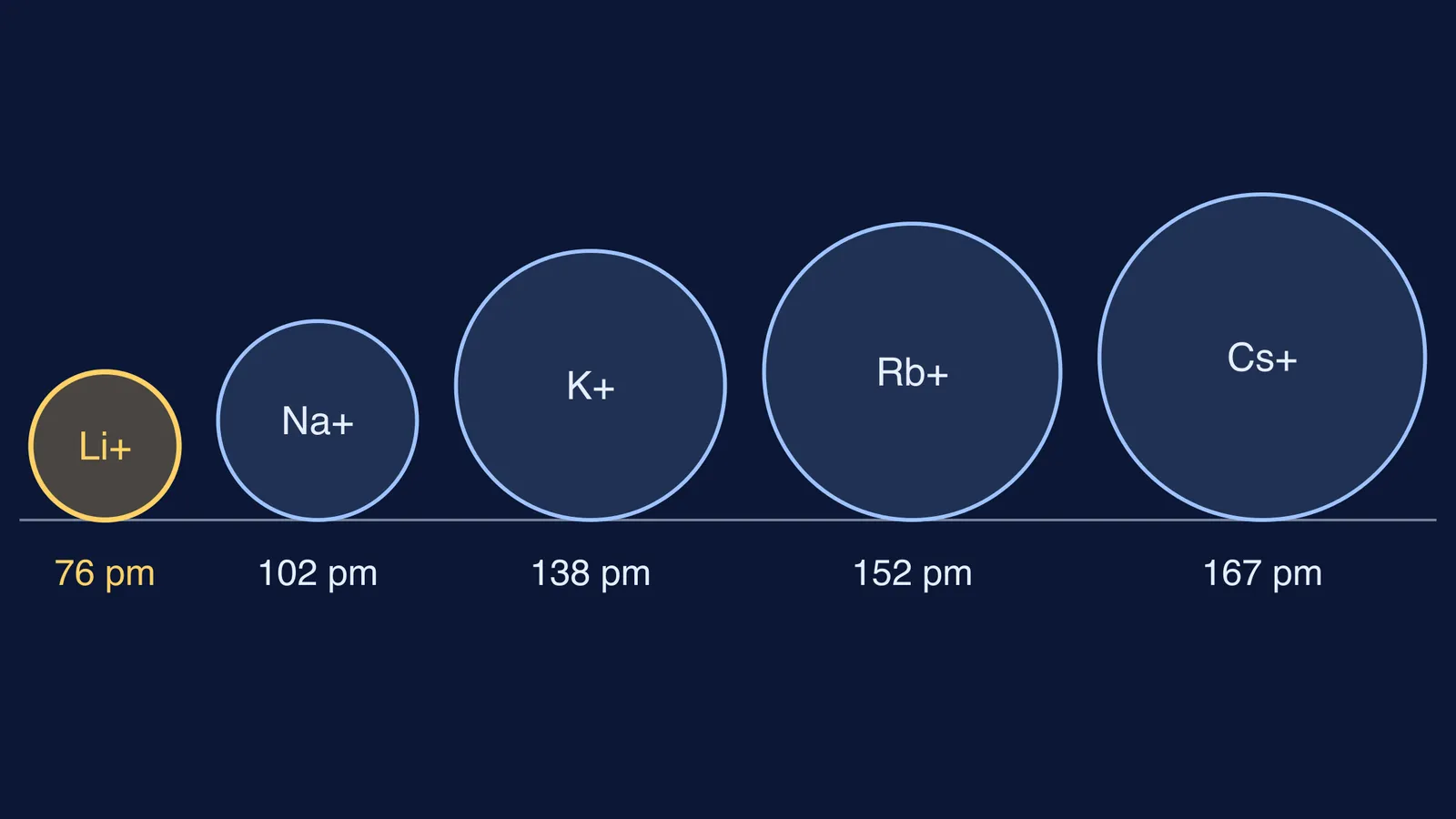
The Li+ ion is tiny. Its effective ionic radius is 76 pm, against 102 pm for Na+ and 167 pm for Cs+, using the six-coordinate values from R. D. Shannon's 1976 table of ionic radii as listed on Wikipedia's ionic radius page.
Pack a +1 charge into a sphere that small and you get a high charge density, which chemists call high polarising power: the cation pulls on the electron cloud of a nearby anion and distorts it. As the Wikipedia article on alkali metals puts it, the small Li+ cation polarises anions and gives its compounds more covalent character. The same article notes that lithium and magnesium have similar atomic radii, which is why lithium often resembles magnesium (the diagonal relationship).
Why does only lithium form a nitride (Li3N)?
Lithium reacts with the nitrogen in air as well as the oxygen: 6Li + N2 → 2Li3N. Chemguide states that lithium is the only Group 1 element to form a nitride this way, and Wikipedia's lithium nitride entry calls Li3N the only stable alkali metal nitride.
Why lithium? Making the N3- ion costs a lot of energy. That cost is repaid only if the ions in the crystal pack very tightly and release a large lattice energy. Small Li+ ions can sit close to the small, highly charged N3- ion; Na+ and K+ are too big to pay the bill. Magnesium, lithium's diagonal neighbour, also forms a stable nitride, as the alkali metals article notes, which fits the pattern. Li3N reacts with water to give ammonia: Li3N + 3H2O → 3LiOH + NH3.
Why does Li2CO3 decompose on heating when Na2CO3 does not?
Heat lithium carbonate and it breaks down: Li2CO3 → Li2O + CO2. Chemguide's page on Group 1 compounds notes that the rest of the Group 1 carbonates do not decompose at Bunsen-burner temperatures, though they will at higher ones.
The explanation is polarisation. The smaller the cation, the higher its charge density and the more it distorts the large carbonate ion, weakening a C–O bond so that CO2 can leave. A second, size-based way to say it: small Li+ forms a very stable lattice with the small O2- ion, so the product Li2O is favoured.
Why does LiCl form hydrates when NaCl does not?
Wikipedia's lithium chloride entry says LiCl forms crystalline hydrates, unlike the other alkali metal chlorides, and that it is hygroscopic and deliquescent: left in air, it pulls in enough water to dissolve itself. Its solubility is 84.25 g per 100 mL of water at 25 °C, according to the same entry. The entry lists mono-, tri- and pentahydrates, so learn the idea rather than a single formula.
The cause is the same small ion. Li+ attracts the negative oxygen end of water molecules very strongly, so it holds on to water in solution and in the crystal. The alkali metals article adds that most simple lithium salts are met in hydrated form because the anhydrous forms are extremely hygroscopic.
How do you write a full-marks answer on lithium?
Use this four-step chain for any question that asks you to explain the anomalous behaviour of lithium:
Fact: state what lithium does that the others do not, with an equation.
Property: Li+ is very small (76 pm against 102 pm for Na+, from the Shannon radii table), so its charge density, or polarising power, is high.
Mechanism: name the link: lattice energy, polarisation of the anion, or hydration.
Contrast: say what sodium or potassium does instead.
Here is a worked example for the question: why does lithium carbonate decompose on heating while sodium carbonate does not?
On heating, Li2CO3 → Li2O + CO2. The Li+ ion is very small and has high polarising power. It distorts the electron cloud of the large carbonate ion and weakens it, so CO2 is lost easily; small Li+ also forms a stable lattice with small O2-. Na+ is larger and polarises carbonate less, so Na2CO3 does not decompose at Bunsen temperatures.
Before your exam, check yourself:
Can you write all three equations from memory?
Can you give each one its mechanism word: lattice energy, polarisation or hydration?
Can you name magnesium as the diagonal partner that also forms a nitride?
If a link in the chain still feels shaky, the Fermi Concept Library has its own lesson for every concept in chemistry, so you can revisit lattice energy or polarisation before coming back to lithium. To practise turning the chain into written answers, the Fermi Problem Library has worked problems with a step-by-step solver that explains the reasoning rather than printing an answer.