On this page
On a May afternoon on a national highway, the road ahead often seems to hold a sheet of water. You never reach it. It stays a fixed distance ahead, and for a car driver that distance is usually a couple of hundred metres. Why that number, and not 20 m or 2 km?
Two Fermi News posts already explain what the "water" is: an image of the sky, bent upward by hot air over the road. See why roads look wet on hot days and how a mirage forms on a hot road. Both say the puddle recedes and depends on your height. This post puts numbers on it: the angle at which sky light grazes the road, and how far ahead the puddle starts for a child, a driver and a truck driver.
How much does hot air change the refractive index?
The refractivity of air, n − 1, is proportional to its density. At fixed pressure, by the ideal gas law, density goes as 1/T. Siebren van der Werf, writing in Applied Optics (2011), uses:
n = 1 + AP/T, with A = 7.872 × 10⁻⁵ K/hPa for visible light, P in hPa and T in kelvin.
At 0 °C and 1013 hPa this gives n − 1 = 2.92 × 10⁻⁴. The same paper notes that on a sunny day, the road surface and the air just above it can easily be 20 °C or more hotter than the air half a metre higher.
Hotter air has a lower n. Near the road the index is lowest, and it rises with height.
Why can only shallow rays bend back up?
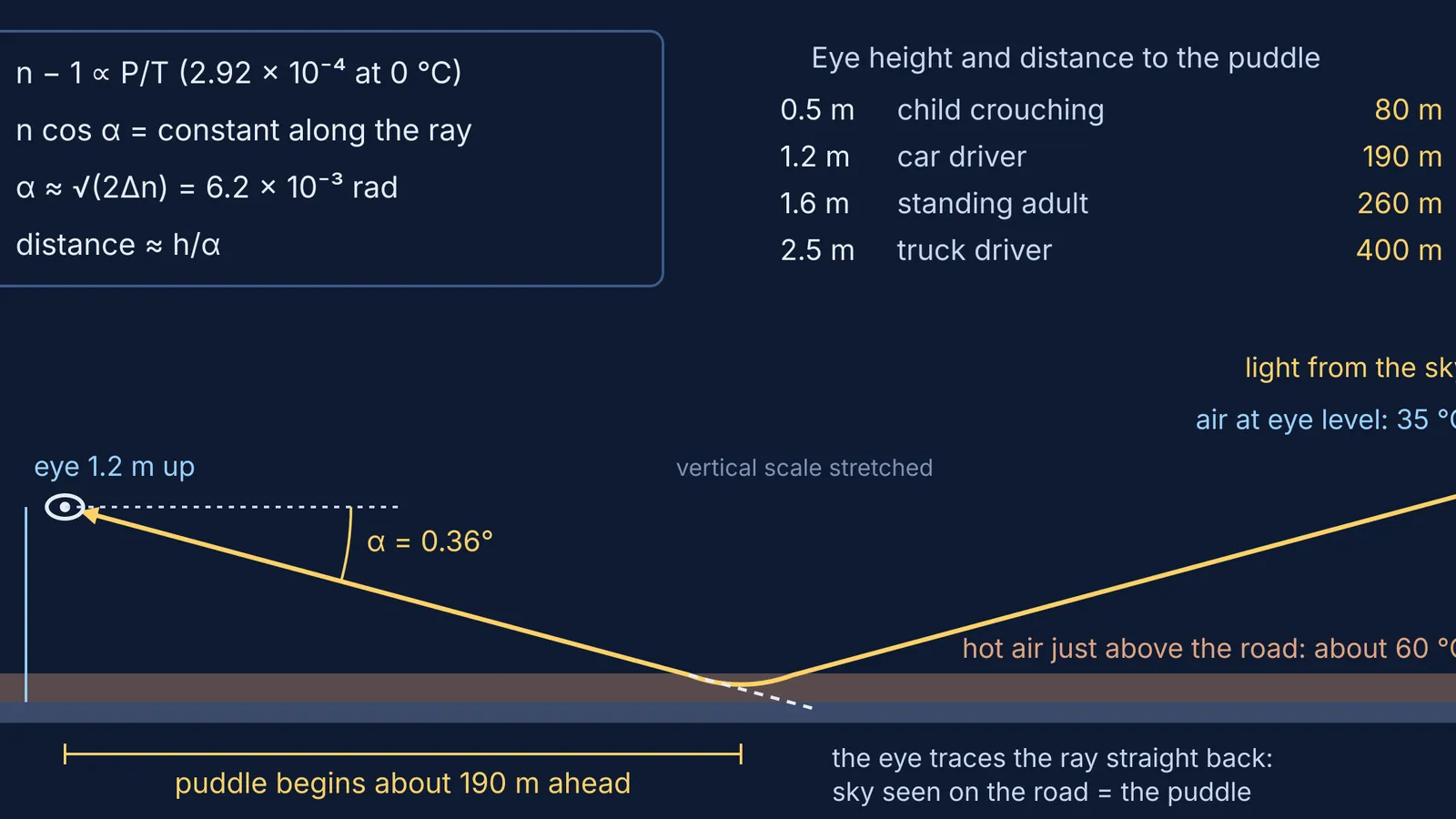
In air whose index changes only with height, a ray obeys Snell's law layer by layer: n cos α stays constant along the ray, where α is the ray's angle above or below the horizontal.
Follow a ray from the sky down towards the road. As n falls, cos α must rise, so the ray flattens. If it becomes horizontal (α = 0) before reaching the road, it turns round and climbs again. At that turning point n cos 0 = n₀, the index of the hottest air.
So a ray that leaves eye-level air (index nₕ) at angle α turns round only if nₕ cos α ≤ n₀. For small angles cos α ≈ 1 − α²/2, which gives the steepest ray that can turn back:
α ≈ √(2Δn), where Δn = nₕ − n₀.
Steeper rays hit the road and you see asphalt. Shallower rays from the sky turn back and reach you. This bending is sometimes called total internal reflection. That is a shorthand: there is no sharp surface, as there is in the critical angle between glass and water, only a smooth curve in a gradient.
Worked example: how far ahead is the puddle?
Take air at 35 °C at eye level and 60 °C just above the asphalt. These are illustrative figures for an Indian summer afternoon, a 25 °C jump that sits within van der Werf's "20 °C or more". The air right at the road is cooler than the asphalt surface itself.
Temperatures: Tₕ = 308.15 K, T₀ = 333.15 K. AP = 7.872 × 10⁻⁵ × 1013.25 = 0.0798 K.
Δn = AP(1/Tₕ − 1/T₀) = 0.0798 × (1/308.15 − 1/333.15) = 1.94 × 10⁻⁵.
Grazing angle: α = √(2 × 1.94 × 10⁻⁵) = 6.23 × 10⁻³ rad = 0.36°, about 21 arc minutes. That is less than the width of the full Moon, about 0.5°.
Distance: if the hot layer is thin compared with your eye height, the rays travel in straight lines down to it. Your eye at height h sees the near edge of the puddle where a line at angle α meets the road, at h/α.
Car driver, h = 1.2 m: 1.2/0.00623 ≈ 190 m.
Van der Werf gives the same rule in one line, L = h√(T₀Tₕ/(2AP(T₀ − Tₕ))). His example, h = 1 m with 300 K and 320 K, gives about 175 m.
How does the distance change with your height and the heat?
Since distance = h/α and α is the same for everyone on that stretch of road:
Child crouching, 0.5 m: about 80 m.
Car driver, 1.2 m: about 190 m.
Standing adult, 1.6 m: about 260 m.
Truck or bus driver, 2.5 m: about 400 m.
The heat matters too. If the air at the road is 50 °C instead of 60 °C (a 15 °C jump), Δn falls, α drops to 0.28° and the driver's puddle moves out to about 240 m. A hotter road brings the puddle closer.
This also explains why the puddle never gets nearer. As you drive, your height and α do not change, so the near edge stays the same distance ahead.
Is the model exact?
No. It is a simple model, and real roads add detail.
The hot layer has thickness. The turn happens a few centimetres above the road rather than on it, which shortens the distance slightly.
Roads are not flat. Van der Werf showed that dips of about 2 cm over tens of metres break the near edge of the mirage into separate strips, and some reflected images even appear upright.
Reflection plays a part at the lowest angles. Zhou and co-workers, in Chinese Science Bulletin (2011), photographed mirror-like images on a winter road with no clear temperature gradient. They put the critical grazing angle at about 0.2° and argued that rough-surface reflection at grazing angles also contributes. The refraction explanation remains the standard one, but very shallow views of any road can look shiny.
How should you look for one safely?
Never stand on a road, or on a highway's edge, to look for a mirage. Watch from a car's passenger seat, or from a footpath, terrace or open ground well away from traffic. Long, flat surfaces such as a sunny playground or an empty parking area also show the effect. If you are driving, keep your eyes on the traffic: a mirage is not water, and it is not a reason to brake or swerve.
To see how a gradient bends a ray, try the Simulation Lab, which has interactive simulations for ideas that are easier to see than read. The Concept Library covers refraction and Snell's law if you want to revise the basics.
Quick checklist
Air's refractivity n − 1 ∝ P/T: about 2.92 × 10⁻⁴ at 0 °C.
Along a ray in layered air, n cos α is constant.
Steepest ray that turns back: α ≈ √(2Δn), about 0.36° for 35 °C over 60 °C air.
Distance to the puddle ≈ h/α: about 190 m for a car driver, 400 m from a truck cab.
A hotter road gives a larger α and a nearer puddle.
Watch from well off the road, never from the carriageway.