

On this page
In short
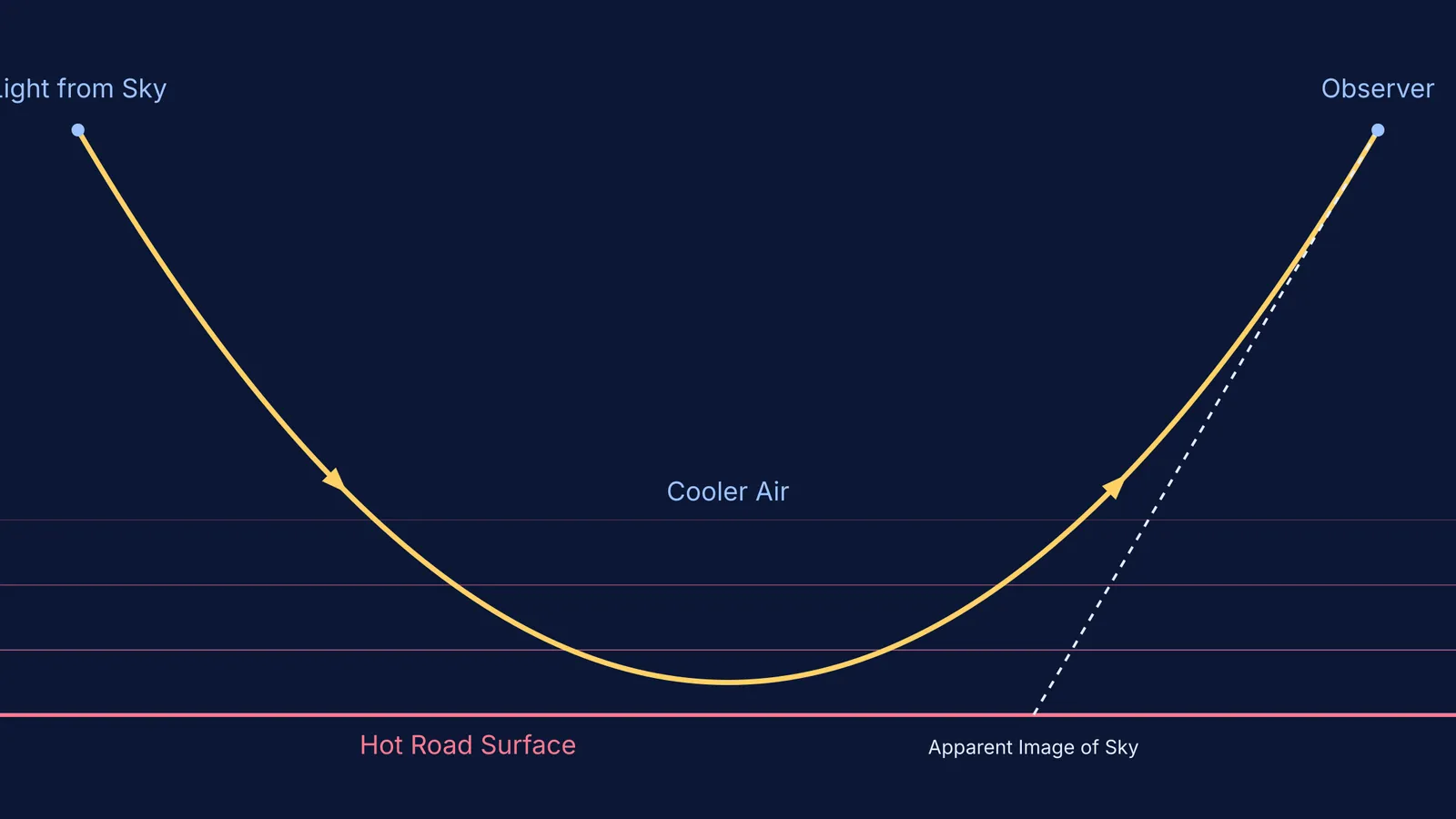
On a sunny day, asphalt absorbs solar radiation and becomes dangerously hot, lowering the refractive index of the air directly above it. This steep temperature gradient bends light from the sky upward to your eye, which your brain misinterprets as a reflection in a puddle of water.
If you’ve ever driven down a highway on a blistering summer afternoon, you have likely seen it: a shimmering puddle of water on the road ahead that vanishes as you get closer. This optical illusion, known as an inferior mirage, is not a trick of the mind but a predictable consequence of atmospheric physics.
For students studying optics for JEE or NEET, understanding mirages bridges the gap between textbook ray diagrams and real-world phenomena. Here is how a hot road bends light to create the illusion of water.
Why does a hot road look wet?
The "water" you see on the asphalt is actually an image of the blue sky. Your brain is accustomed to light traveling in a straight line, so when light from the sky curves upward into your eye from the ground, your brain assumes there must be a reflective surface on the road.
This requires extreme heat. Dark asphalt absorbs significant solar radiation, acting as a thermal battery. The asphalt surface can become dangerously hot, creating a steep temperature gradient where a thin layer of air immediately above the road is much hotter than the air just a few feet higher.
What does the refractive index have to do with it?
Light travels at slightly different speeds depending on the density of the medium it passes through, a property measured by the refractive index.
As air heats up, it expands and becomes less dense. Consequently, the refractive index of air drops as temperature rises. For example, calculations from the NIST Engineering Metrology Toolbox show the refractive index of dry air falls from roughly 1.00027 at 20°C to 1.00025 at 40°C.
When a ray of light from the sky travels downward toward the road, it moves from cooler, denser air into progressively hotter, less dense air. According to Snell's Law, as light enters a medium with a lower refractive index, it bends away from the normal (the vertical axis). Because the temperature change is gradual rather than sudden, the light ray does not just bend once. Instead of striking the asphalt, the light ray follows a continuous curve, refracting slightly more at every inch of descent, eventually bending so much that it turns horizontal and then travels upward toward your eye.
You can also think of this through Fermat's Principle, which states that light takes the path that requires the least time. Because light travels faster in the hot, thin air near the road, it "prefers" to dip down into the hot layer to save time on its journey to your eyes, resulting in a curved path.
How can we predict the path of light?
In a classroom, you might explore refraction by tracing a ray through a glass slab, where light bends sharply at a distinct boundary. A mirage is different because the air has a continuous gradient rather than a sharp edge.
To truly grasp this, you have to move beyond static diagrams. If you want to test how different temperature profiles change the curvature of the ray, the Fermi Simulation Lab lets you adjust the ground temperature and instantly see how the light path warps.
Understanding the continuous bending of light also helps when studying other optical phenomena, such as the deviation vs incidence curve in a prism. The physics remains the same: light takes the path of least time, and a steep temperature gradient ensures that path is a curve.
How can you test your observation?
If you are trying to determine whether you are seeing a mirage or an actual puddle, run through this quick checklist to test your observation:
Is the road surface extremely hot? The ambient air needs to be hot enough for the asphalt to reach the critical temperatures required to bend light. A cool or overcast day cannot produce a strong enough temperature gradient.
Does the "water" vanish as you approach? Because the light bends at a specific grazing angle, you must be far away to see the sky reflected. As you get closer, your viewing angle changes, the grazing angle is lost, and the mirage simply disappears from the road ahead.
Can you see the sky in it? An inferior mirage will mirror the color of the horizon above it. If the sky is bright blue, the puddle will be bright blue. If you are looking at a mirage of a distant car, you might even see the car's reflection inverted beneath it, just as it would look in a real pool of water.


