On this page
These pairs and questions are built on NCERT Class 12 Biology, Chapter 11, Organisms and Populations (Reprint 2026-27). The NEET (UG) 2026 syllabus places it in Unit 10, Ecology and Environment. All questions are original, not past-paper items.
What are the NCERT exceptions in Organisms and Populations?
Rule first, then the exception NCERT itself names.
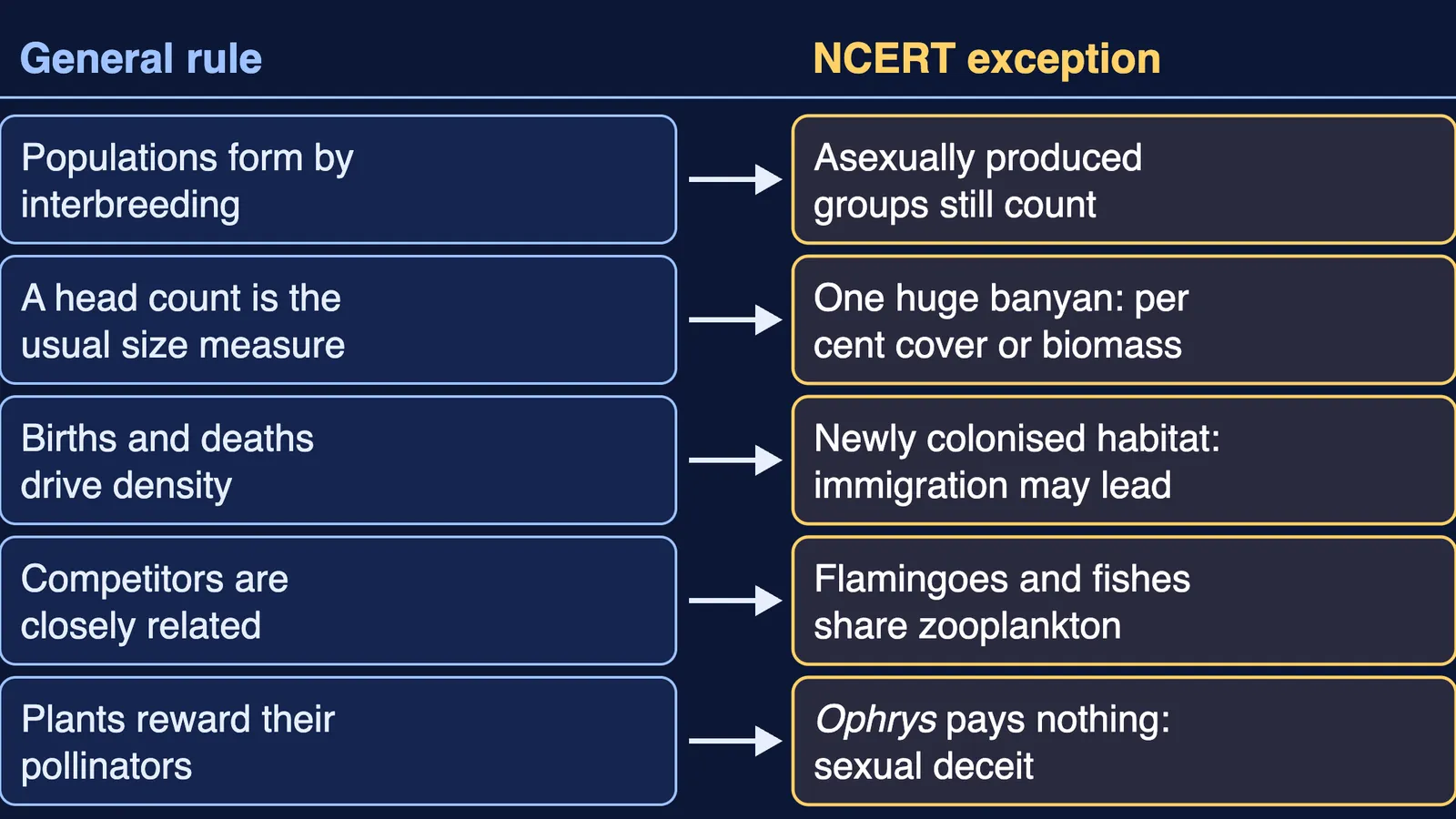
Interbreeding, a sexual process, defines a population; a group produced asexually is generally treated as one too (11.1.1).
A total count is generally the best measure of density; where a single banyan stands among 200 carrot grass plants, per cent cover or biomass says more (11.1.1).
Births and deaths normally drive density; in a habitat just being colonised, immigration may add more than births (11.1.2).
Competition is generally pictured between closely related species over a limiting resource; NCERT names two breaks: unrelated flamingoes and fishes share lake zooplankton in South America, and interference competition can cut feeding efficiency even with plentiful food and space (11.1.4 ii).
Gause's principle says closely related competitors cannot coexist indefinitely; NCERT limits it to limiting resources, and MacArthur's five warbler species shared one tree by foraging differently (11.1.4 ii).
Predation brings to mind a tiger and a deer; a seed-eating sparrow is a predator too, and herbivores are not very different from predators in a broad ecological sense (11.1.4 i).
Lice and ticks feeding from a host's surface are ectoparasites; the female mosquito needs human blood to reproduce, yet is not considered a parasite (11.1.4 iii).
Plants pay pollinators with pollen or nectar; not all orchids do, and *Ophrys* relies on sexual deceit (11.1.4 v).
How do you handle odd-one-out and exception questions?
Write the basis from the stem in a few words, and judge every option against it alone.
Check that no second option fails another obvious test, such as one species versus two.
In "NOT an exception" items, pick the option that simply obeys its rule.
Odd-one-out questions
Q1. Judged only on whether NCERT would call it a population, which is the odd one out? (1) Bacteria in a culture plate (2) Rats in an abandoned dwelling (3) The fungus and alga of one lichen (4) Cormorants in a wetland
Answer: (3). A population is one species; a lichen pairs two. The bacteria count though they multiply asexually.
Q2. Judged on the sign pair NCERT gives the interaction, which is the odd one out? (1) An orchid growing on a mango branch (2) Cattle egret beside grazing cattle (3) Barnacles on a whale's back (4) Mycorrhizal fungus with plant roots
Answer: (4). Mycorrhiza is mutualism (+, +); the rest are commensalism (+, 0).
Q3. Judged on whether NCERT would call the first a predator of the second, which is the odd one out? (1) A tiger and a deer (2) A sparrow and the seeds it eats (3) A goat and the plants it browses (4) A tick and the dog it feeds on
Answer: (4). The tick is an ectoparasite; NCERT counts seed-eaters and herbivores as predators.
Q4. Judged on whether NCERT presents it as a defence against predators, which is the odd one out? (1) Cryptic colouring in some insects and frogs (2) Being poisonous (3) The Monarch butterfly's distasteful chemical (4) Koel eggs resembling crow eggs
Answer: (4). Egg mimicry hides a brood parasite's eggs from the host, not from predators.
Which is NOT an exception?
Q5. Which is NOT an exception NCERT names? (1) An asexually produced group counted as a population (2) Immigration outpacing births in a newly colonised habitat (3) A huge banyan better described by per cent cover than by count (4) Lice feeding on the human body surface
Answer: (4). Lice are NCERT's ordinary ectoparasite example.
Q6. Which does NOT run against NCERT's general ideas about competition? (1) Interference competition with abundant food (2) Competing species evolving ways to coexist rather than be excluded (3) Competition between unrelated species (4) A superior species eliminating another in a laboratory with limited resources
Answer: (4). NCERT calls this easy to show in the laboratory.
Two-statement and single-correct questions
Options for Q7 to Q10: (1) both correct (2) both incorrect (3) only I correct (4) only II correct.
Q7. I: NCERT says competition happens only when the shared resource is limiting. II: In interference competition, one species can lower another's feeding efficiency even with abundant food and space.
Answer: (4). NCERT says resources need not be limiting.
Q8. I: NCERT says evidence for competitive exclusion in nature is always conclusive. II: NCERT says Gause's principle holds whether or not resources are limiting.
Answer: (2). Natural evidence is not always conclusive; the principle may hold only with limiting resources.
Q9. I: Even a plant that makes its own food needs soil microbes to return inorganic nutrients. II: NCERT says no natural habitat on earth holds just a single species.
Answer: (1). Both are in the opening of 11.1.4.
Q10. I: NCERT says a head count is impractical for a huge population that is impossible or slow to count. II: NCERT's example of a population running into millions is Siberian cranes at Bharatpur.
Answer: (3). The cranes can number below 10 in a year; *Chlamydomonas* in a pond reaches millions.
Q11 and Q12 are single-correct.
Q11. If the female bee's colour pattern shifted slightly during evolution, NCERT expects *Ophrys*: (1) to lose pollination success unless its petal co-evolves to keep the likeness (2) to gain more visits from male bees (3) to be unaffected, since it pays bees with nectar (4) to switch to wind pollination
Answer: (1). NCERT's example of flower-pollinator co-evolution.
Q12. In NCERT's best definition of competition, one species' fitness is judged by: (1) its r, the intrinsic rate of increase, being significantly lower when the other species is present (2) a rise in its carrying capacity K (3) its body size (4) its total offspring in a lifetime
Answer: (1). NCERT measures fitness in terms of r.
What should you do after this set?
Redo all 12 with answers covered, writing each odd-one-out basis.
Turn every miss into a one-line rule and exception.
Then switch formats: the statement and match-the-list set on this chapter, the diagram-based questions on age pyramids and growth curves and the assertion-reason questions on Organisms and Populations.
Which exception keeps slipping away? Fermi's AI tutor works out what you already know and builds a plan for the session.