On this page
The NMC's NEET (UG) 2026 syllabus lists Evolution in Unit 7, Genetics and Evolution. Each rule and exception below comes from NCERT Class 12 Biology, Chapter 6 (Reprint 2026-27) with its section and the hinge word NCERT uses. The 11 questions are original, not past-paper items. Antibiotics appear only as NCERT's selection example: a study summary, not medical advice.
What are the NCERT exceptions in Evolution?
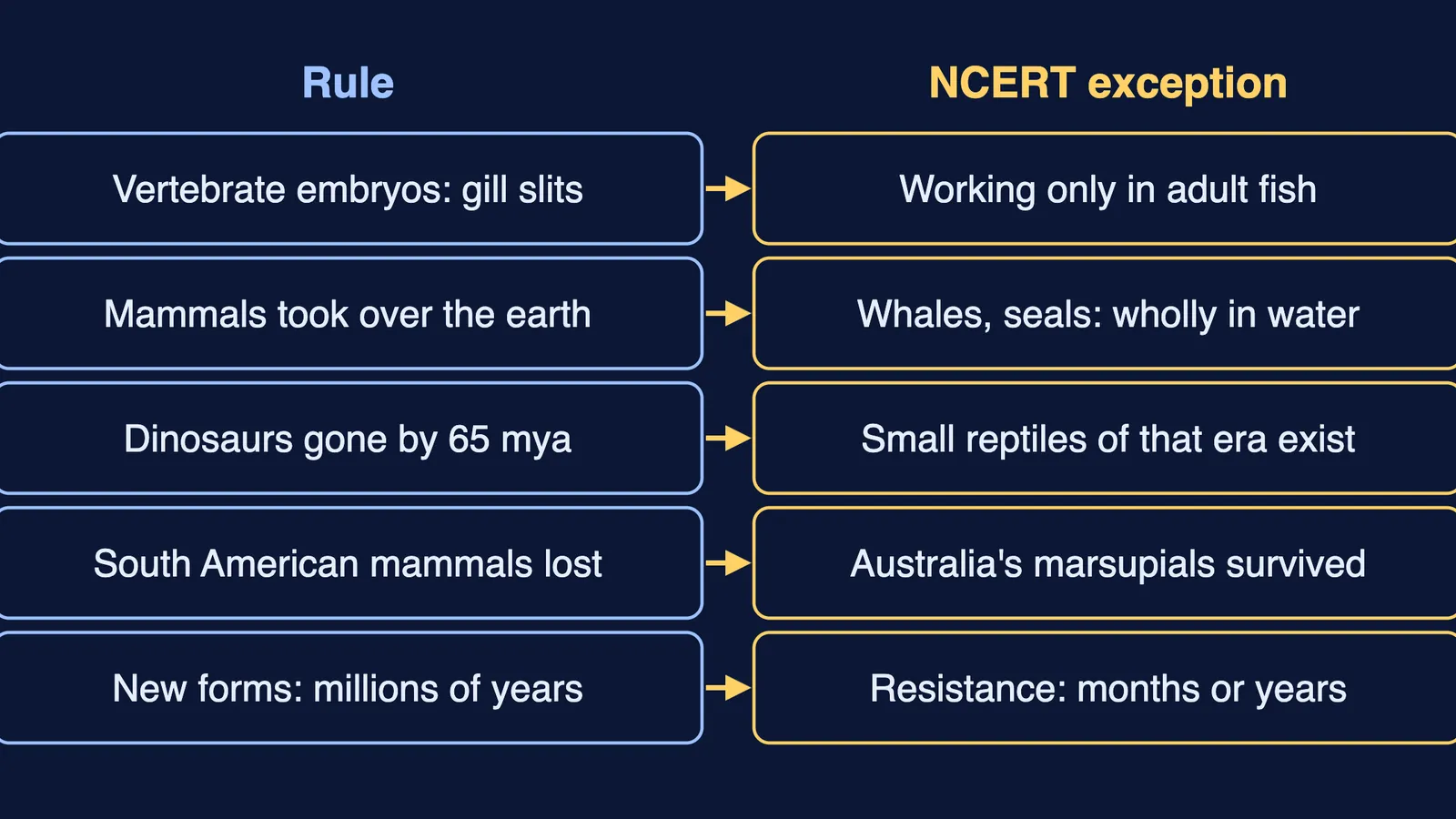
Rule: every vertebrate embryo, human ones too, forms a row of vestigial gill slits just behind the head. Exception ("only"): they work as an organ only in fish, and no other adult vertebrate has them (6.3).
Rule: predators pick out the moth that contrasts with its trunk, white on soot, dark on lichen. Exception ("remember"): NCERT adds that no variant is ever completely wiped out (6.3).
Rule: life forms change over millions of years; a new form in fish or fowl would take that long, as their life spans run in years (6.5). Exception: with excess use of herbicides, pesticides, antibiotics or drugs, resistant organisms or cells appear within months or years, not centuries, which NCERT calls evolution by anthropogenic action (6.3).
Rule: adaptive radiation is many species arising from one ancestral stock in one area, then radiating into other habitats. Exception: when more than one radiation occurs in an isolated area, NCERT says this can be called convergent evolution, as with Australia's marsupials and placental mammals (6.4).
Rule: populations stay stable in size. Exception ("except"): seasonal fluctuation (6.5).
Rule: under the Hardy-Weinberg principle, allele frequencies hold steady across generations, a genetic equilibrium. Exception: five factors disturb it, natural selection, mutation, recombination, gene flow (migration) and genetic drift, and NCERT reads the disturbance as evolution (6.7).
Rule: when South America joined North America, its mammals resembling horse, hippopotamus, bear and rabbit were overridden by North American fauna. Exception ("the same continental drift"): Australia's pouched mammals survived, as no other mammal competed with them (6.8).
Rule: about 65 mya the dinosaurs suddenly disappeared. Exception ("still"): small-sized reptiles of that era are alive today (6.8).
Rule: land reptiles dominated the earth for some 200 million years, and after their decline mammals took over. Exception ("some"): some land reptiles returned to water as fish-like reptiles such as Ichthyosaurs, probably about 200 mya, and some mammals (whales, dolphins, seals, sea cows) live wholly in water (6.8).
How do you handle odd-one-out and exception questions?
Write the stem's basis in the margin first: group, habitat, time scale or fate. Mark each option yes or no on that basis alone; two noes mean you drifted to another feature. In a "NOT" item, find the option NCERT never says.
Odd-one-out questions
Q1. All four are aquatic animals. Judged by vertebrate class, which is the odd one out? (1) Whales (2) Seals (3) Sea cows (4) Penguins
Answer: (4). Penguins are birds; the rest are NCERT's mammals living wholly in water (6.8).
Q2. Judged by whether the adult has functional gill slits, which is the odd one out? (1) Human (2) Crocodile (3) Fish (4) Bird
Answer: (3). Only adult fish have them (6.3).
Q3. Judged by what NCERT says continental drift did to them, which is the odd one out? (1) Australia's pouched mammals (2) South America's horse-like mammals (3) South America's bear-like mammals (4) South America's rabbit-like mammals
Answer: (1). It survived; the others were overridden (6.8).
Q4. Judged by whether NCERT lists it among the factual observations behind natural selection, which is the odd one out? (1) Natural resources are limited (2) Population sizes stay stable apart from seasonal fluctuation (3) Most variations are inherited (4) Natural populations keep growing exponentially
Answer: (4). NCERT calls exponential growth theoretical; real sizes are limited (6.5).
Q5. Judged by whether NCERT says living members remain today, which is the odd one out? (1) Frogs (2) Salamanders (3) The first amphibians (4) Crocodiles
Answer: (3). NCERT says no specimens of the first amphibians are left (6.8).
Which is NOT an NCERT rule-exception pair?
Q6. Which pair does NCERT NOT state? (1) Mammals took over the earth / some mammals live wholly in water (2) Dinosaurs vanished about 65 mya / small reptiles of that era survive (3) Land reptiles dominated / some returned to water as Ichthyosaurs (4) White moths failed on sooty trunks / dark moths were wiped out where trunks stayed pale
Answer: (4). NCERT says no variant is completely wiped out (6.3).
Q7. Which statement about Australia's mammals does NCERT NOT make? (1) Many marsupials evolved from one ancestral stock within the island continent (2) Placental mammals there also show adaptive radiation (3) Each placental form appears similar to a matching marsupial (4) Each placental form evolved from the marsupial it resembles
Answer: (4). NCERT notes likeness, not descent: convergent evolution (6.4).
Two-statement and single-correct questions
Codes for Q8 to Q10: (1) Both correct (2) Only I correct (3) Only II correct (4) Neither correct.
Q8. I: NCERT says intensive breeding has produced dog breeds that differ from other breeds. II: NCERT says such breeds no longer belong to the same group.
Answer: (2). NCERT says they are still of the same group (6.3).
Q9. I: NCERT says every reptile alive in the dinosaurs' era disappeared about 65 mya. II: NCERT names turtles, tortoises and crocodiles as modern-day descendants of reptiles.
Answer: (3). NCERT says small reptiles from that era survive today (6.8).
Q10. I: Under Hardy-Weinberg, a population's allele frequencies hold steady across generations. II: NCERT calls this constant gene pool genetic drift.
Answer: (2). NCERT calls it genetic equilibrium; drift is a chance change (6.7).
Q11. NCERT says population size would grow exponentially if everyone reproduced maximally. Where does it say this can actually be seen? (1) A fish population (2) A growing bacterial population (3) Darwin's finches (4) Australian marsupials
Answer: (2). NCERT names a growing bacterial population (6.5).
What should you do with your misses?
Missed Q1, Q5 or Q9: redraw the 6.8 timeline, marking survivors. Missed Q3 or Q7: reread 6.4 and the drift lines. Others: reread the section in the answer. Other formats: Evolution statement and match-the-list questions, Evolution diagram-based questions and Evolution assertion-reason questions.
Which exception keeps slipping away from you? Fermi's AI tutor works out what you already know and builds a plan for the session.