On this page
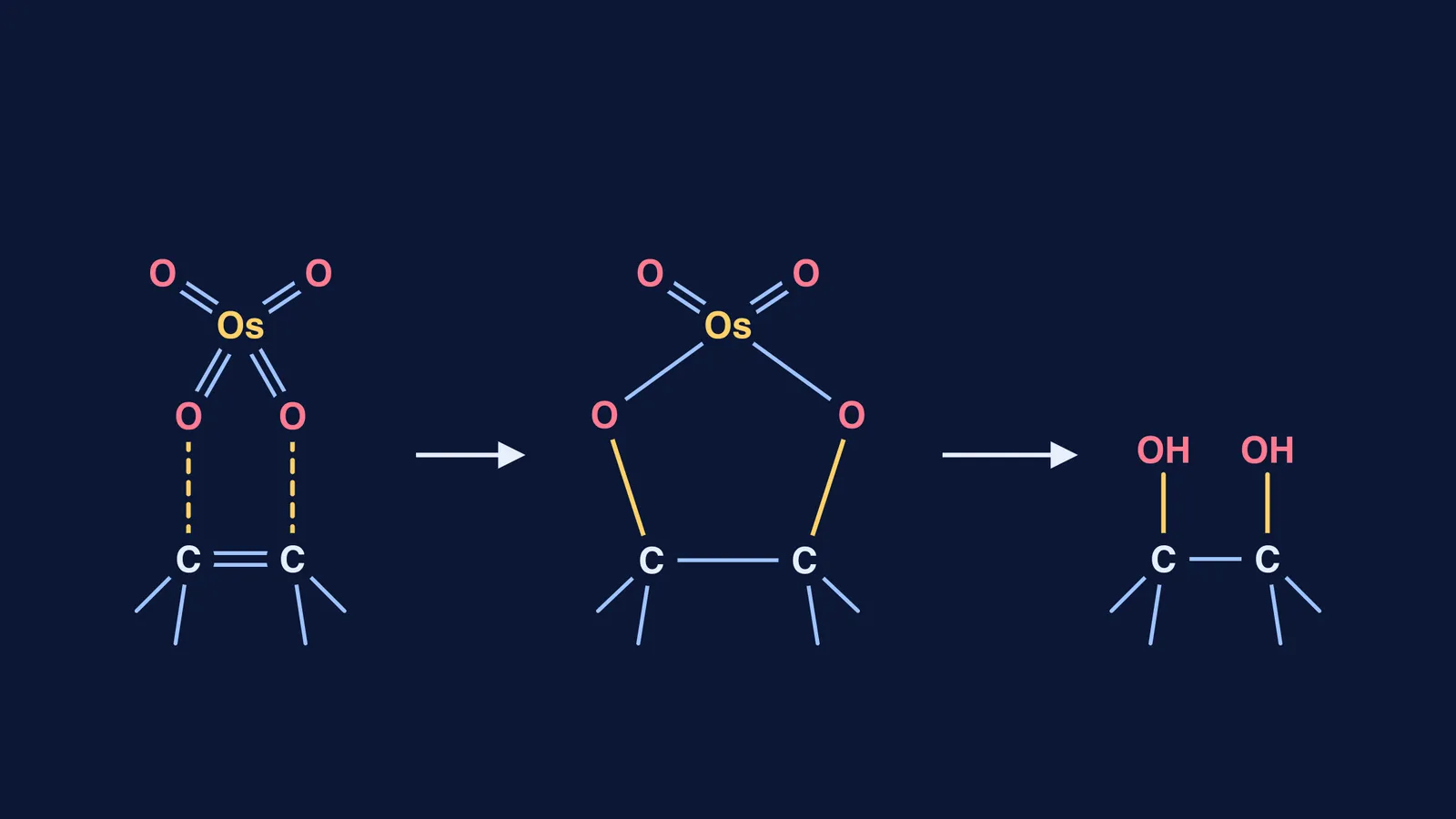
Osmium tetroxide (OsO4) is the reagent chemists reach for when they want two OH groups on neighbouring carbons, both on the same side of the molecule. For JEE Main, JEE Advanced or Class 12 boards, the whole reaction comes down to one picture: a five-membered ring that grabs the double bond from one face.
What does osmium tetroxide do to an alkene?
OsO4 converts an alkene into a vicinal diol (a 1,2-diol, or glycol). The LibreTexts module on vicinal syn dihydroxylation describes the reaction with OsO4 as a concerted process that has a cyclic intermediate and no rearrangements. The same source starts with osmium(VIII) tetroxide and notes that the cyclic ester holds Os(VI), so the metal has been reduced by two units while the alkene carbons gain bonds to oxygen.
The intermediate has a long history. The German chemist Rudolf Criegee reported osmium acid esters as intermediates in these oxidations in Justus Liebigs Annalen der Chemie in 1936.
Why does OsO4 add both oxygens to the same face?
Count the atoms in the ring that forms: carbon, carbon, oxygen, osmium, oxygen. That is a five-membered ring, and two oxygens attached to one osmium atom can only reach the two alkene carbons from the same side. They cannot stretch around to opposite faces. So both new C-O bonds form on one face at the same moment, which is what syn addition means.
The second step matters just as much. A reducing workup breaks the O-Os bonds and releases the diol; LibreTexts lists H2S, or an aqueous sulfur salt, for this (vicinal syn dihydroxylation). The carbon-oxygen bonds are never touched, so the geometry set in step one is the geometry you keep.
Does a cis alkene give a meso diol?
Yes. Cis alkenes give meso products and trans alkenes give racemic mixtures, according to the LibreTexts dihydroxylation chapter. Here is a four-step method you can use on any exam question:
Draw the alkene flat, with every substituent in the plane of the page.
Add both OH groups on wedges (or both on dashes). Never one of each.
Check for an internal mirror plane. If the two halves of the molecule mirror each other, the product is meso.
If there is no mirror plane, the other face gives the enantiomer just as easily, so you get a racemic pair.
Worked example: start with cis-but-2-ene. The two methyl groups are on the same side, and both OH groups add on wedges. The product, butane-2,3-diol, has a mirror plane through the middle of the C2-C3 bond, so it is meso: one achiral compound, (2R,3S).
Now take trans-but-2-ene. The methyls are on opposite sides. Adding both OH groups on wedges gives a molecule with no mirror plane, (2R,3R). Attack from the other face gives (2S,3S) at the same rate, so you get a racemic mixture.
The same logic turns cyclohexene into cis-cyclohexane-1,2-diol.
How is OsO4 different from KMnO4 and peracids?
Three common reagents turn an alkene into a diol, and you should know which face each one uses:
OsO4, then reducing workup: syn diol, clean, no rearrangement.
Cold, dilute KMnO4: also gives the syn diol, but LibreTexts notes poor yields because of overoxidation (see our guide to cold dilute versus hot KMnO4 with alkenes).
Peracid, then aqueous acid: anti diol, because water opens the epoxide from the back face (see how epoxidation leads to anti-dihydroxylation).
If you keep mixing up syn and anti, compare OsO4 with bromine, which goes anti because the bromide attacks a bridged bromonium ion from the opposite side. A ring that stays bonded to one face gives syn; a ring that gets attacked from behind gives anti.
Why do chemists use only a catalytic amount of OsO4?
OsO4 is expensive and highly toxic, so the reaction has been modified to use catalytic amounts of OsO4 with a stoichiometric amount of another oxidising agent, such as hydrogen peroxide (LibreTexts). The NIOSH Pocket Guide gives a US workplace exposure limit for osmium tetroxide of 0.002 mg/m3 as a time-weighted average, and lists the eyes, skin and respiratory system as target organs.
In 1976, V. VanRheenen, R. C. Kelly and D. Y. Cha published an improved catalytic OsO4 method that uses tertiary amine oxides as the oxidant (Tetrahedron Letters78093-2)). Known as the Upjohn dihydroxylation after the authors' company, it uses N-methylmorpholine N-oxide (NMO) to reoxidise the osmium. Barry Sharpless later made the reaction enantioselective; he shared the 2001 Nobel Prize in Chemistry "for his work on chirally catalysed oxidation reactions" (Nobel Prize), and he and his co-workers reviewed catalytic asymmetric dihydroxylation in Chemical Reviews in 1994.
How do you practise syn dihydroxylation questions?
Take five alkenes, cis and trans, open-chain and cyclic, and run the four-step method on each before checking. If you get stuck on why a product is meso, the Fermi Concept Library gives each concept its own lesson and its place in the map. For mixed alkene-reaction questions, the Fermi Problem Library has worked problems with a step-by-step solver that explains the reasoning rather than printing an answer.